
24/7 Customer Support

Free returns

Same-day & Next-day Delivery

Quality Guaranteed

Unlock Your Welcome Offers: FREE Delivery | Up to 80% OFF | Free 30-day JoyPlus trial
Download the APP
A console table can make an entrance feel organised, create a useful surface behind a sofa or add display space to a living room. However, attractive photography does not always reveal whether a table will fit your wall, support your belongings or remain stable on a busy hallway floor.
Before buying console tables, look beyond the finish and check the measurements, materials, weight limits and fixing instructions. These are the details most likely to affect everyday satisfaction.
A table may be described as “slim” because it is narrow from front to back, but its overall length could still block a doorway or restrict movement. Measure the wall, skirting boards and nearby doors before choosing a hallway console table or slim hallway table.
Leave enough clearance for comfortable passage. In a narrow entrance, also check whether the tabletop, frame or handles project beyond the main depth.
A minimalist narrow console table may provide only a display surface. If you need somewhere for keys, letters or chargers, look for drawers, shelves or baskets specifically. Open shelving is easy to access but remains visible, while enclosed drawers help keep everyday clutter out of sight.
Marketing images often show lamps, ornaments and books arranged attractively, but the maximum load may vary between the tabletop, shelf and individual drawers. A table that will be used as a sofa table, living room side table or home-office surface needs a suitable stated capacity.
Always assemble the furniture on a level surface, tighten fittings correctly and use the supplied anti-tip or wall-fixing device where instructed. This is particularly important in homes with children or pets.
Record the available width, depth and height, rather than relying on general descriptions such as “compact”. For example, a 30–36 cm depth can work behind a sofa or along a hallway wall, while a 50 cm-deep design may need more circulation space.
Height also affects usability. A console table around 74–82 cm high generally provides a practical surface for lamps, keys and decorative items, but compare it with the height of your sofa back, radiator and nearby furniture.
Engineered wood, particleboard, solid wood, metal, glass and rattan each create a different appearance and maintenance requirement. A paper veneer or melamine finish can be wiped with a dry or slightly damp cloth, while glass may show fingerprints more readily. Solid wood and wood veneer can bring visible grain variation, so the product photographs should be treated as a guide to colour rather than an exact guarantee.
For an industrial console table, inspect the frame material and foot design. Adjustable feet can help compensate for minor unevenness and reduce floor scratching, but they do not replace correct assembly.
Check the stated capacity for every section. One product may support 22 kg across the table, while another specifies separate limits such as 25 kg for the tabletop, 15 kg for a shelf and 5 kg per drawer. Distribute weight evenly and avoid placing heavy objects at the front edge.
Furniture that could tip should be secured using the supplied wall attachment device and suitable fixings for your wall type. Follow the manufacturer’s instructions rather than assuming a universal fixing will be appropriate.
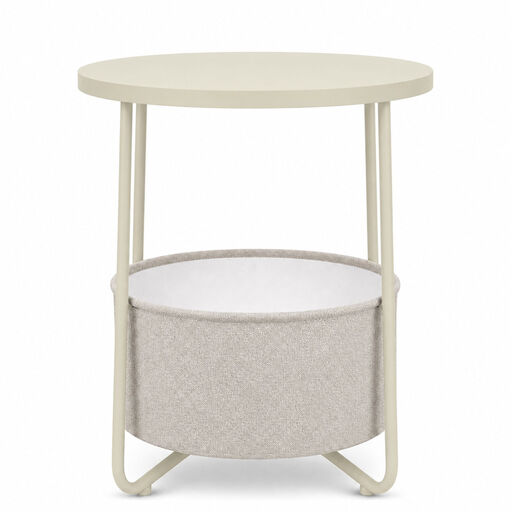
Why This Fits Their Persona: Its round 45 x 50 cm format suits renters, first homes and smaller sitting rooms where a full-length entryway table may be impractical. The fabric basket provides a simple place for smaller items.
The stated dimensions make its footprint clear, while the integrated basket avoids relying on an open tabletop alone for basic storage.
Round shape; fabric storage basket; four listed colour options.

Why This Fits Their Persona: The parquet-effect top and black X-frame base suit shoppers seeking a decorative console table with a more distinctive furniture finish for an entrance or living room.
Its listed 99 x 35 x 80 cm dimensions and 50 kg capacity provide useful information beyond appearance, helping buyers assess fit and intended use.
Mindi wood construction; geometric parquet top; narrow 35 cm depth.
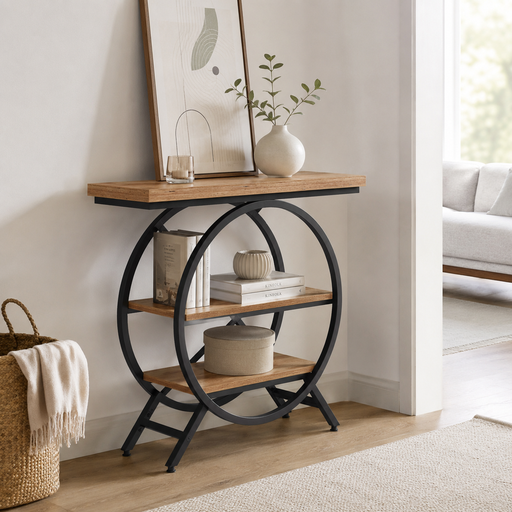
Why This Fits Their Persona: The three staggered shelves work for households needing display and accessible storage in a living room, hallway, corridor or behind a sofa.
It specifies a 4 cm particleboard top, metal frame, adjustable feet and a stated load capacity of up to 150 kg. Follow the product instructions and do not treat this figure as a reason to overload individual sections.
Three staggered shelves; adjustable feet; open industrial design.
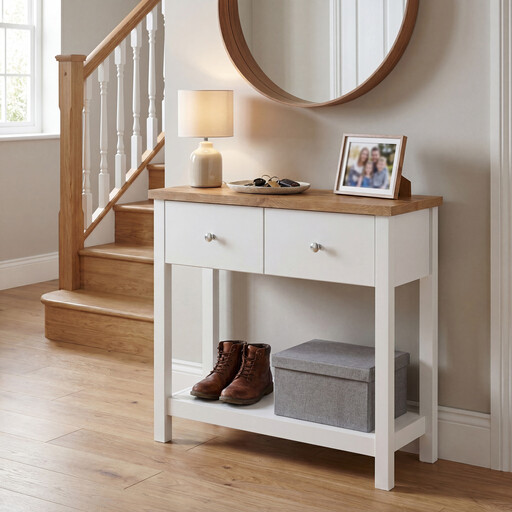
Why This Fits Their Persona: The 100 cm-wide Shaker-style table offers concealed storage and a lower shelf for families, home offices or entrances where visible clutter needs managing.
Separate limits are supplied for the tabletop, shelf and drawers, and an anti-tip device is specified. Permanent wall fixing should be completed as instructed.
Three drawers; lower open shelf; 25 kg tabletop and 15 kg shelf limits listed.
We have compiled a complete, real-time list of products that fully satisfy these strict selection criteria and UK safety regulations.
Yes, provided the depth and clearance are suitable. Measure the usable wall space, account for skirting boards and keep doors, stairs and walkways unobstructed. Designs around 30–36 cm deep are often easier to position than deeper living room side tables.
A console table can work as a sofa table if its height is compatible with the sofa and its depth does not interfere with seating or walking space. Avoid placing heavy items where they could be knocked onto the floor, and check the stated load capacity.
Assemble it on a flat surface, tighten every fitting and check that the frame sits evenly. Use adjustable feet where supplied. If the instructions include an anti-tip strap or wall attachment, secure it to a suitable wall point using appropriate fixings. Recheck stability after moving the furniture or adding heavier items.