
24/7 Customer Support

Free returns

Same-day & Next-day Delivery

Quality Guaranteed

Unlock Your Welcome Offers: FREE Delivery | Up to 80% OFF | Free 30-day JoyPlus trial
Download the APP
A contact grill can handle toasties, paninis, burgers, vegetables and steaks without occupying the space of a full cooker. However, choosing the wrong model can leave you with unevenly cooked food, difficult cleaning and an appliance that spends most of its time in a cupboard.
Before buying an electric contact grill, watch for three common pitfalls:
The right choice depends on what you prepare most often, how much worktop space you have and whether you need a simple sandwich maker or a multifunction appliance.
Plate dimensions are more useful than vague descriptions such as “large” or “generous”. A 22.5 × 14cm cooking area is suitable for individual meals, while plates around 28 × 22cm are more practical for family portions.
Also consider whether the grill opens flat. A 180-degree opening turns a contact grill into an indoor grill with two usable cooking surfaces, which can be helpful for vegetables, burgers or several pieces of meat. A floating top plate is useful when cooking food of different thicknesses, as it can sit on top without pressing thinner sandwiches excessively.
Most worktop models in this category range from approximately 700W to 2,200W. A 700W sandwich maker is generally designed for toasties and smaller snacks, while a high-power steak grill can reach cooking temperature more quickly and support larger plates.
Wattage is not the only factor. Adjustable temperature control gives you more flexibility for bread, meat and vegetables. Simpler models with automatic temperature regulation can be convenient for breakfast use, but offer less control over browning and cooking speed.
For UK kitchens, check that the appliance is suitable for the local mains supply. Products listing 220–240V are aligned with the standard domestic voltage range, but always check the plug type. Some imported appliances may require a suitable UK adapter.
A non-stick grill should be used with silicone, nylon or wooden utensils rather than metal tools, which may scratch the coating. Removable plates make it easier to clean around melted cheese and cooking juices. Dishwasher compatibility can further reduce effort, although you should follow the product manual rather than assume every removable part is dishwasher-safe.
A drip tray or sloped plate design is useful when grilling fatty foods. It helps direct excess grease away from the cooking surface, but it does not remove the need to handle hot surfaces carefully or clean the appliance after use.
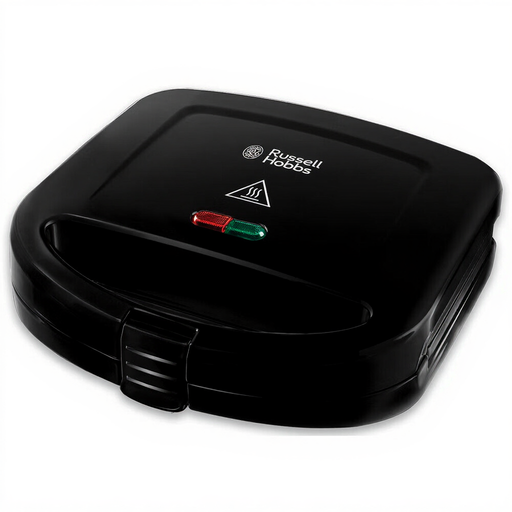
Why This Fits Their Persona: Its two-portion format and upright storage suit students, couples and smaller UK kitchens where cupboard space matters.
The stated two-portion capacity is clearer than a broad “family” claim, while power and ready indicator lights show when it is warming and ready.
700W output, non-stick plates, locking handle and upright storage.
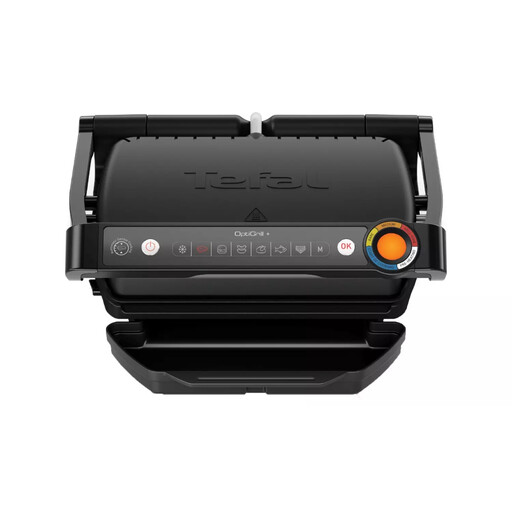
Why This Fits Their Persona: Suited to households wanting more guided cooking and a larger surface for regular meals, without using an outdoor barbecue.
The specification lists removable dishwasher-safe plates, a drip tray and a cooking surface designed for up to five portions.
2000W power, six automatic programmes, sloped grill and two-year manufacturer’s guarantee.

Why This Fits Their Persona: Its 28 × 22cm plates are aimed at busy families and home cooks who want one appliance for steaks, burgers, paninis and vegetables.
The large plate dimensions make the usable capacity clear, while double-sided heating avoids relying on manual turning for contact-grilled foods.
2000W output, food-grade non-stick coating and cooking from both sides.

Why This Fits Their Persona: A 396g microwave toastie maker suits students, office kitchens and homes with a limited worktop or storage space.
Its microwave format avoids buying a larger electric grill when toasties are the main requirement; the stated maximum microwave rating is 1200W.
Compact 15 × 14.2 × 4.5cm design and dishwasher-safe components.
A contact grill’s electricity use depends on its wattage and how long it operates. For example, an 800W appliance running for 15 minutes uses approximately 0.2kWh, while a 2,000W model used for the same time uses approximately 0.5kWh. Your actual cost depends on your electricity tariff.
Always place the appliance on a stable, heat-resistant surface with clearance around it. Preheat according to the instructions, avoid overcrowding the plates and unplug the grill before cleaning. Do not immerse the main unit, cord or plug in water. Allow hot plates to cool completely before removing them and keep children away during operation.
We have compiled a complete, real-time list of products that fully satisfy these strict selection criteria and UK safety regulations.
It can use less electricity for small portions because it heats a smaller cooking area. The actual cost depends on wattage, preheating time, cooking duration and your tariff. Compare the stated power rating rather than relying on general efficiency claims.
Yes, models with suitable plate space and higher power can be used for steak. Check whether the top plate adjusts for thickness and whether temperature control is available. Always follow safe food-handling guidance and ensure meat is cooked appropriately.
Lifespan depends on frequency of use, cleaning and utensil choice. Avoid metal tools, abrasive cleaners and sudden temperature changes. Removable plates and accessible drip trays can make routine care easier, helping you keep the appliance in usable condition for longer.