Cooking fillets of different thicknesses
If your fillets vary in thickness, a sensor or probe can provide more guidance than a fixed timer. You still need to check the thickest part with a thermometer before serving.


For chicken fillets of varying thickness, consider a grill with cooking guidance or a temperature probe; for several fillets at once, prioritise usable plate area; for frequent everyday use, compare plate cleaning and drip handling. Whichever grill you choose, its programme or indicator cannot confirm that the thickest part of the chicken is cooked: Food Standards Scotland advises checking for 75°C or above with a thermometer.
If your fillets vary in thickness, a sensor or probe can provide more guidance than a fixed timer. You still need to check the thickest part with a thermometer before serving.
If you regularly prepare chicken for a household or meal prep, compare usable plate area with the size of your usual fillets. A stated portion count alone will not tell you whether they fit in one layer.
If you use a contact grill often, look closely at how the plates and drip tray are cleaned. A floating hinge may also help the upper plate sit over fillets of differing thicknesses.
Decide how you will check the chicken is cooked, then compare the space your usual batch needs and the cleaning routine you can accommodate.
| Concern | What to check | Who this matters to |
|---|---|---|
| Checking doneness | Compare chicken programmes, thickness sensing and temperature-probe options; plan to check the thickest part with a thermometer. | When fillets vary in thickness, I want cooking guidance without mistaking an indicator for a safety check. Around 50% of consumers put dependable doneness checks first. |
| Batch capacity | Compare usable plate dimensions with your usual fillets, and check the appliance dimensions for storage. | If I cook several fillets in one session, I need them to fit without overlapping. For around 30% of consumers, batch fit is the primary concern. |
| Cleaning and storage | Check whether each plate and the drip tray are removable, how they must be washed, and whether the grill stores upright. | After frequent chicken meals, I want a cleaning routine that works in my kitchen. Ease of upkeep comes first for around 20% of consumers. |
A programme guides the grill, but fillets can differ in thickness. The indicator does not measure the centre of every piece.
Check the thickest part with a thermometer. Food Standards Scotland advises a reading of 75°C or above for chicken.
A stated portion count does not show whether your usual fillets fit on the plates without overlapping or whether the grill fits your cupboard.
Compare cooking-surface and appliance dimensions with your typical batch before choosing.
Non-stick describes the plate surface, not whether the plates can be removed or put in a dishwasher.
Check the cleaning instructions for both plates and the drip tray on the exact model.
A probe used with chicken needs cleaning between uses to avoid cross-contamination. GOV.UK advises fully cleaning a cooking thermometer after each use.
Follow the probe instructions for placement and cleaning, including before using it on another fillet.
The OptiGrill range is relevant if you want cooking guidance for fillets that vary in thickness or a larger cooking surface for batches.
The range includes contact grills with flat-open cooking arrangements and a Precision Grill with a temperature probe.
The ActiGrill Everyday and Family models provide stated plate dimensions for comparing a typical chicken batch.
These contact grills offer two ways to approach the same chicken-fillet task: compare the Tefal model if guided programmes matter to you, or consider the Philips model if an adjustable cooking arrangement is your priority. Check usable plate space and chicken temperature whichever you choose.
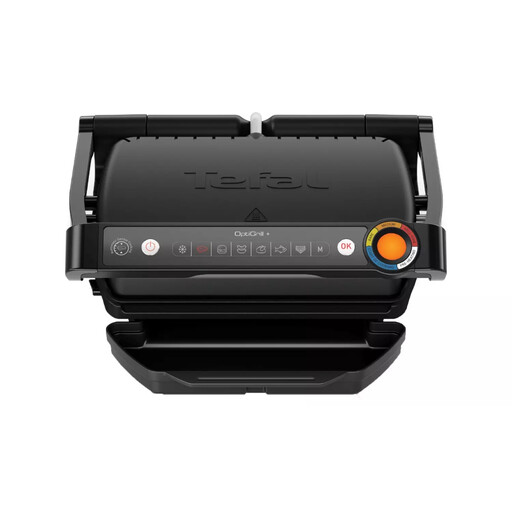 Image unavailable
Consider this model if you want programme-based guidance when grilling chicken fillets of varying thickness. Its product name specifies six automatic programmes; check that the settings suit how you cook, and use a thermometer at the thickest part rather than relying on an indicator.
Compare the usable plate dimensions with your usual batch before buying.
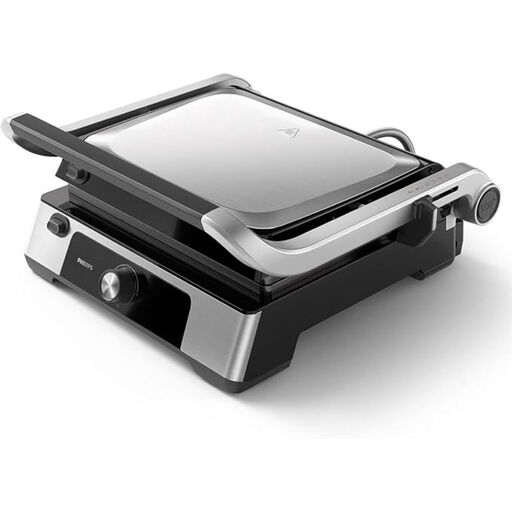 Image unavailable
Consider this model if an adjustable top plate or flat-open cooking arrangement suits your routine. Check how your usual fillets fit on the plates and how much counter space the open grill needs.
Check the plate-cleaning instructions for this variant, and use a thermometer to check chicken at its thickest part.
No. A programme or indicator can guide cooking, but it cannot establish the temperature at the thickest part of each fillet. Food Standards Scotland advises checking chicken with a thermometer for a reading of 75°C or above.
Look for a hinge that accommodates thicker pieces and decide whether sensor guidance or a probe would be useful. Arrange the fillets so the lid closes evenly, and check the thickest part rather than assuming every piece finishes together.
They may make thorough clean-up more convenient if you cook chicken frequently, but removal and dishwasher suitability vary by model. Tefal specifies removable dishwasher-safe plates for the OptiGrill Elite GC750D40; check the instructions for the exact grill you intend to buy.
A larger grill is useful if your usual fillets fit in one layer and the appliance fits your kitchen. Tefal specifies an 800 cm² cooking surface for the OptiGrill+ XL GC722D40, while Salter specifies 36 × 26 cm plates for the ActiGrill Family; compare the relevant dimensions with your typical batch and storage space.