For regular cheese-straw baking, start with a countertop oven that explicitly offers fan or convection baking, then check that its full footprint, open door and required ventilation space fit your kitchen. A flat tray that holds your usual straw length and controllable temperature matter more than a long programme list; an air-fryer oven offers other cooking functions, while a larger two-level oven makes more sense when you regularly need bigger batches.
Who these ovens suit
Small-counter cooks who bake snacks often
If pastry snacks and small tray bakes are the main job, allow room for the whole oven, its open door and the ventilation space specified for that model. For cheese straws, a flat tray and the ability to preheat also deserve attention.
One-appliance multifunction buyers
If the same appliance needs to bake cheese straws and handle other cooking tasks, compare its bake setting, temperature controls and usable tray arrangement before giving extra functions weight.
Occasional large-batch hosts
If you make cheese straws for gatherings or use the oven for larger meals, two cooking levels may be useful—provided the appliance’s depth and required clearance still leave enough working space.
What to check before buying
Dedicated convection mini oven
Choose when: Tray bakes are the main job and the exact model explicitly offers fan or convection baking.
Trade-off: A compact description does not guarantee a shallow appliance; Lakeland’s convection mini-oven example measures 50 × 44 × 35 cm and is discontinued.
Air-fryer mini oven
Choose when: You also want other cooking functions and its bake setting and tray suit your usual straws.
Trade-off: Tray shape and airflow vary by model, so watch cheese-topped pastry as it browns rather than assuming recipe timing transfers unchanged.
Large two-level convection oven
Choose when: Multiple trays or larger meals justify the extra capacity.
Trade-off: Ninja lists its DT200UK at 50.5 cm deep, a substantial commitment on a short worktop.
Convection microwave combination
Choose when: One appliance must also microwave and grill, and its manual confirms a suitable pastry-baking arrangement.
Trade-off: A listed convection mode alone does not tell you whether the supplied tray accommodates long cheese straws.
| Concern |
What to check |
Who this matters to |
| Worktop fit and clearance |
Measure the oven’s width, depth, height and open-door space; follow the exact model’s ventilation instructions. |
I need to keep enough counter space to prepare food without crowding the oven or blocking its vents. Around 33% of consumers put workable fit and clearance first. |
| Pastry-baking control |
Confirm an explicit fan or convection setting, a suitable temperature range and a flat tray; check how the oven preheats. |
When I bake a short batch, I want to set the heat for the recipe and catch the cheese before it over-browns. Controllable baking comes first for around 33% of consumers. |
| Batch size and other uses |
Compare usable tray dimensions, shelf positions and the cooking functions you would use beyond baking. |
I want room for my usual batch, or one appliance that also handles other meals. Roughly 20% of consumers make batch flexibility or multiple uses their primary concern. |
| Electrical setup |
Check the exact model’s electrical rating and instructions against the intended socket arrangement; do not overload or daisy-chain extension devices. |
If the convenient counter position leaves me relying on an extension lead, I need a setup I can use safely. For about 14% of consumers, electrical setup takes priority. |
Buying pitfalls
-
Assuming fewer litres means a smaller footprint
Cavity capacity does not include the appliance’s external dimensions, open door or ventilation space. De’Longhi lists its 12-litre EO12012 at 480 × 370 × 235 mm, illustrating why capacity alone cannot settle a worktop-fit decision.
Compare complete dimensions and the installation instructions for the exact oven with the space available in your kitchen.
-
Assuming every mini oven has a fan
A bake or grill setting is not proof of convection. De’Longhi lists bake and grill for the EO12012, whereas the referenced Lakeland, Sage and Ninja models explicitly describe convection or fan circulation.
If you plan to use fan-oven recipes, look for an explicit fan or convection specification for the model you intend to buy.
-
Treating an older feature page as a current model choice
The referenced Lakeland digital mini oven, Cuisinart TOA60U and Sage Smart Oven Pro are marked discontinued. Their controls can help you decide what features to seek, but their model numbers should not be mistaken for current alternatives.
Check the current model number, manual, seller and warranty details before choosing an alternative.
-
Placing the oven wherever an extension lead reaches
Electrical Safety First warns that overloaded extension devices can overheat and advises against daisy-chaining leads or using a cable reel while it remains wound.
Prefer a suitable fixed socket. If you use an extension device, check its marked rating against the combined load and fully unwind a cable reel.
Brands and model formats to consider
These named models illustrate different controls and sizes; check the exact model you are considering rather than applying one model’s features to a whole brand.
De’Longhi
The compact EO12012 is a 12-litre bake-and-grill oven with a 100–220°C thermostat, according to De’Longhi UK.
- Its listed dimensions are 480 × 370 × 235 mm, making the low external height worth checking where vertical room is tight.
- Bake and grill do not establish fan operation; the EO12012 is listed as out of stock on De’Longhi’s page.
Lakeland
Lakeland’s referenced digital mini oven lists convection technology, preheat and separate upper and lower heat settings.
- Those controls offer a useful checklist for a pastry-focused mini oven.
- The referenced oven measures 50 × 44 × 35 cm and is marked discontinued.
Cuisinart
The TOA60U illustrates a multifunction air-fryer oven with a bake setting, two shelf levels and a baking tray, according to Cuisinart UK.
- Its listed 90–230°C settings offer a reference point for checking whether an air-fryer oven reaches your recipe temperature.
- Cuisinart marks this exact model discontinued; its accessories do not establish whether another model’s tray will hold your straws.
Sage
Sage describes the Smart Oven Pro BOV820BSS as having an inbuilt convection fan, an interior light and multiple cooking functions.
- The stated fan and viewing light are relevant features to seek when adjusting and monitoring a short bake.
- Sage’s GB page marks this exact model discontinued; check any replacement model’s own specifications.
Ninja
Ninja’s DT200UK represents the larger, two-level countertop convection format.
- Two-level cooking is relevant if you regularly need more batch space.
- Its stated 50.5 cm depth requires particular attention in a small kitchen; Ninja’s cooking-performance claims are not cheese-straw baking results.
Joybuy air-fryer oven option
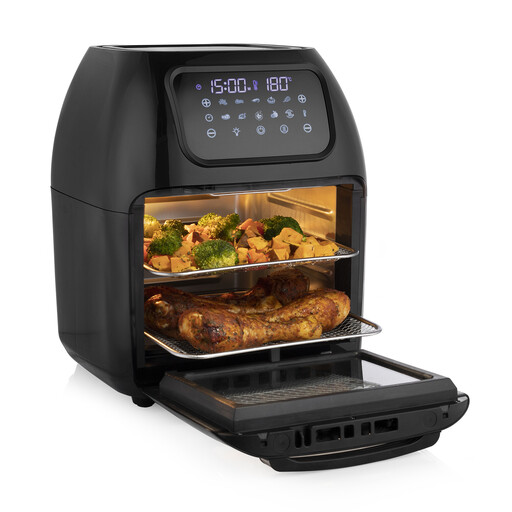
This air-fryer oven is relevant if you want to consider a multifunction appliance for cheese straws. Check its exact baking settings, tray and installation instructions against your usual batch and available counter space before choosing it.
 No image available
Tristar Multi Crispy FR-6964 Air Fryer Oven, 10 L
Consider this format if you want an air-fryer oven for snack baking as well as other cooking tasks, subject to confirming a suitable bake setting and flat tray for your cheese straws.
The product name specifies a 10 L capacity, 1800 W rating, touch screen and 10 programmes. Check the appliance’s external dimensions, required ventilation space and model-specific electrical instructions for your intended position.
View on Joybuy
Frequently asked questions
What oven setting should I start with for cheese straws?
Start with the setting in your recipe and adjust for the exact oven. River Cottage’s cheese-straw recipe calls for a preheated oven at 190°C fan or 210°C conventional, with 1–2 cm straws on a flat, parchment-lined tray for 10–15 minutes; lower the heat if the cheese begins to burn.
How much space should I leave around a countertop oven?
Use the clearance instructions for the exact model, as they are not interchangeable. For example, the Tower T14045 instructions shown by Joybuy specify at least 20 cm of clearance on all sides; that figure should not be applied to another oven without checking its manual.
Can I use an extension lead for a countertop oven?
Only if the extension device and combined connected load are within its marked rating and it can be used as instructed. Electrical Safety First advises against overloading or daisy-chaining extension leads and says cable reels should be fully unwound before use. If you regularly need an extension lead, consider asking a registered electrician about a suitable fixed socket.
Will a convection microwave bake cheese straws like a mini oven?
A convection microwave is an option only if its baking accessories and usable tray space suit your straws; the presence of a convection mode does not establish equivalent baking results. The Joybuy-listed Toshiba MW3-SAC23SF (MB) specifies convection-oven capability, so check its manual and supplied accessories before choosing it for pastry.


