Cooks focused on browned wedges
If wedges are your priority, look beyond the oven’s litre capacity. Check whether its racks or trays let you spread out your usual batch, alongside its fan-driven cooking mode and temperature controls.


If potato wedges are the main job, start with an oven-format air fryer whose tray can hold your usual batch without crowding and whose crumbs are easy to clear. Consider a larger two-level convection oven when several people need to cook at once, or a mini oven with hotplates only if you also need hob functions. Whichever format you choose, check kitchen rules, the socket arrangement, worktop clearance and cleaning responsibilities before buying.
If wedges are your priority, look beyond the oven’s litre capacity. Check whether its racks or trays let you spread out your usual batch, alongside its fan-driven cooking mode and temperature controls.
An oven has to fit while leaving room for preparation and the clearances required by its manual. Compare exterior dimensions as well as capacity: SharkNinja UK lists the Ninja Foodi DT200UK at 50.5 cm deep.
Before adding a high-heat appliance, check the kitchen’s rules, available socket and where its cable will run. Agree who will clear crumbs and grease after use; Electrical Safety First also advises against overloading extension leads and adaptors.
Choose the oven format around your usual wedge batch and any other cooking it must do, then check whether it can be placed, powered and cleaned comfortably in the shared kitchen.
Choose when: Wedges are the main task and you want to arrange a modest batch on an oven tray.
Bear in mind: Rack levels and stated capacity do not tell you how many wedges fit in a single layer.
Choose when: Housemates need to cook separate foods or larger meals at the same time.
Bear in mind: A deeper appliance needs enough permanent worktop space and the clearances specified in its manual.
Choose when: The same appliance must provide basic hob functions as well as bake wedges.
Bear in mind: Hotplates add surfaces to clean and make household rules and electrical arrangements especially important to check.
| Concern | What to check | Who this matters to |
|---|---|---|
| Browning without crowding | Check the cooking mode and usable tray or rack area for your usual wedge batch; follow the model’s loading instructions. | If I mainly make wedges, I want room to spread them out rather than pile them up. Around 36% of consumers would put uncrowded wedge cooking first. |
| Batch size and worktop fit | Compare exterior dimensions and manual clearances with the available space; check tray layout separately from litre capacity. | When several of us use the kitchen, I need enough cooking room without taking over the counter. Worktop-and-batch fit would come first for around 29% of consumers. |
| Electrical use and permission | Check accommodation rules and a suitable socket arrangement; avoid overloading extension leads or blocks. | I need to know that an extra oven is permitted and can be plugged in without an overloaded shared adaptor. For around 21% of consumers, safe and permitted use would be the primary concern. |
| Cleaning between users | Check the crumb tray, which accessories can be washed, and the model’s cooling and cleaning instructions. | If the next housemate needs a clean oven, I want a clear way to deal with crumbs and grease after my turn. Around 14% of consumers would make cleaning and handover their first priority. |
Cavity capacity does not show how many wedges fit on a tray or whether the appliance and its required clearances fit the shared worktop.
Measure the proposed position in width, depth and height. Compare the exact model’s exterior dimensions, manual clearances and supplied tray layout before deciding.
Electrical Safety First warns that overloaded extension leads and adaptors can overheat and cause fire.
Check that the socket arrangement suits the appliance and other connected equipment. Avoid daisy-chaining extensions, and stop using a plug, lead or socket that shows damage, scorch marks or unusual heat.
The Ministry of Housing, Communities & Local Government’s rented-sector electrical-safety guidance for England addresses landlords’ duties concerning electrical installations; it does not approve a tenant-owned oven for a particular kitchen.
Check your tenancy or accommodation rules, and ask the landlord or kitchen manager if permission or placement is uncertain.
Residue makes shared use harder, and Electrical Safety First identifies grease build-up in ovens and grills as a fire concern.
Agree who cleans after each use. Allow the appliance to cool, remove food residue and wash only the parts approved in its instructions.
For an oven-format air fryer, Tefal’s Easy Fry Multifunction Oven FW556DG0 is a 15 L example with three rack levels and temperature control up to 230°C, according to Tefal UK Shop.
The Ninja Foodi DT200UK illustrates the larger two-level countertop oven route for households cooking more than one food at once, as described by SharkNinja UK.
Russell Hobbs UK describes the Mini Kitchen 22780 as a 30 L fan-assisted oven with two hotplates, a baking tray and a grill rack.
These oven-format air fryers offer racks or a baking tray to consider for countertop wedge cooking. Check the usable cooking area, worktop clearance and kitchen arrangements against your own batch and space.
 No image available
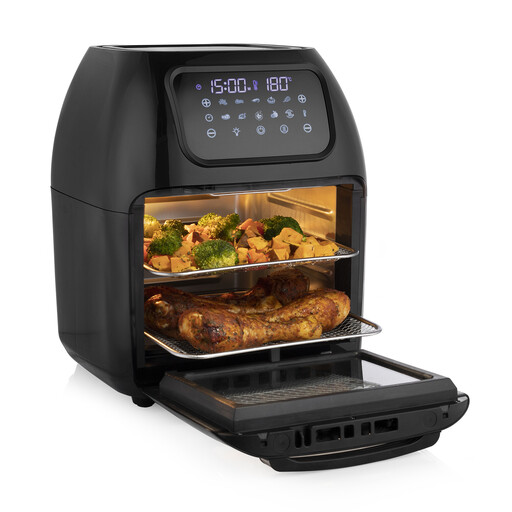
For wedges cooked in an oven-format air fryer, compare the supplied rack layout with the amount you usually make.
The product name specifies 10 L capacity, 1800 W power, touch-screen controls, 10 programmes and dishwasher-safe parts.
Check the racks’ usable area, exterior dimensions, required clearances and the plug and fuse details for the delivered unit before placing it in a shared kitchen.
 No image available
For a wedge batch arranged on a baking tray, consider this oven-format model if its usable tray area fits the amount you cook.
The product name specifies 15 L capacity and nine functions. Tefal UK Shop documents three rack levels and a removable crumb tray for the FW556DG0.
Check the tray dimensions, exterior size, required clearances and plug and fuse details for your kitchen and delivered unit.
Check the rules for your particular accommodation before buying; permission to add an appliance is not automatic. The Ministry of Housing, Communities & Local Government’s electrical-safety guidance for rented homes in England concerns landlords’ duties, not approval of a tenant-owned oven for every kitchen. Ask your landlord or accommodation provider if the rules are unclear.
Only use an arrangement that is suitable for the appliance and the total connected load. Electrical Safety First advises against overloading extension leads, reels and adaptors or daisy-chaining extensions. Check the lead’s rating and condition rather than treating a shared power strip as an extra cooking socket.
Check the exact model’s plug, instructions, worktop clearances and cooking accessories. Electrical Safety First says electric air fryers should have a UK three-pin plug and fuse; it also suggests considering features such as a timer, stable feet and a cool-touch design. Those features do not replace supervision or safe placement.
Agree who clears crumbs and grease after each use, and follow the model’s instructions for cooling and washing its accessories. Electrical Safety First advises allowing an air fryer to cool before cleaning and not immersing the appliance itself in water. Check which removable parts, if any, are dishwasher-safe.