Holiday cooks without a suitable full oven
If the cottage oven or hob cannot handle your chicken-and-vegetable traybake, prioritise the usable tray area, clearance around the food and a suitable place to set up the appliance.


Choose an oven by the space your chicken and roasting tray need, not by its stated litre capacity alone. A two-level countertop oven may help with a main dish and sides, while an oven with hotplates is worth considering if the cottage hob is inadequate. For a smaller traybake, a compact mini oven may be easier to accommodate; whichever format you choose, confirm tray clearance, worktop space and the electrical setup before buying.
If the cottage oven or hob cannot handle your chicken-and-vegetable traybake, prioritise the usable tray area, clearance around the food and a suitable place to set up the appliance.
If sides or gravy need cooking alongside the roast, consider two-level oven cooking or a model with hotplates. Check that the arrangement works for the dishes and pans you intend to use.
A compact oven may be easier to place for a smaller joint or traybake. Compare its external dimensions with the available worktop, then check that the food and tray fit inside.
Consider it when: You want to roast the main dish and cook a side on a separate level.
Allow for: A larger worktop footprint; Ninja lists the DT200UK at H33.5 × W43.5 × D50.5 cm.
Consider it when: The cottage hob is inadequate and you need to use a pan while the oven roasts.
Allow for: Space for pans and handles as well as the oven, and check the electrical load before using functions together.
Consider it when: You are cooking a smaller joint or traybake and worktop space is tight.
Allow for: Less room for a whole chicken and vegetables, with no integrated hob for sides.
| Concern | What to check | Who this matters to |
|---|---|---|
| Chicken and tray fit | Measure your tray; compare it with the usable tray dimensions, internal height and rack positions. Litres alone cannot establish fit. | When I bring a whole chicken and a roasting tray, I need room for both without crowding the food. Around 42% of consumers would put chicken-and-tray fit first. |
| Cooking the whole meal | Check whether two shelves can be used together or whether hotplates suit your pans; confirm the accessories needed for that arrangement. | If the cottage hob cannot handle the sides, I want a way to finish them alongside the roast. For around 33% of consumers, preparing the main dish and sides is the primary need. |
| Temporary setup | Check appliance wattage, the available socket and the manufacturer’s worktop-clearance instructions. Do not overload extension equipment. | In an unfamiliar kitchen, I need a suitable place and electrical connection before switching on the oven. Safe temporary setup comes first for around 25% of consumers. |
Stated capacity does not tell you the usable rack area, tray dimensions or headroom around your chicken.
Measure the tray you plan to use and check the oven’s internal dimensions, supplied tray and rack positions before buying.
Electrical Safety First warns that overloading extension leads, cable reels or adaptors can cause overheating and create a fire risk.
Check the oven’s power rating against the extension equipment’s marked rating, do not daisy-chain leads and fully unwind a cable reel.
Cooking time can vary with the chicken, tray load and oven. The Food Standards Agency says heating chicken all the way through to 70°C or more reduces bacteria within minutes.
Check the thickest part with a suitable food thermometer before serving; the oven setting and timer do not establish the chicken’s internal temperature.
The DT200UK illustrates the multifunction countertop-oven route for cooks preparing a main dish and sides.
Its mini-oven range illustrates both oven-and-hotplate cooking and a larger oven-only capacity.
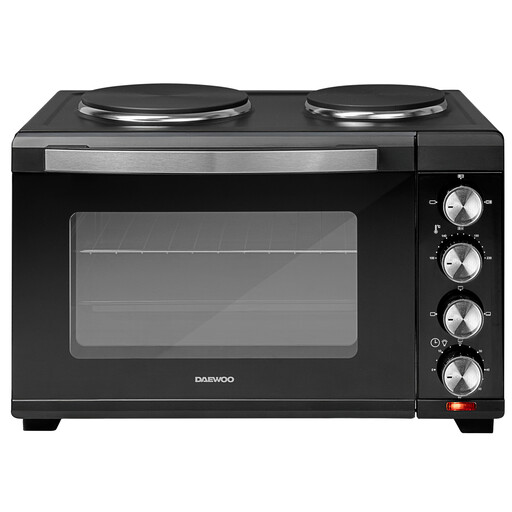
The 28L Mini Oven with Hob is an oven-and-hotplates option for a kitchen with limited hob space.
The SDA1608 illustrates the compact convection-mini-oven route for a smaller traybake.
This oven-with-hotplates option is relevant if the cottage has limited hob space. If convection cooking is essential, confirm the oven mode before buying, along with tray fit and the electrical requirements.
 No image available
Consider this oven-and-hotplates format if you need to use pans as well as roast in a cottage kitchen.
The product name states a 32L capacity and 3000W rating. Confirm convection operation if required, measure the usable oven and tray space for your chicken, and check the appliance instructions and available socket before use.
Measure your roasting tray and compare it with the oven’s usable tray space, internal height and rack positions. Leave room for the chicken and vegetables without crowding them; a litre figure on its own cannot confirm that your combination will fit.
No: check the chicken itself with a suitable food thermometer. The Food Standards Agency says heating chicken all the way through to 70°C or more reduces bacteria within minutes; an oven setting or elapsed time does not show the temperature inside the chicken.
Use one only if its marked rating is suitable for the appliance and the complete load. Electrical Safety First advises against overloading or daisy-chaining extension leads and says to fully unwind cable reels. Check the oven instructions and the cottage’s socket arrangement before setting it up.
A host letting a self-catering holiday home in England should follow the electrical-safety guidance identified by GOV.UK for that setting. The Health and Safety Executive says electrical equipment must be suitable for its intended use and conditions; damaged plugs, connectors or cables should be taken out of use. This England-specific guidance should not be treated as a rule for Scotland, Wales or Northern Ireland.