One-dish small-kitchen bakers
If you mainly want to bake one cobbler at a time, compare your dish and its handles with the usable rack space, then check that the oven and its required clearances fit your worktop.


Choose a fan-assisted countertop oven only after checking that your cobbler dish, including its handles, fits the usable rack and that the appliance can stand on your worktop with its required clearances. A 20–22 litre model may suit a single dish; consider a 30 litre model if you need more oven space, but check its baking mode, footprint and electrical setup rather than relying on capacity alone.
If you mainly want to bake one cobbler at a time, compare your dish and its handles with the usable rack space, then check that the oven and its required clearances fit your worktop.
If the appliance will also handle grilling, toast or other meals, look for functions you will use regularly without letting them take priority over dish fit and a suitable baking setting.
If you bake more than an occasional cobbler, check the exact model for fan operation, adjustable temperature, shelf positions and a timer that suit the recipes you make.
Start with the dish and the available worktop space. Then check baking controls and extra functions against what you cook, before settling on a position and power connection for the oven.
| Concern | What to check | Who this matters to |
|---|---|---|
| Dish fit and footprint | Compare the dish, including handles, with the exact model’s usable rack and door opening. Check the appliance footprint and required clearances. | If my cobbler dish cannot go in or the oven cannot sit safely on the worktop, other features will not help; around 36% of consumers would put fit first. |
| Baking controls | Confirm the exact model’s Bake or fan setting, temperature range and shelf positions against your recipe and dish height. | When I bake regularly, I want settings I can use for my recipes rather than a long list of unrelated functions; roughly 29% of consumers would make baking control their primary concern. |
| Extra functions and cleaning | Check which additional modes you would use and what accessories and removable parts come with the exact model. | If one countertop appliance will cover other meals too, I need its extra modes and cleaning routine to suit everyday use; for about 21% of consumers, that versatility would come first. |
| Power and placement | Read the model’s clearance and surface instructions, and check its plug and power requirements against the intended socket arrangement. | With limited space and sockets, I need a place to run the oven without crowding it or overloading a connection; electrical setup and placement would lead the choice for around 14% of consumers. |
A capacity figure does not tell you the usable rack width, dish height or space for handles and the door to close.
Measure your dish and compare it with the exact oven’s internal and rack dimensions. Use capacity to narrow the options, not to confirm fit.
Russell Hobbs UK’s cited energy comparison for the 26680 concerns 400 g of frozen French fries cooked against a conventional oven at 213°C; its preheat comparison concerns reaching 220°C. Neither establishes a cobbler’s baking time or energy use.
Check for a suitable baking setting and use your recipe as a starting point, watching the first bake rather than assuming a result from a different food test.
Placement requirements differ by model, and nearby surfaces or objects can be exposed to heat. The Russell Hobbs 22780 manual, for example, specifies at least 50 mm of space around the appliance.
Read the exact model’s instructions and choose a stable, level, heat-resistant surface with its stated clearances. Keep tea towels and oven gloves away from the heat.
Electrical Safety First warns that overloading an extension lead or adaptor can cause overheating and a fire risk, particularly when an oven shares it with other large appliances.
Use a suitable wall socket where possible. If an extension lead is needed, check its rating and the combined load, and do not connect extension leads in a chain.
Russell Hobbs UK lists the 30 litre Mini Kitchen 22780 with fan assistance and double hotplates, alongside the 20 litre Express Air Fry Mini Oven 26680 with a Bake setting.
The Dualit 89220 is a 22 litre mini oven for buyers considering a compact baking appliance without integrated hotplates.
The Igenix IG7131 offers a 30 litre tabletop-oven option for supplementary baking and other oven tasks.
The Sage Smart Oven Pro BOV820BSS is a fan mini oven for buyers who place particular value on programmed controls and shelf flexibility.
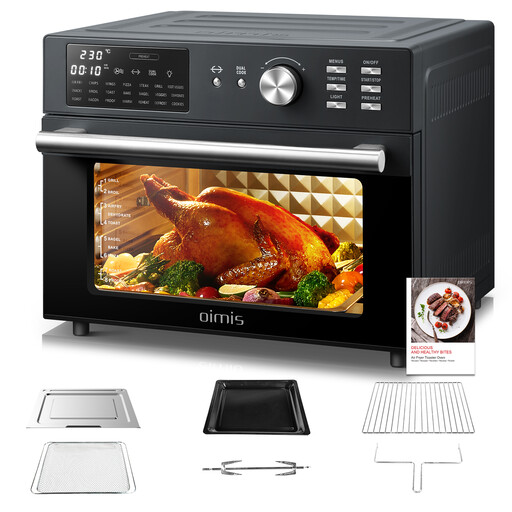
This 30 litre air fryer toaster oven is a choice to consider if you also want functions beyond cobbler baking. Confirm that its baking setting, usable rack space and placement requirements suit your dish and kitchen before choosing it.
 No image available
Consider it if you want a countertop oven for varied cooking as well as a possible cobbler bake. Its stated features include 1800 W power, rotisserie and dehydrator functions, and space for a 13-inch pizza; none of those details confirms that your cobbler dish will fit. Check the usable rack dimensions, baking setting, temperature range and required worktop clearances for this model.
Only if the lead’s rating and the combined load of connected appliances make it suitable. Electrical Safety First warns against overloading extension leads and connecting one extension lead to another; a plug-in oven used alongside other large appliances may overload a lead. If you are unsure about the wiring or load, ask a qualified electrician.
Follow the exact model’s placement instructions rather than one clearance figure for every oven. The Russell Hobbs 22780 manual specifies at least 50 mm all around, while the product information for the Sage BOV820BSS specifies 100 mm to the sides. Keep flammable kitchen items away from the appliance.
Check the requirements of the particular oven and your existing electrical setup before assuming it needs installation work. The product information lists the Sage BOV820BSS for connection to a 13 A socket, but its plug arrangement does not establish that every kitchen socket or shared circuit is suitable. Ask a qualified electrician if the available connection or circuit load is uncertain.