Occasional small-batch tartlet baker
You want a separate oven for a few tartlets and need a baking setting that can accommodate the 200°C fan heat in Good Food’s recipe. Tin fit matters more than stated cavity volume alone.


For a few tomato tartlets at a time, start with a countertop oven that has a Bake or convection setting capable of the 200°C fan heat specified in Good Food’s tartlet recipe, provided your tin fits its usable rack. A larger multi-function model makes sense if you will use its extra space or cooking modes; choose a built-in compact oven when you are planning an integrated kitchen, not simply to bake a small batch.
You want a separate oven for a few tartlets and need a baking setting that can accommodate the 200°C fan heat in Good Food’s recipe. Tin fit matters more than stated cavity volume alone.
You plan to use one worktop appliance for tartlets and other cooking. Compare the baking setting, usable tray space and additional functions you expect to use.
You are choosing an oven for fitted cabinetry rather than adding a portable appliance. Installation dimensions and the available hot-air settings guide that decision.
For Good Food’s tomato tartlets, the reference method uses a lined baking sheet at 200°C fan heat for 10–15 minutes. Choose an oven format for how often you bake, then confirm that its setting and usable rack accommodate your recipe and tin.
Consider it when: You mainly bake occasional small batches and want a separate worktop appliance.
Trade-off: A smaller stated capacity does not establish whether your tartlet tin fits the rack.
Consider it when: You will regularly use more tray space or additional cooking modes alongside baking.
Trade-off: Extra capacity takes worktop space, and an air-fry mode does not replace checking the Bake or convection setting for pastry.
Consider it when: You are planning an integrated kitchen rather than shopping for a portable second oven.
Trade-off: Cabinetry and installation requirements make it a different commitment from a countertop model.
| Concern | What to check | Who this matters to |
|---|---|---|
| Baking setting and temperature | Look for a Bake or convection setting and controls that reach the recipe’s 200°C fan setting. | I want to follow the tartlet recipe without assuming an air-fry programme works the same way. Around 36% of consumers put a suitable baking setting first. |
| Tray and worktop fit | Compare your tin with the usable rack or tray dimensions, and check the appliance footprint and door clearance. | My tartlet tin needs to sit properly inside the oven, while the appliance must fit my counter. For around 29% of consumers, physical fit is the primary concern. |
| Everyday functions | Check which additional programmes match meals you actually make, while retaining a suitable baking setting. | If I will also toast, grill or air-fry regularly, those functions affect which oven I choose. Around 21% of consumers prioritise wider everyday use. |
| Cleaning and running costs | Check removable parts and cleaning instructions; assess energy claims against the food and cooking conditions used. | After baking filled pastry, I want manageable cleaning and a sound basis for judging electricity use. Practical upkeep or running costs come first for around 14% of consumers. |
A 12.6L, 20L or 22L figure describes cavity volume, not the usable rack width and depth for your baking sheet or tartlet tin.
Measure the outside of your tin and compare it with the usable rack and supplied-tray dimensions before ordering.
Russell Hobbs’ stated comparisons for its mini ovens use frozen chips or pizza, with cooking conditions that differ from baking tomato tartlets.
Choose by the documented baking controls and your recipe requirements rather than treating those comparisons as a tartlet result.
A larger countertop oven needs room on the counter and space to open its door. A built-in compact oven also requires cabinetry planning.
Check the appliance dimensions and the installation or ventilation clearances in its instructions before deciding whether the extra capacity is useful to you.
Its Express Mini Oven 26090 and Express Air Fryer Mini Oven 26680 represent smaller countertop formats to compare for tartlet baking.
The SOV860BSS Smart Oven Air Fryer is a larger, multi-function countertop option.
The Sfornatutto Chef EO34302 represents a larger countertop-electric-oven format; De'Longhi’s UK support site identifies it as a 34L model.
The CSG7361B1 is relevant to an installed compact-oven project, rather than a portable countertop purchase.
This countertop oven is a compact option to consider for small batches. Check its baking instructions and usable rack dimensions against your 200°C fan-oven recipe and tartlet tin before choosing it.
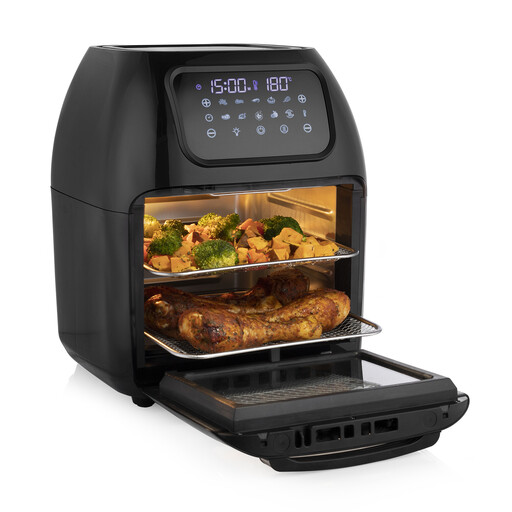 Image unavailable
A 10L countertop option to consider for a few tartlets, provided its usable rack fits your tin and its instructions confirm the baking setup your recipe requires.
The product name specifies 1800W, a touch screen, 10 programmes and dishwasher-safe parts; check which removable parts the cleaning instructions cover.
Look for a Bake or convection setting that can accommodate the 200°C fan heat in Good Food’s tartlet recipe. Its method uses a lined baking sheet and calls for a 10–15 minute bake; check the oven’s instructions and tray fit rather than assuming an air-fry setting is equivalent.
Capacity alone cannot tell you whether a particular tin fits. Compare the tin’s outside dimensions with the oven’s usable rack or supplied tray, including the available shelf position and door clearance.
Follow the instructions for your particular model and let it cool before cleaning. Russell Hobbs says the removable accessories of its 26680 can be washed in a dishwasher or sink, but that does not establish the cleaning method for another oven.
No: a result from cooking another food does not establish electricity use for tomato tartlets. Russell Hobbs’ stated mini-oven comparisons use frozen chips or pizza; for a tartlet-specific cost comparison, the relevant factors include your cooking time, actual appliance use and electricity tariff.