Choose a countertop convection oven if you need a separate space for baking peanut butter cookies and can manage its trays, racks, crumbs and interior after peanut use. Check for a Bake setting, temperature and timing controls, a tray that suits your batch, and a cleaning routine agreed with other kitchen users. Extra cooking functions do not prevent peanut cross-contact.
Who this is for
Shared-kitchen bakers managing peanut allergens
If other people prepare food in the same kitchen, you need to account for peanut residue on equipment and work surfaces, not just how the cookies bake. The Food Standards Agency warns that allergenic food left on surfaces or equipment can contaminate other food; defined work areas matter where physical separation is not possible.
Small-batch countertop bakers
If you want an additional oven for occasional trays, compare usable tray dimensions, the Bake setting, accessories and storage space rather than judging capacity by litres alone. Russell Hobbs and Cuisinart list different cavity sizes and accessories for their countertop models, but those figures do not tell you how many cookies will fit.
Repeat-batch cookie bakers
If you bake often, preheat feedback and a visible countdown may help you manage successive batches. Sage specifies these features for its Smart Oven Air Fryer; you will still need to check its footprint and manage every accessory used with peanuts.
What to check before buying
For peanut butter cookies in a shared kitchen, settle how you will manage peanut residue before choosing tray size and baking controls.
| Concern |
What to check |
Who this matters to |
| Peanut cross-contact |
Check access to the tray, rack, crumb area and interior; decide whether food-contact accessories can be reserved for peanut baking. |
When others may use the same equipment, I need a way to keep peanut residue from reaching their food. Around 36% of consumers put allergen control first. |
| Batch size and space |
Compare usable tray dimensions with your intended batch, then check the counter space and clearances specified by the manufacturer. |
I need enough room for a useful tray of cookies without taking over a shared counter. For around 29% of consumers, batch and space fit is the primary concern. |
| Browning and timing |
Look for a Bake setting, a suitable temperature range and a timer; monitor one tray before planning repeat batches. |
If I bake repeatedly, I want controls that let me follow the recipe and watch the first batch closely. Baking control comes first for around 21% of consumers. |
| Cleaning and ownership |
Read the cleaning instructions for each accessory and agree who will clean and store peanut-used items. |
I need other kitchen users to know which items have held peanuts and who is responsible for cleaning them. Around 14% of consumers prioritise that shared routine. |
Buying pitfalls
-
Choosing on convection features alone
Airflow and baking settings do not address peanut residue on trays, racks, crumbs or shared work surfaces. The Food Standards Agency notes that allergenic food left on equipment can contaminate other food.
Before buying, check whether you can clean the relevant surfaces and reserve or control food-contact accessories when someone with a peanut allergy could be affected.
A workable routine may also require separate trays or racks, labelled storage and cleaning supplies.
-
Treating litres as cookie capacity
Cavity capacity does not show the usable area of a flat tray, rack clearance or how many cookies you can space on it.
Check tray dimensions and the oven’s counter footprint, then monitor a first batch using your recipe’s fan-oven guidance before planning larger batches.
-
Applying energy claims to cookie baking
Russell Hobbs describes a comparison involving frozen chips, while Sage describes an internal comparison with a built-in oven. Neither test establishes the energy used for your peanut butter cookies.
Consider the batch size, preheating and cooking routine you would actually use rather than applying a manufacturer comparison to a different food.
-
Selling cookies without checking food requirements
Food-business responsibilities depend on the activity and where it takes place; labelling requirements also depend on how food is sold.
If you intend to sell cookies, check your activity with the relevant local authority before trading. For food prepacked for direct sale, consult the Food Standards Agency’s applicable ingredients and allergen-labelling guidance.
Brands to consider
Russell Hobbs
Its Express Air Fryer Mini Oven 26680 is a countertop example with a Bake setting and supplied accessories.
- Russell Hobbs specifies a 20-litre capacity, 1500 W power and an oven tray, rack, shelf and crumb tray.
- Its manufacturer comparisons should not be used to predict cookie quality or the energy used for your batches; check the tray’s usable area and your cleaning routine separately.
Sage
Its Smart Oven Air Fryer SOV860BSS4GUK1 is a countertop option to examine if preheat and timing feedback matter to you.
- Sage specifies 10 cooking functions, including Bake, alongside digital PID temperature control, preheat indication and a countdown display.
- Sage’s convection and energy statements include manufacturer comparisons; they do not establish better results for peanut butter cookies.
Cuisinart
Its TOA60U illustrates a countertop format with two cooking levels.
- Cuisinart specifies a 17-litre capacity, Bake setting, baking tray and oven rack.
- Cuisinart identifies the TOA60U as discontinued. If considering one, check the exact version, supplied accessories, seller and warranty rather than assuming current availability.
Countertop oven choices on Joybuy
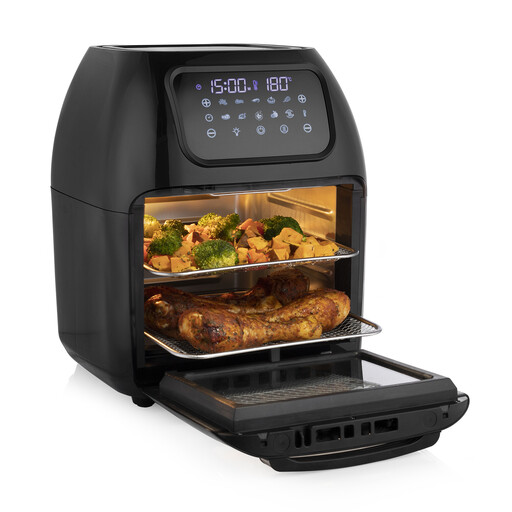
This countertop air fryer oven is relevant if you want to assess a compact appliance for cookie baking. Check that it accommodates a suitable flat tray and that you can manage cleaning after peanut use.
 No image available
Tristar Multi Crispy FR-6964 Air Fryer Oven, 10 L
Consider this countertop oven if you can confirm that a suitable flat cookie tray fits and arrange a cleaning routine for shared peanut use.
The listed variant is 1800 W, with a touchscreen, 10 programmes, dishwasher-safe parts and a non-stick coating. Its 10 L capacity does not establish usable cookie-tray area; check which accessories are supplied and follow the cleaning instructions for all food-contact surfaces.
View on Joybuy
Frequently asked questions
Can a convection oven make peanut butter cookies safe for someone with a peanut allergy?
No: the oven type does not remove the risk of peanut cross-contact. The Food Standards Agency warns that allergenic food left on surfaces or equipment can contaminate other food. In a shared kitchen, use separation where possible and control the work area, accessories and cleaning process; do not describe food as peanut-free if cross-contact has not been controlled.
What should I do before baking the first tray?
Follow the oven’s instructions, identify its food-contact parts and decide how peanut-used trays and racks will be stored and cleaned. Use the recipe’s fan-oven guidance as a starting point, then watch the first tray before relying on the same timing for further batches.
Can energy-saving claims tell me what cookie baking will use?
Not unless the comparison reflects your baking routine. Russell Hobbs’ stated comparison involves frozen chips, while Sage describes an internal benchmark against a built-in oven; neither establishes the energy used for a tray of peanut butter cookies.
What should I check if I plan to sell the cookies?
Check whether your activity is a food business and which requirements apply where you operate. GOV.UK directs food businesses to register with their local authority, while Food Standards Agency guidance requires food businesses producing food prepacked for direct sale to label it with its name and a full ingredients list. Confirm the applicable registration, kitchen and allergen-information requirements with the relevant local authority before trading.


