Solo bakers short on worktop space
You need room for a one-person casserole dish without giving over more worktop than necessary. Compare the dish’s outside dimensions, including handles, with the oven’s usable rack area and door clearance.


For one portion of chicken enchiladas, choose an appliance with a bake or convection setting and enough usable rack space for your actual oven-safe dish; stated capacity alone cannot establish that the dish fits. A compact fan oven suits a dedicated baking task, while a convection microwave makes more sense if you also need microwave reheating and can follow its mode-specific cookware rules. If you already have a suitable fan oven and bake this dish only occasionally, consider using it before adding another appliance.
You need room for a one-person casserole dish without giving over more worktop than necessary. Compare the dish’s outside dimensions, including handles, with the oven’s usable rack area and door clearance.
You want to bake enchiladas but also expect to use functions such as grilling, toasting or reheating. Consider which modes you will use regularly before choosing a larger multifunction oven.
You need both functions in one appliance and are willing to check which cookware is suitable for each mode. Electrical Safety First notes that a convection microwave uses a fan and heating element for baking and browning.
Choose it when: You mainly want to bake a small dish and have limited worktop space.
Trade-off: A compact exterior or stated capacity cannot confirm that your handled dish will fit.
Choose it when: You will regularly use other oven functions alongside baking enchiladas.
Trade-off: Extra functions and a larger footprint may offer little value for an occasional single portion.
Choose it when: Microwave reheating and convection baking are both priorities.
Trade-off: Cookware suitability depends on the selected mode and the appliance instructions.
Choose it when: Your current oven accommodates the dish and you bake enchiladas only occasionally.
Trade-off: You keep the appliance you have rather than gaining a separate countertop cooking space.
| Concern | What to check | Who this matters to |
|---|---|---|
| Dish fit and worktop space | Compare your dish, including handles, with usable rack width, depth and height. Check worktop and ventilation clearances. | If worktop space is tight, I need my actual dish to sit securely inside the oven without obstructing the door; around 42% of consumers put dish fit and worktop practicality first. |
| Baking control and chicken safety | Look for a bake or fan-assisted mode and adjustable temperature control. Check the centre of the chicken filling with a food thermometer. | I want the filling cooked through, not just browned cheese on top; for around 33% of consumers, controllable baking and checking the chicken are the primary concern. |
| Useful extra functions | Identify the modes you will use beyond baking and check cookware rules for any microwave function. | If one appliance will also handle regular reheating, grilling or toasting, those functions may matter more to me than minimum size; around 25% of consumers prioritise that versatility. |
Neither measurement establishes whether a casserole dish will fit with its handles or clear the door. A pizza diameter and an oven capacity describe different things.
Measure your dish and compare it with the exact oven model’s usable rack dimensions and internal clearance.
The topping can brown while the centre of the filling still needs checking. The Food Standards Agency reports that heating chicken all the way through to 70°C or more reduces bacteria within minutes.
Use a clean food thermometer to check the centre where practical, and follow the recipe’s cooking guidance and appliance instructions.
Electrical Safety First warns that ovens and grills used with other large appliances can overload an extension lead, creating an overheating and fire risk.
Check the appliance’s power requirements and the electrical setup. Do not daisy-chain extensions or exceed an extension lead’s rating; ask a qualified electrician if the supply is uncertain.
A dish suitable for convection baking is not automatically suitable for microwave operation. Restrictions can differ between the appliance’s modes.
Follow the exact model’s instructions before using metal, foil or a particular dish, especially when switching to a microwave function.
Ninja’s countertop range includes compact mini ovens and larger multifunction formats.
Sage’s Smart Oven Air Fryer is a countertop option for cooks who expect to use several oven functions.
Russell Hobbs offers tabletop fan-assisted ovens, including its Mini Kitchen format.
These combination microwaves offer a convection-baking route alongside microwave functions. The DAEWOO and Samsung models are countertop choices; the CDA model is built in and needs a compatible cabinet installation. Check your dish against the exact model before choosing any of them.
 No image available
Consider this countertop combination model if you want a bake function as well as microwave reheating; check that your enchilada dish fits before ordering.
 No image available
This model is a choice for cooks who need convection cooking alongside microwave use, provided their dish fits the usable cooking space.
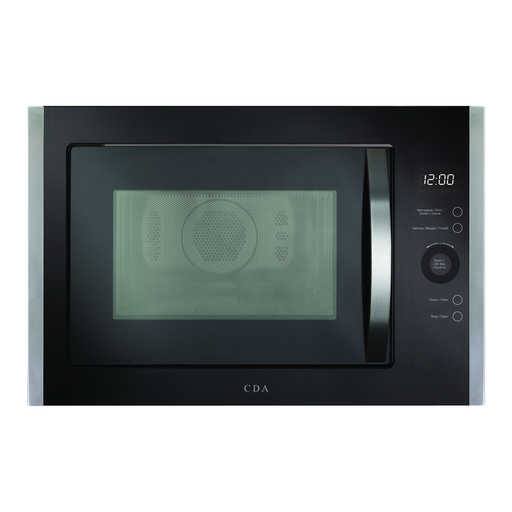 No image available
Consider this only if you want microwave and convection functions in a built-in installation, rather than a freestanding worktop oven.
Choose by the usable space around your dish, not by a litre figure alone. Measure the dish’s outside width, depth and height, including handles, and compare them with the exact model’s rack area and internal clearance.
Check the centre of the filling rather than judging by the browned topping. The Food Standards Agency reports that heating chicken all the way through to 70°C or more reduces bacteria within minutes; use a clean food thermometer where practical and follow the recipe’s cooking guidance.
Yes, a convection microwave can be an option when it has a suitable baking mode and your dish fits. Electrical Safety First explains that convection models use a fan and heating element for baking and browning; follow the exact appliance’s cookware rules when changing modes.
Do not assume an extension lead is suitable. Electrical Safety First warns that ovens and grills can overload one when used with other large appliances; check the appliance’s power requirements and the extension’s rating, and seek a qualified electrician’s advice if the electrical setup is uncertain.