A portable convector can provide supplementary warmth while you work, provided you can leave clear space around it, but it will not fix cold walls. Energy Saving Trust explains that heat escapes through building fabric and draughts: if the office remains difficult to warm, investigate that heat loss before relying on a higher-output heater. Choose controls that fit your working hours, then check the room and the heater’s placement before deciding on a model.
Who is this for?
People working in a persistently cold room
If your office has cold external walls or noticeable draughts, supplementary heat may help while you work. Energy Saving Trust’s heat-loss guidance also makes it worth checking the walls and gaps that let warmth escape.
People working short, quiet sessions
If you heat the office only while using it, a portable convector with temperature control may suit your routine. Check the maker’s noise claims and allow the clearance the heater needs; room comfort will still depend on heat loss.
People keeping regular office hours
If your working times repeat each week, a programmable timer may help you align heating with those hours. Check what the timer actually does on the model you choose, and continue to follow portable-heater safety guidance.
What matters when choosing?
Decide whether the cold room needs attention to draughts or insulation as well as a heater. For the heater itself, weigh comfort during your working hours against control and the space available for safe placement.
| Concern |
What to check |
Who this matters to |
| Cold walls and heat loss |
Check room size, external walls, insulation and draughts before deciding whether the heater is for occasional top-up heat. |
If my office stays cold after the air warms up, I need to understand where heat is escaping before choosing more output. Around 33% of consumers would put heat loss first. |
| Comfort during desk work |
Compare heat settings, thermostat controls, stated noise characteristics and the clearance needed for airflow. |
For short work sessions, I want warmth without distracting noise or a long wait. Quiet working comfort comes first for around 27% of consumers. |
| Heating hours and temperature |
Check whether the model has a thermostat and whether any timer follows a daily or weekly schedule. |
When I work regular hours, I want heating to follow that routine rather than leave it running longer than needed. Around 20% of consumers would prioritise scheduling and control. |
| Safe placement |
Plan a stable position with the clearance specified by the maker, away from curtains, furniture and paperwork; check model-level safety features. |
With cables, furniture and little floor space near my desk, I need somewhere the heater can stand without being knocked or obstructed. Placement is the primary concern for around 20% of consumers. |
Mistakes to avoid
-
Expecting the heater to fix cold walls
Energy Saving Trust explains that warmth can escape through walls and gaps. Raising the room-air temperature does not close those paths.
Use a convector for supplementary comfort, and investigate draughts, insulation and persistent damp or condensation concerns if the room remains cold.
A room that continually loses heat may require the heater to run for longer to maintain comfort.
-
Choosing by wattage alone
A heater’s rated output does not establish how well it will suit a particular room with cold external walls.
Check the room’s dimensions, insulation, draughts and intended heating periods before treating a stated wattage as adequate.
-
Crowding the heater against office furnishings
Electrical Safety First says portable convectors need clear space above and around them. GOV.UK advises keeping heaters away from curtains and furniture and never using them to dry clothes.
Follow the model’s clearance instructions, keep its airflow unobstructed and position cables away from walkways.
-
Treating a timer as permission to leave it unattended
A timer does not replace safe placement or supervision. GOV.UK advises unplugging electric heaters when going out or going to bed.
Turn off and unplug a portable heater before leaving or going to bed, even if it has a timer or thermostat.
Relevant brands to consider
Dimplex
Dimplex offers portable convectors for supplementary room heating, including the ML2T 2 kW model.
- Dimplex lists a rotary thermostat, frost setting, carry handles and overheat protection for the ML2T. Its description of near-silent heat distribution is the manufacturer’s claim.
- Dimplex states that the ML2T is suitable only for well-insulated spaces or occasional use. That condition matters in an office that loses heat through cold walls.
De'Longhi
De'Longhi offers convectors and oil-filled radiators for different heating routines.
- De'Longhi lists 800 W and 2,000 W settings and a room thermostat for its HSX2320 convector. The brand positions convectors for occasional room heating.
- De'Longhi positions oil-filled radiators for maintaining room temperature over several hours; that is a different use case, not evidence that either type will use less electricity in this office.
Stiebel Eltron
Stiebel Eltron offers convectors with programmable controls, including the freestanding CNS 2000 Plus LCD Move.
- The manufacturer lists a weekly timer, open-window detection, tip-over shut-off and overheat protection for that model.
- Its stated 7.9 kg weight and 738 mm width make floor space and portability worth checking for a compact office.
Joybuy convector heaters
These portable convectors are options for adjustable, supplementary heat during home-office hours. Neither a stated 2,000 W rating nor a timer in a product title establishes how well a heater will suit your room: check heat loss, placement and the controls on the exact item before buying.
 No image available
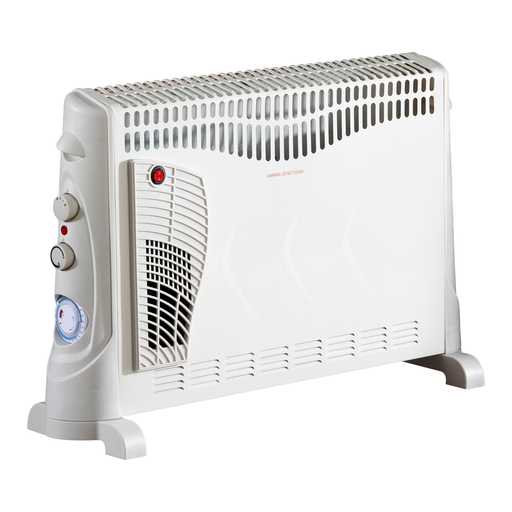
DAEWOO 2000 W Convector Heater, 3 Heat Settings, White
This portable convector is an option for adjustable supplementary heat while you work.
Its product name lists 750 W, 1,250 W and 2,000 W settings, an adjustable thermostat and overheat protection. Confirm the exact model variant and how its listed timer works before relying on it for scheduled heating.
Check the room’s heat loss and the heater’s placement requirements before treating its rated output as suitable.
View on Joybuy
 No image available
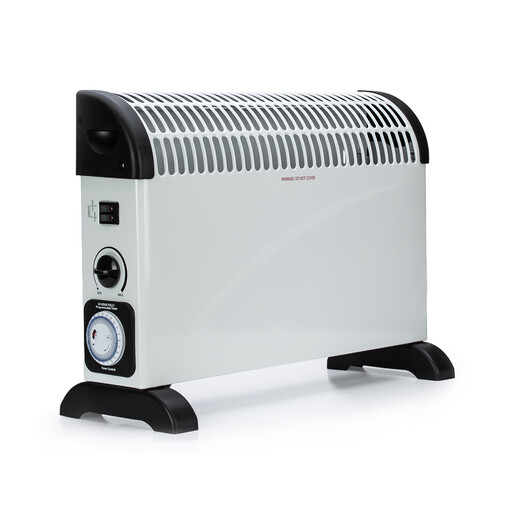
Status 2000 W Convector Heater, 3 Heat Settings, White
This portable convector is another option for supplementary heat during occupied office hours.
Its product name lists a 2,000 W rating, three heat settings and an adjustable thermostat. Check whether the exact item has the timer mentioned in its title and what that timer can do.
Allow the required clearance around the heater, and assess room size, insulation and draughts before choosing it by wattage.
View on Joybuy
Questions about heating a cold-walled office
Will a convector heater fix cold walls in my home office?
No. A convector warms room air but does not insulate walls or seal gaps. Energy Saving Trust identifies building fabric and draughts as routes for heat loss, so consider checking those if the room remains cold despite supplementary heating.
Should I choose a convector or an oil-filled radiator for office work?
A convector may suit occasional heating while you work; an oil-filled radiator is worth considering if you occupy the room for several hours and can accept a slower warm-up. De'Longhi positions its convectors for occasional heating and its oil-filled radiators for longer periods of warmth. Neither choice fixes heat escaping through cold walls.
How can I estimate a convector heater’s electricity use?
Multiply its rated power in kilowatts by the time it actually runs at that power. A 2 kW heater running continuously at full power for one hour uses 2 kWh; thermostat cycling, a lower setting and room conditions can change actual use. Apply the unit rate on your electricity bill to the resulting kWh rather than assuming the rating predicts a fixed hourly cost.
Can I leave a portable convector on overnight if it has a timer?
No: do not use a timer as a reason to leave a portable heater running overnight. GOV.UK advises unplugging electric heaters when going to bed or going out; follow the heater’s instructions and keep it clear of curtains and furniture whenever it is in use.


