Quiet desk-session hobbyists
Painting, sewing or detailed desk work calls for background warmth that does not distract you. Look at thermostat control and whether the exact model uses a fan, as well as where it can stand safely among your materials.


A manual 2 kW convector with an adjustable thermostat can suit occasional background warmth in a well-insulated hobby room, provided the heater can stay at least one metre from the seated user, chair and combustible materials. For regular sessions, a timer or digital controls may be more useful; if the room cannot accommodate that clearance, do not position a convector near the desk.
Painting, sewing or detailed desk work calls for background warmth that does not distract you. Look at thermostat control and whether the exact model uses a fan, as well as where it can stand safely among your materials.
If hobby sessions follow a routine, a timer or programmable control may be more useful than repeatedly adjusting a manual heater. Scheduling does not replace safe placement or the model’s operating instructions.
A slim, movable heater may be easier to store after a session. Its dimensions matter only if the room still allows the required one-metre gap around the seated user, chair and combustible materials.
Plan the heater’s position before comparing controls: a slim body, thermostat or timer cannot make an unsafe desk-side layout suitable.
| Concern | What to check | Who this matters to |
|---|---|---|
| Safe placement | Measure the proposed position for at least one metre between the heater and the seated user, chair and combustible materials. Check that it can stand securely. | In a tightly arranged room, I need to work without my chair, paper or fabrics encroaching on the heater. Roughly 45% of consumers put safe positioning first. |
| Quiet, controlled warmth | Check the thermostat and heat settings on the exact model, and whether any fan is optional. Treat quiet-operation descriptions as model-specific claims. | During focused desk sessions, I want adjustable background warmth without a distracting fan. Around 33% of consumers prioritise quiet, controllable heating. |
| Space and scheduling | Compare dimensions and handles; if sessions follow a routine, check whether the exact model has a timer or programmable controls. | With limited floor space or regular evening sessions, I need a heater I can move afterwards or control to suit my timetable. Roughly 22% of consumers place compactness or scheduling first. |
A narrow body saves floor or storage space, but it does not remove the risk posed by close seating and combustible hobby materials. London Fire Brigade advises sitting at least one metre from a heater.
Mark out the position before buying. If the seated user, chair and materials cannot stay at least one metre away, choose another position rather than relying on the heater’s slim shape.
Output does not tell you whether the controls fit occasional sessions or whether a fan will suit noise-sensitive work. Dimplex describes its ML2T as suitable only for well-insulated spaces or occasional use.
Choose between manual thermostat control and scheduling based on how you use the room. Check whether fan operation is optional if quiet desk work matters to you.
Electrical Safety First warns that overloading sockets or extension leads is dangerous, particularly with high-powered appliances such as heaters.
Follow the exact heater’s connection instructions, avoid overloading sockets and keep its cable away from chair wheels and places where furniture could damage it.
A marking route does not establish that an individual listing is genuine or that the heater will fit a crowded hobby-room layout.
Check the exact model, its instructions and current recall information before use. Electrical Safety First directs consumers to the Office for Product Safety and Standards for current recall information.
Dimplex offers a choice between the manually controlled ML2T and the scheduled HeatLite Smart convector.
The HSX2320 is a slim manual-control convector, while the HSX4324E provides digital controls and 24-hour programming.
PRO ELEC is relevant to buyers considering straightforward convector controls or a timer-and-fan variant.
These convectors offer heat settings and thermostat control for supplementary hobby-room warmth. Compare their controls against your session routine, then confirm that the chosen heater can be positioned safely near the desk.
 No image available
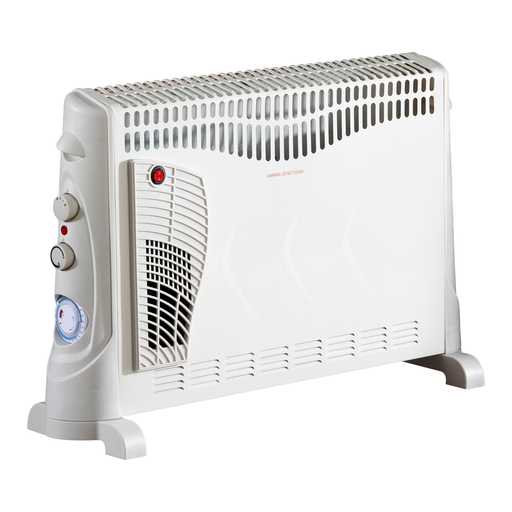
Consider this model if you want selectable heat for occasional desk sessions. Its stated settings are 750 W, 1,250 W and 2,000 W, with an adjustable thermostat and overheat protection.
If scheduling matters, confirm that the stated timer applies to the exact model or variant being sold. Follow its instructions to use a wall socket directly and maintain the required clearance.
 No image available
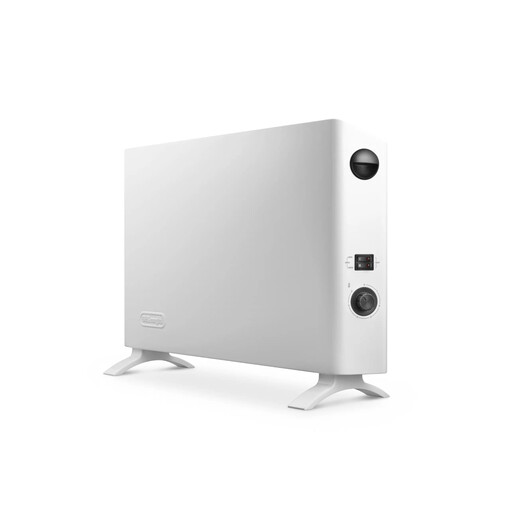
Consider the HSX2320 if moving or storing a slim manual-control heater matters more than scheduling. De'Longhi specifies a 90 mm depth, carry handles and heating power from 800 W to 2,000 W.
Check its exact operating instructions and planned position: a narrow body does not reduce the one-metre clearance needed for this desk-area use.
 No image available
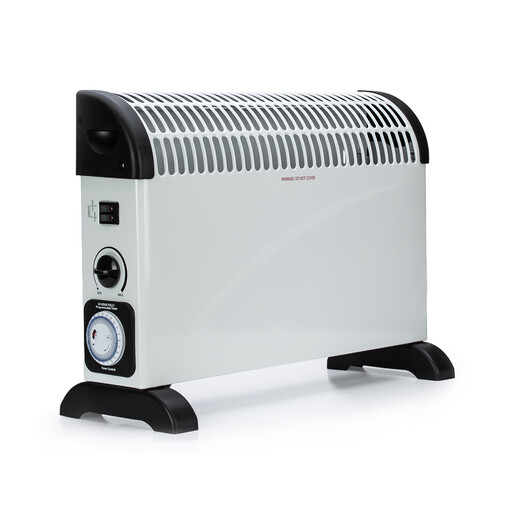
Consider this heater for manually adjusted supplementary warmth. Its stated features include three heat settings, an adjustable thermostat, overheat protection and a carry handle.
Check whether the exact unit has a timer if you need scheduled operation, and allow at least one metre from the seated user, chair and combustible materials.
Yes, it can provide occasional background room warmth if the room and layout are suitable. Do not put it under the desk or close to the chair: keep the seated user, chair and combustible materials at least one metre away.
Not on wattage alone. Consider the room’s insulation, heat loss and how long you use it, then check the exact model’s controls and stated suitability; a higher output does not resolve a lack of safe clearance.
Follow the exact heater’s instructions and avoid overloading an extension lead or socket. Electrical Safety First identifies heaters as high-powered appliances for which overloading can be dangerous; keep the cable where a chair cannot crush it.
The Department for Business and Trade lists UKCA or CE marking routes for electrical equipment placed on the Great Britain market. A mark alone does not establish that a particular listing is genuine or suitable for your room; check the exact model and its instructions.
Check current recall information for the exact model before using it. Electrical Safety First directs consumers to the Office for Product Safety and Standards for current recall information; retain your purchase details so you can identify the unit if needed.