What to check when choosing
For desk-side warmth in a small flat, establish a safe position first. Then consider how quietly the heater needs to run and how much control you want over repeated use.
| Concern |
What to check |
Who this matters to |
| Safe fit and airflow |
Check the model’s required clearance and whether its grilles, feet and cable can be accommodated at the intended position. |
I need room for the heater without crowding it with papers, curtains or furniture; around 40% of consumers put safe placement first. |
| Quiet desk work |
Check whether the model has a fan-assisted mode and what the maker says about operating noise. |
When I am working or on calls, I want background warmth without distracting fan noise; roughly 30% of consumers prioritise quiet desk use. |
| Output and control |
Compare heat settings with the enclosed room and its insulation, then check for a thermostat or timer that suits your routine. |
For regular working hours, I want to control when the heater runs rather than use full output throughout; about 30% of consumers put controllable use first. |
Freestanding convectors on Joybuy
These freestanding convectors offer thermostats and timers for desk-area heating. Check that your intended position meets each model’s instructions before choosing between their controls and heat settings.
 No image available
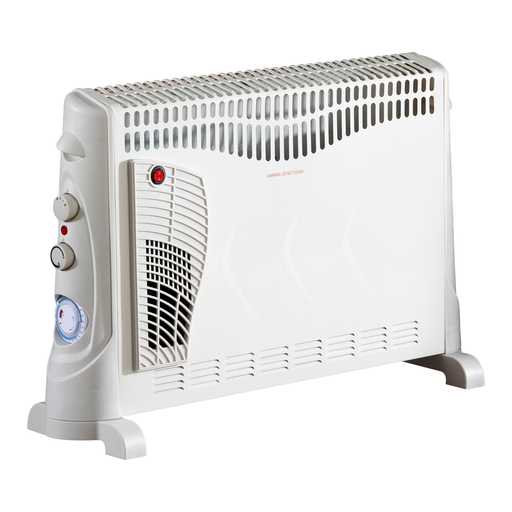
DAEWOO 2000 W convector heater, white
The timer and adjustable thermostat may suit recurring desk sessions if there is enough clearance at the intended position.
The product title lists three heat settings, a timer and overheat protection. Confirm the exact model and applicable heat-setting values before buying.
The product description calls for 1 metre of clearance from combustible materials. Check the instructions for the confirmed model, and check its noise characteristics if quiet work is essential.
View on Joybuy
 No image available
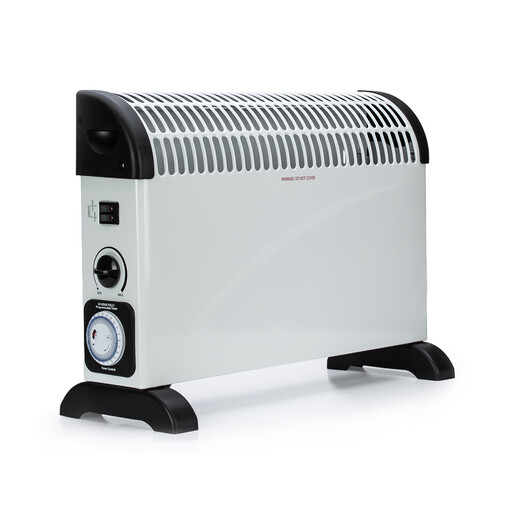
Status 2000 W convector heater, white
The timer and adjustable thermostat may suit a regular desk routine, provided the heater can be positioned with clear airflow.
The product title lists three heat settings. Check the model manual for placement distances near furniture and curtains, and check its noise characteristics if quiet work is essential.
View on Joybuy
Frequently asked questions
What wattage should I choose for a desk area in a small flat?
Choose output for the enclosed room rather than the desk area alone. Insulation, draughts and ceiling height affect the choice; Dimplex states that its 2 kW HeatLite Smart is intended for rooms up to 20 m², but that model-specific figure is not a sizing rule for every heater or room.
Can a convector heater go beside my desk?
Yes, if the position meets the particular model’s clearance and stability instructions. Electrical Safety First advises leaving space above and around portable heaters; keep paper, curtains and furniture away from the grilles.
Can I plug a convector heater into a desk extension lead?
Do not assume the lead or a shared power strip is suitable. Electrical Safety First warns against overloading socket-outlets and extension leads; follow the heater instructions and check the rating of any extension equipment.
Can I leave a portable convector on overnight?
Electrical Safety First recommends against overnight portable-heater use. A thermostat or timer does not replace the model’s operating instructions, and the heater must not be used to dry clothes.
How can I work out a convector heater’s electricity use?
Multiply its power in kW by the hours it operates at that power; multiply the resulting kWh by your electricity unit rate to consider the cost. VonHaus explains that a 1,000 W heater uses 1 kWh in one hour at full power. Thermostat cycling and different heat settings change actual use.


