What matters when choosing?
Start with where the heater can safely stand and how often you use the office. Then compare the exact model's room guidance, controls and operating sounds against your working day.
Portable convector with manual controls
Consider it when: You need to move or store the heater between occasional work sessions. De'Longhi describes the 2 kW HSX2320 as portable spot heating for small and medium rooms.
Trade-off: A manual thermostat needs more attention to your work schedule than a model with weekly programming; room suitability still depends on the space, not wattage alone.
Programmable portable convector
Consider it when: You use the office on a regular schedule and want to set heating periods in advance. Dimplex lists an electronic thermostat and seven-day timer for its ML3TSTie7.
Trade-off: That Dimplex example is rated at 3 kW and has its own room-use conditions; programming does not remove portable-heater placement precautions.
Wall-mounted convector
Consider it when: The office has a permanent wall position with the clearances required by the specific heater, and you want to keep the floor area near the desk free.
Trade-off: You give up easy repositioning. Check the exact model's mounting and electrical instructions before deciding how it would be installed.
| Concern |
What to check |
Who this matters to |
| Temperature and operating time |
Check for a thermostat and whether any timer offers daily or weekly scheduling that fits your work hours. |
If I work here most weekdays, I want to set heating periods rather than remember to switch it each time; around 36% of consumers put scheduled temperature control first. |
| Warmth for the room |
Compare the exact model's room guidance and heat settings with the office's size, insulation and draughts. |
A particularly chilly room makes adequate warmth my main concern, but a larger wattage figure alone will not tell me how the room will feel; roughly 29% of consumers prioritise sufficient room warmth. |
| Distraction during work |
Check whether the exact heater includes a fan and whether a stated noise figure is available for the way you would use it. |
During calls or focused work, I do not want the heater's operating sound close to my desk or microphone; around 21% of consumers put low-distraction operation first. |
| Position and electrical safety |
Check the required clearances, stable-placement instructions and whether the cable reaches a suitable wall socket. |
With furniture and leads around my desk, finding a clear, stable place is my deciding factor; about 14% of consumers make safe placement their primary concern. |
Joybuy product choices
These portable 2 kW convectors offer options for movable home-office heating. Compare their stated controls and check the exact heater's room guidance, plug and placement instructions before choosing.
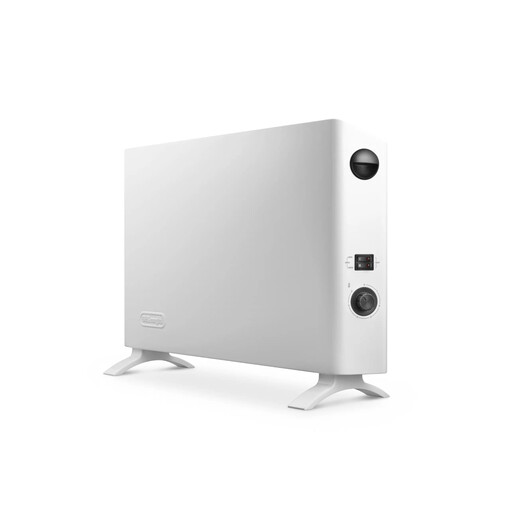 Image unavailable
De'Longhi HSX2320 slim convector, 2000 W
Consider this portable model for occasional supplemental warmth; De'Longhi describes the HSX2320 as spot heating for small and medium rooms.
The product title specifies three heat settings and a thermostat. If scheduled weekday operation matters, check the exact controls before buying. Confirm the plug and follow the model's placement instructions.
View on Joybuy
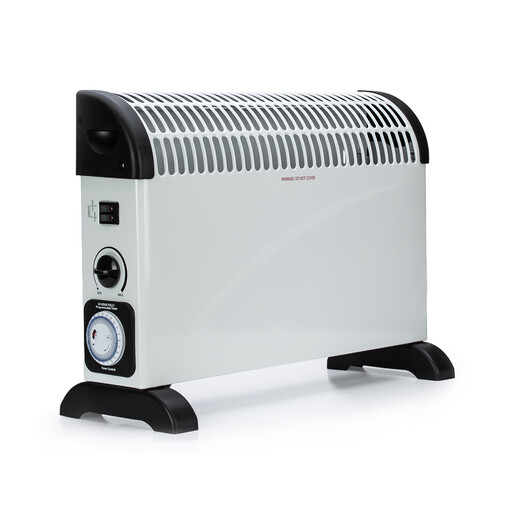 Image unavailable
Status 2000 W convector with thermostat and timer
Consider this portable option if adjustable warmth matters during intermittent desk work.
The product title specifies three heat settings, an adjustable thermostat and a timer. Check how the timer operates if you need a particular schedule, and confirm the plug and clearance instructions for your intended position.
View on Joybuy
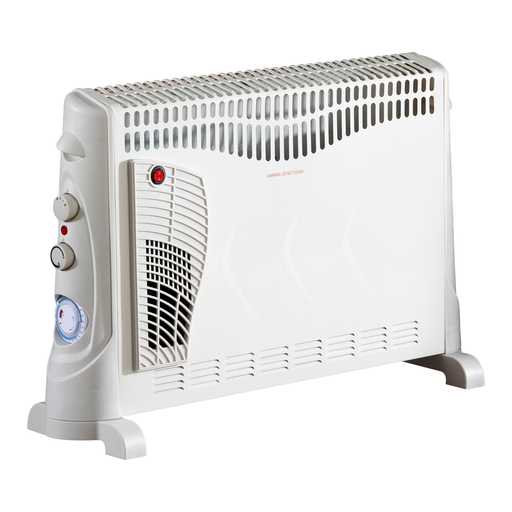 Image unavailable
DAEWOO 2000 W convector with thermostat and timer
Consider this portable option if its timer suits recurring office hours, subject to confirming the supplied variant.
The product title specifies 750 W, 1250 W and 2000 W settings, an adjustable thermostat, a timer and overheat protection. Confirm that these features apply to the supplied model. Follow its instructions for a direct wall socket and clearance from flammable materials, and confirm the plug before buying.
View on Joybuy
Common questions
What output should I choose for a home office?
Choose output using the exact model's room guidance alongside your office's size, insulation and draughts, rather than wattage alone. De'Longhi describes its 2 kW HSX2320 as spot heating for small and medium rooms; Dimplex describes its 3 kW ML3TSTie7 as intended for larger rooms and suitable only for well-insulated spaces or occasional use.
Will a convector heater be quiet enough for video calls?
A non-fan convector is worth considering if operating sound matters, but check the exact model before relying on it for calls. De'Longhi and Dimplex describe convection heating as quiet; those manufacturer descriptions are not comparable noise measurements. Check for a fan function and consider where the heater would sit relative to your microphone.
How much electricity does a convector use?
Electricity use depends on the power setting and how long the heater runs: at continuous full output, a 2 kW heater uses 2 kWh in one hour, while a 3 kW heater uses 3 kWh. A thermostat that cycles the heater or a lower heat setting changes actual use, so compare heaters over the same operating period.
Can I leave a portable convector running overnight or when I go out?
No: Home Office fire-safety guidance says to unplug electric heaters when going out or going to bed, and Electrical Safety First advises against using a portable heater overnight. Keep the heater away from curtains and furniture, leave its grilles clear and never use it to dry clothes.
Can I use an extension lead or cable reel?
Use a suitable wall socket where practical and follow the exact heater's instructions; some models instruct users to connect directly to one. Where an extension is permitted, Electrical Safety First advises checking the combined load against its rating, avoiding daisy-chaining and fully unwinding a cable reel.


