For a small occupied home office, choose a thermostat-controlled convector whose stated room suitability and controls fit your working hours. A portable model suits a layout that changes, while a wall-mounted model calls for a suitable permanent position; neither wattage nor extra controls replace safe placement and clear airflow.
Who a home-office convector suits
Quiet-focus home workers
If calls or concentrated work make noise distracting, look for a thermostat and noise information for the exact model. A timer may help fit heating around desk hours, but quiet operation should not be assumed for every convector.
Flexible room-to-room users
If the office is heated only while occupied and the heater will move elsewhere afterwards, compare carry handles, dimensions and physical controls. Keep the required space around it wherever it is placed.
Fixed-desk setup planners
If the workstation stays in one place, a wall-mounted convector may keep the heater out of circulation paths. Check that the wall position, installation requirements and surrounding clearances work for the room.
What matters when choosing
Start with the room and a safe heater position, then decide which controls suit the hours you spend at your desk.
| Concern | What to check | Who this matters to |
|---|
| Quiet, steady warmth |
Look for a thermostat and noise information for the exact model; compare its stated room suitability with your office. |
When calls and concentration fill my working day, I want background heat without distracting noise; around 26% of consumers would put quiet, steady warmth first. |
| Electricity use |
Compare selectable power settings and thermostat controls, then consider how long the heater will run. |
If I heat the room only during desk hours, I want control over output and running time. Around 26% of consumers would make electricity use their primary concern. |
| Safe occupied-room placement |
Plan space around the heater and a cable route away from walkways; consider overheat and, for freestanding models, tip-over protection. |
With a chair, papers and cables near my desk, I need a heater position that leaves room to work safely; around 21% of consumers would prioritise placement and protective features. |
| Fit and portability |
Measure the intended position, including required clearances, and compare the model’s dimensions, weight and handles. |
If floor space is tight or I move the heater after work, I need it to fit without crowding the desk. Around 16% of consumers would put fit and portability first. |
| Scheduling |
Check whether the model has a daily or weekly timer and whether its controls suit your routine. |
On regular workdays, I want the room warming around my start time without remembering each switch-on; around 11% of consumers would make scheduling their main priority. |
Common buying mistakes
-
Choosing by maximum wattage alone
A higher maximum setting does not establish whether a heater suits the office’s size, insulation or draughts. Continuous full-power use also draws more electricity than a lower setting while each is running.
Measure the room, check the exact model’s stated conditions and consider a thermostat and selectable settings.
-
Fitting the heater into the nearest gap
Blocked grilles restrict airflow, while a desk, papers or furnishings close to the heater can create a hazard. London Fire Brigade advises sitting at least one metre from a heater and keeping it well away from furnishings.
Follow the model’s clearance instructions, leave its vents unobstructed and check the position from your seated workspace.
-
Treating a timer as a safety feature for unattended heating
Scheduling does not correct blocked vents, an unsuitable connection or unsafe placement.
Set up the heater safely before using a timer, switch a portable heater off when it is not needed and follow Electrical Safety First’s advice against overnight use.
-
Judging safety by the listing alone
A product listing is no substitute for the heater’s safety instructions and a suitable electrical connection.
Electrical Safety First advises buying portable heaters from a reputable retailer. Read the instructions before use and retain the purchase record.
Relevant brands to consider
Compare the particular models and their stated conditions rather than treating a brand name as a guarantee of room fit.
Dimplex
Dimplex offers portable 2 kW convectors ranging from dial-controlled models to the timer- and Wi-Fi-equipped HeatLite Smart.
- Dimplex describes the ML2T as portable and thermostat-controlled; its HeatLite Smart has a stated 10–35°C setting range and 24-hour timer.
- Dimplex states that the ML2T is suitable only for well-insulated spaces or occasional use. Its HeatLite Smart room-area claim should be checked against your room’s conditions.
De'Longhi
The HSX2320 is a slim portable convector with physical controls for buyers who expect to move the heater.
- De'Longhi lists 800 W minimum and 2,000 W maximum settings, a room thermostat, 90 mm product depth, 4 kg weight and carry handles.
- If scheduled operation matters, check whether the exact model offers the timer functions you need.
Stiebel Eltron
Its range includes a wall-mounted convector for a fixed layout and a portable programmable model.
- Stiebel Eltron lists a weekly timer and open-window detection for the wall-mounted CNS 200 Trend NC; the portable CNS 2000 Plus LCD Move has a weekly timer and tip-over switch.
- A wall-mounted model requires a suitable installation position and gives up room-to-room portability.
HOMCOM
The portable 820-244V70WT is an option to compare if adjustable temperature and a daily timer matter.
- The Joybuy product page states low, medium and high modes, a 7–35°C setting range and a 24-hour timer.
- Treat its stated 12–18 m² coverage as a product-page claim and check the manual’s placement requirements against your office.
Portable convectors on Joybuy
These portable convectors are options for heating an occupied home office. Compare their controls and physical fit with your working pattern, and plan a position that meets the heater’s clearance instructions.
 No image available
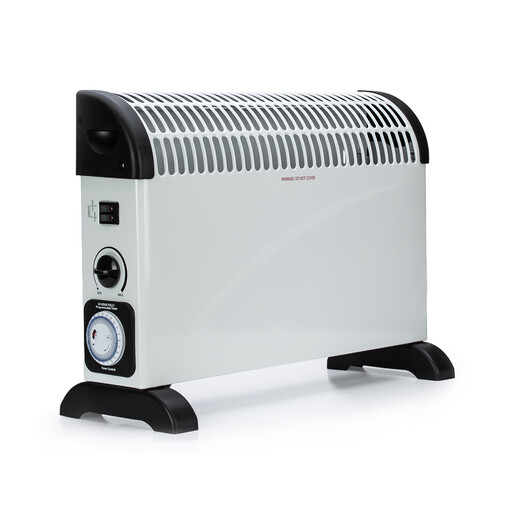
Status 2000 W Convector Heater, White
Consider this portable model if you want adjustable heating during desk hours. Its title specifies three heat settings, an adjustable thermostat and a timer; confirm the timer’s programming options if scheduling is important.
Joybuy
 No image available
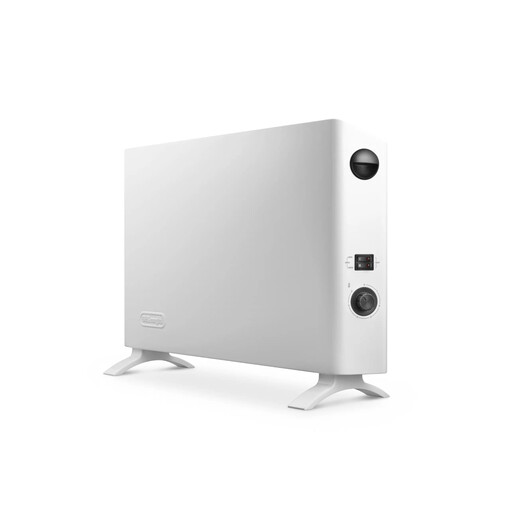
De'Longhi HSX2320 Convector Heater, White
Consider the HSX2320 if physical controls and moving the heater between rooms matter. De'Longhi lists a room thermostat, 800 W, 1,200 W and 2,000 W settings, 90 mm product depth, 4 kg weight and carry handles. Check the clearances needed in your chosen position.
Joybuy
 No image available
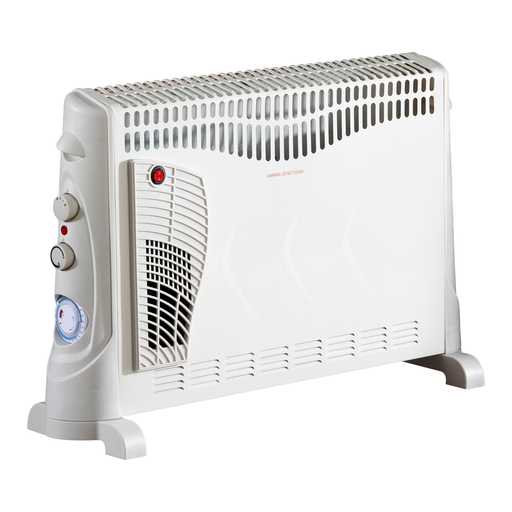
DAEWOO 2000 W Convector Heater, White
Consider this model if a daily heating routine calls for a timer. Its title specifies 750 W, 1250 W and 2000 W settings, an adjustable thermostat, a timer and overheat protection. Check its dimensions and placement instructions against your office before choosing it.
Joybuy
Home-office convector questions
Should I leave a portable convector on overnight?
No. Electrical Safety First advises against overnight use of portable heaters. A thermostat or timer does not replace the manufacturer’s safety instructions.
How far should my desk chair be from the heater?
London Fire Brigade advises sitting at least one metre from a heater and keeping it well away from curtains and furniture. Apply the heater’s own clearance instructions to its position near your desk, papers and chair.
Can I plug a convector heater into an extension lead?
Check the heater manufacturer’s instructions and the electrical arrangement before using one. Electrical Safety First warns that overloading an extension lead, reel or adaptor can cause overheating; a suitable wall socket avoids relying on an overloaded extension arrangement.
How much electricity does a 2 kW convector use?
A heater drawing 2 kW continuously for one hour uses 2 kWh of electricity. Actual use depends on the selected setting, how long the heater draws power and any thermostat cycling.


