Choose a portable convector with an adjustable thermostat, suitable heat settings and overheat protection if you want relatively quiet warmth across a small shared lounge rather than a short burst of directional heat. Electrical Safety First notes that convectors tend to warm a room more slowly than fan heaters, so check the exact model’s room-size guidance and make sure there is a clear, safe place to use it. A timer may suit a regular routine, but it does not replace safe placement or supervision.
Who might use one?
People balancing shared comfort
When several people use the lounge, a thermostat and adjustable heat settings make it easier to respond to different comfort preferences. A convector may also suit conversations or television viewing where fan noise would be distracting; Dimplex describes its ML2T as near-silent.
People planning a safe position
A movable heater needs space around its air openings and a position away from furnishings and busy walkways. Electrical Safety First advises leaving clear space around portable heaters; the instructions for the Dimplex ML2T also warn against blocked openings and set supervision conditions for occupants unable to leave a small room unaided.
People heating the lounge at regular times
A timer or electronic thermostat may be useful when the lounge is occupied on a predictable schedule. Check how the controls work on the exact model: Dimplex lists smart controls on its DXCV2002, while its ML2T instructions describe background heating intended to complement a principal heat source.
What matters when choosing?
For a small occupied shared lounge, find a safe operating position before comparing warmth, controls and storage.
| Concern | What to check | Who this matters to |
|---|
| Placement and supervision |
Check the model’s required clearances and overheat protection. Plan for occupants who may need supervision around a portable heater. |
If I cannot keep the heater clear of furniture and people moving through the lounge, convenience features come second. Around 37% of consumers put safe placement and supervision first. |
| Quiet shared comfort |
Check whether the model is fan-assisted and whether its stated room-size guidance fits the lounge. |
I want to take the chill off while people talk or watch television, rather than direct a strong stream of hot air at one seat. Quiet shared comfort comes first for around 27% of consumers. |
| Temperature and timing |
Compare thermostat and heat-setting controls; check what any timer can actually schedule. |
When we use the lounge at regular times, I want controls everyone can understand without leaving the heater running unnecessarily. Around 18% of consumers make routine control their primary concern. |
| Footprint and portability |
Check dimensions, handles and cable length against a position that still allows the required operating clearance. |
Limited floor space means I may need to move or store the heater between uses, but it still needs room around it when switched on. For around 18% of consumers, fitting and moving it is the first priority. |
Common buying mistakes
-
Choosing by maximum wattage alone
A 2kW rating cannot, by itself, establish the right fit for a small lounge. Dimplex and Russell Hobbs give room-size guidance for particular models, not a sizing rule for every convector.
Compare the exact model’s guidance and controls with the lounge’s size, insulation, draughts and intended use.
-
Relying on overheat protection instead of clear airflow
Protection features do not make it safe to cover a heater or obstruct its grilles. The Dimplex ML2T instructions explicitly warn against blocking air inlets and outlets.
Follow the model’s clearance instructions and keep its openings free of furniture, clothing and other objects.
-
Putting an overloaded extension arrangement where a socket is inconvenient
Electrical Safety First warns that appliances can overload an extension lead, cable reel or adaptor when their combined load exceeds its marked current rating.
Plan for an accessible wall socket. If an extension is being considered, check both the heater instructions and the extension device’s rating; do not daisy-chain extension devices.
-
Assuming a timer makes overnight use safe
A timer changes when the heater operates; it does not provide clearance, check the electrical connection or supervise occupants. Electrical Safety First recommends against using portable heaters overnight.
Use scheduling only within the model’s instructions and the household’s supervision arrangements.
Convector brands for reference
Dimplex
Dimplex offers portable convectors with different levels of control, from the manual ML2T to the smart DXCV2002.
- Dimplex lists a rotary thermostat, carry handles and overheat protection for the ML2T; its DXCV2002 listing describes a timer, adjustable temperature settings and app control.
- These features depend on the model. The ML2T instructions describe it as background heating for well-insulated spaces or occasional use, ideally alongside a principal heat source.
Russell Hobbs
The RHCVH4002 is a freestanding convector aimed at buyers who want manual heat adjustment and a timer.
- Russell Hobbs lists 0.75kW, 1.25kW and 2kW settings, an adjustable thermostat and an integrated timer for this model.
- Its stated suitability for rooms up to 20m² applies to the RHCVH4002 listing; check the exact variant and your lounge rather than extending that claim to other models.
STIEBEL ELTRON
Its convector range includes freestanding auxiliary heaters and wall-mounted models with different controls.
- STIEBEL ELTRON describes the CNS 2000 Plus LCD move as a freestanding auxiliary or interim heater.
- Check installation and power-connection requirements by exact model: a wall-mounted convector should not be treated as an interchangeable portable plug-in heater.
Joybuy portable convectors
These portable convectors relate to taking the chill off a shared lounge. Compare their controls with the room and the position where you would use the heater; a model name alone cannot establish room suitability.
 No image available
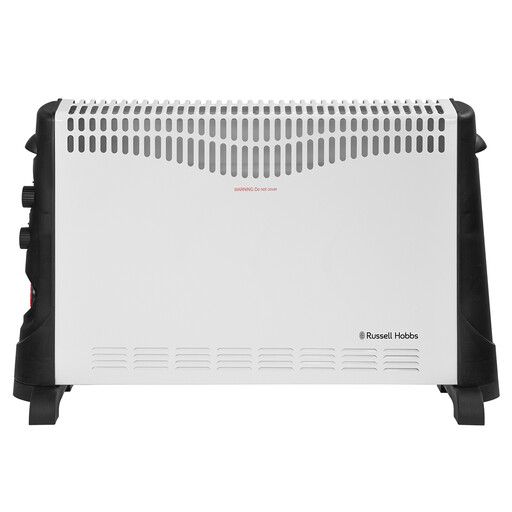
Russell Hobbs RHCVH4002 (EU) 2kW Convection Heater
Consider this model if you want a portable convector for scheduled periods in the lounge. Its title identifies the 2kW RHCVH4002 (EU) variant; check that its plug and market specification suit your intended use before buying.
Compare its room-size guidance with the actual lounge, and follow its instructions for a direct wall-socket connection and clear space around the heater.
View on Joybuy
 No image available
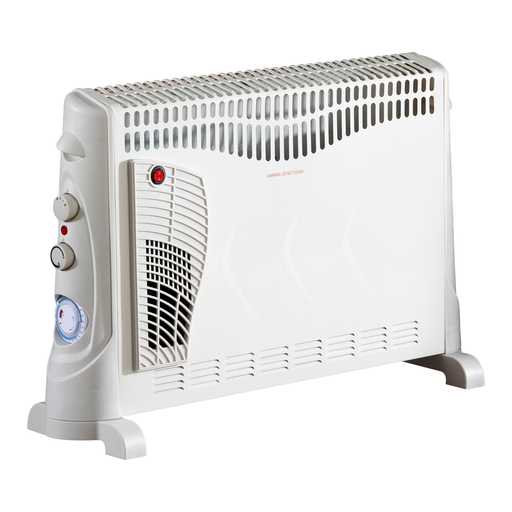
DAEWOO 2000W Convector Heater with Timer
Consider this freestanding model when occupants want adjustable heat rather than a fixed output. Its title specifies three settings—750W, 1250W and 2000W—an adjustable thermostat, a timer and overheat protection.
Check its fit and plug specification for the intended room and socket. Follow the product’s direct wall-socket and clearance instructions; overheat protection is not a reason to obstruct it.
View on Joybuy
 No image available
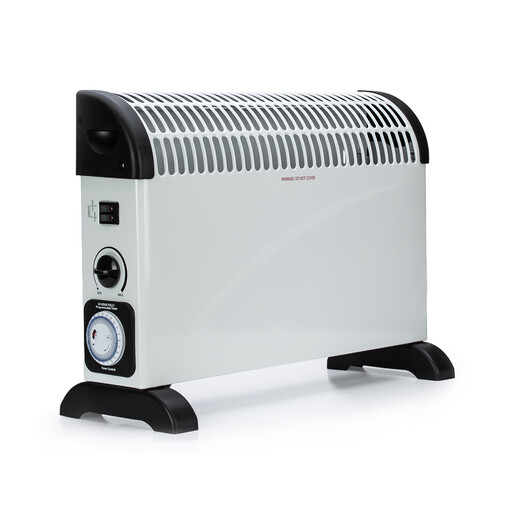
Status 2000W Convector Heater with Timer
Consider this movable convector if adjustable heat is a priority. Its title identifies three heat settings and an adjustable thermostat, but check the timer’s operating details before depending on a particular schedule.
Confirm the model’s room-size suitability and a placement that meets its clearance and supervision instructions.
View on Joybuy
Questions about shared-lounge use
Is a convector suitable for a small shared lounge?
A convector can suit a shared lounge when you want relatively quiet room-air heating and can leave the required space around it. Electrical Safety First notes that convectors tend to warm a room more slowly than fan heaters; check the exact model’s room-size guidance instead of assuming its wattage establishes a good fit.
Which safety features and instructions matter most?
Look for overheat protection, then follow the exact heater’s placement, airflow and supervision instructions. The Dimplex ML2T instructions prohibit covering or blocking its openings and require constant supervision if a small room is occupied by someone unable to leave unaided.
Can I use an extension lead with a convector?
Use an accessible wall socket where possible and follow the heater’s instructions; some models call for a direct wall-socket connection. Electrical Safety First warns against exceeding an extension device’s marked current rating, so check its suitability and the combined load rather than assuming a spare socket makes it safe.
Does a timer make overnight use safe?
No. Electrical Safety First recommends against using a portable heater overnight. A timer does not replace the model’s placement instructions or the supervision needed by people using the room.


