A portable convector can provide occasional, supplemental warmth in a student room, but it will not fix a persistently cold or damp wall. Choose one only if its room guidance and controls suit your space and you can leave clear space around it. Report persistent condensation, damp or mould to your accommodation provider or landlord rather than relying on a heater alone.
Who might use a convector heater?
Students seeking background warmth
A convector may suit a bedroom or study space where a fan heater’s noise would be distracting, provided there is clear space around the unit. Electrical Safety First says convectors need clear space above and around them to work effectively.
Students heating the room for short periods
If you mainly need extra warmth while studying or before settling down for the evening, an adjustable thermostat can help you control the heat. A timer may be useful for planned periods when you are present, but not for leaving a portable heater running unattended.
Students concerned about a cold or damp wall
Supplemental heating may make the room more comfortable while a persistent condensation, damp or mould problem is assessed. Report the condition to your accommodation provider or landlord; heating the air does not repair the underlying wall issue.
What matters when choosing one?
Check whether a convector suits the room and has a safe place to stand before comparing controls. If the wall is persistently damp or mouldy, report that problem as well as considering temporary warmth.
| Concern |
What to check |
Who this matters to |
| Room coverage and heat loss |
Compare the exact model’s stated room coverage with your room’s size, and check any limits for poorly insulated spaces or occasional use. |
If my room loses heat through a cold wall, I need to know whether the heater’s stated coverage is relevant to it. Around 33% of consumers put room fit first. |
| Safe placement |
Check for overheat protection and a suitable UK plug, then make sure you can leave clear space above and around the heater, away from bedding and curtains. |
In a furnished room, I need a position that leaves the heater unobstructed rather than simply out of the way. Safe placement comes first for around 25% of consumers. |
| Noise during study |
Look for noise information for the exact model where available; weigh quieter background heating against a convector’s more gradual room warming. |
When I am revising or taking a call, I want background warmth without distracting fan noise. Around 25% of consumers primarily seek quieter heating. |
| Temperature and scheduling |
Prioritise an adjustable thermostat; consider a timer for planned periods when you are present, following the model’s instructions. |
If I only heat the room while I am using it, I want controls that suit those shorter periods. For around 17% of consumers, control is the primary need. |
Mistakes to avoid
-
Expecting a heater to fix a damp wall
A convector warms room air; it does not repair damp, mould or a building defect. For England, GOV.UK guidance says landlords should tackle the underlying cause of reported damp and mould promptly.
Use the heater for supplemental warmth and report persistent condensation, damp or mould to your accommodation provider or landlord. Keep a record of the report.
-
Choosing by wattage alone
The same maximum output does not give every model the same stated room coverage. Dimplex, for example, says its ML2T is suitable only for well-insulated spaces or occasional use.
Measure your room and check the exact model’s coverage guidance, heat settings and suitability conditions before buying.
-
Squeezing a slim heater into a tight gap
Electrical Safety First says convectors need clear space above and around them. UK government fire-safety advice also says to keep heaters away from curtains and furniture and never use them to dry clothes.
Choose a position clear of bedding, clothes, furniture and escape routes before deciding which heater will fit.
-
Treating a timer as unattended-use protection
A thermostat or timer does not remove the need for safe placement and supervision. UK government fire-safety guidance advises unplugging electric heaters when going out or going to bed.
Plan heating for periods when you are present, and follow the model’s instructions and your accommodation rules.
Brands for reference
Dimplex
The ML2T is a conventional 2 kW convector with a rotary thermostat that Dimplex describes as near-silent.
- For the ML2T, Dimplex lists carry handles, frost protection and overheat protection.
- Dimplex states that this model is suitable only for well-insulated spaces or occasional use, a significant qualification for a room with cold walls.
De'Longhi
The HSX2320 is a slim convector with selectable output and a room thermostat for occasional supplemental heating.
- De'Longhi lists an 800 W minimum and 2,000 W maximum setting for the HSX2320.
- De'Longhi’s descriptions of fast, even and silent convector heating are brand claims, not a measure of how this model will perform in a cold-walled room.
Russell Hobbs
The RHCVH4002B provides model-specific room-size guidance alongside an integrated timer and thermostat.
- Russell Hobbs lists 0.75, 1.25 and 2 kW settings, overheat protection and tip-over protection for the RHCVH4002B.
- Its stated suitability for rooms up to 20 m² applies to this model; it does not guarantee comfort in a poorly insulated room.
Joybuy convector heaters
These portable convectors are options for supplemental warmth during occupied periods. Compare their controls and the space each needs, then check room suitability and accommodation rules before use.
 No image available
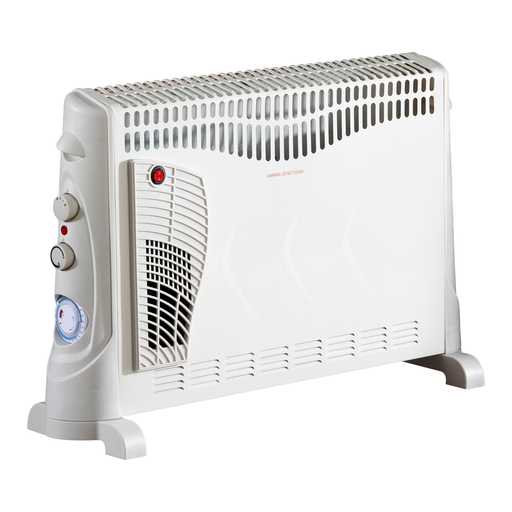
DAEWOO 2000 W Convector Heater, White
Consider this portable convector for planned heating periods if its controls suit the variant offered. The product name lists 750 W, 1,250 W and 2,000 W settings, an adjustable thermostat, a timer and overheat protection; confirm the exact model and its features before buying.
Check whether its room guidance suits your space and whether it has a UK 3-pin plug. Leave clear space around it when in use.
Joybuy
 No image available
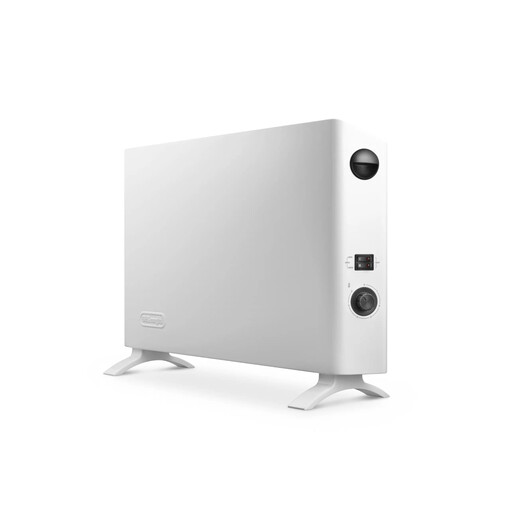
De'Longhi HSX2320 Convector Heater, White
This slim model suits consideration for occasional supplemental heating where adjustable output matters. De'Longhi lists an 800 W minimum, a 2,000 W maximum and a room thermostat for the HSX2320.
Check its room guidance against your room’s size and heat loss, and confirm the plug type. Allow clear space for convection airflow; do not assume a heater will resolve a persistently cold or damp wall.
Joybuy
 No image available
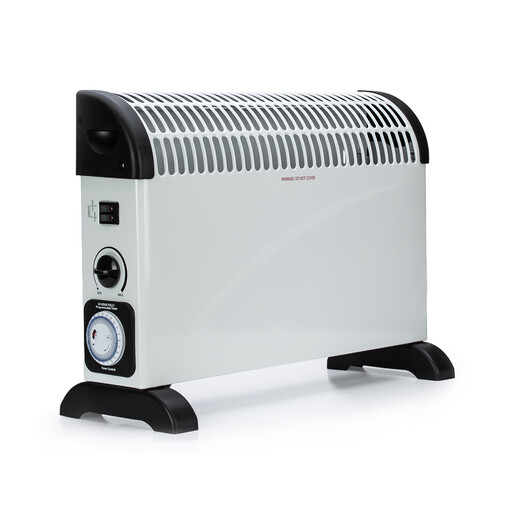
Status 2000 W Convector Heater, White
Consider this portable model if adjustable heat and a thermostat meet your needs for supplemental room heating. The product name lists three heat settings and an adjustable thermostat.
The product name also mentions a timer, so confirm that feature for the exact unit before relying on scheduled operation. Check room suitability and the plug type, and keep its vents clear.
Joybuy
Common questions
Will a convector heater fix a cold wall?
No. A convector can add warmth to the room air but cannot repair damp, mould or a building defect. Report persistent condensation, damp or mould to your accommodation provider or landlord; GOV.UK guidance for England says landlords should tackle the underlying issue promptly.
Can I leave a portable convector on overnight?
Do not plan to leave it running while you sleep. UK government fire-safety guidance advises unplugging electric heaters when going to bed or going out; also follow the heater’s instructions and your accommodation rules.
How can I tell whether a convector will suit my room?
Compare the exact model’s stated room-size or volume guidance with your measured room, then consider whether cold walls or draughts may increase heat loss. A maximum wattage alone is not a room-coverage guarantee: Russell Hobbs states up to 20 m² for its RHCVH4002B, while Dimplex limits its ML2T to well-insulated spaces or occasional use.
Which safety features should I check for a student room?
Check for a suitable UK 3-pin plug and overheat protection; tip-over shut-off is another feature to consider where offered. These features do not replace safe placement: Electrical Safety First says convectors need clear space above and around them, and UK government advice says to keep heaters away from curtains and furniture and never use them to dry clothes.


