Choose a thermostat-controlled convector for occasional or supplementary bedroom warmth only if you can position and use it safely. If the walls stay cold or develop condensation or mould, a portable heater is not a remedy for the underlying problem: ventilation and the cause of the cold surface need attention too. A timer or smart control is worth considering when its schedule fits your routine, but it does not make unattended overnight use of a portable heater appropriate.
Who might consider one?
People needing occasional bedroom warmth
A portable convector may provide top-up heat when the bedroom is uncomfortable at particular times and there is already a principal heating source. Dimplex describes its ML portable convectors as ideally used alongside principal heating and suitable only for well-insulated spaces or occasional use; check the intended use of any model you choose.
Households noticing cold walls and condensation
If a bedroom wall is damp or develops mould, decide how to address the moisture as well as how to warm the room. The Ministry of Housing, Communities and Local Government explains that moisture can condense on cold walls when ventilation is ineffective.
People with a regular bedroom routine
If warmth is needed at predictable times, compare thermostat and timer controls with a basic manually controlled heater. Check that the particular timer can be set for the routine you need, without planning to leave a portable heater running while you sleep.
What matters when choosing?
Start with the purpose of the heat: a freestanding convector offers movable top-up warmth, while a wall-mounted model calls for a suitable fixed position. Then check the controls and whether either format can be used safely in your bedroom.
Manual freestanding convector
Consider it when: You need occasional top-up heat and can switch off and unplug the heater before bed or when leaving.
Trade-off: Manual controls do not provide a scheduled bedroom routine, and portable warmth does not address a persistently cold or damp wall.
Timed freestanding convector
Consider it when: You want supplementary warmth at predictable times and the exact model offers a timer that suits your schedule.
Trade-off: Scheduling adds convenience, not permission to leave a portable heater unattended overnight.
Wall-mounted convector
Consider it when: Floor space is limited and you can arrange a suitable fixed installation for repeated use.
Trade-off: It cannot be moved between rooms like a freestanding heater and will not, by itself, resolve cold-wall condensation.
| Concern |
What to check |
Who this matters to |
| Cold walls and moisture |
Decide whether you need occasional warmth or an ongoing heating arrangement; investigate recurring condensation, mould or water ingress separately. |
If my bedroom wall keeps collecting moisture, warming the air alone is not the whole answer. Around 44% of consumers would make the cause of cold walls and condensation their primary concern. |
| Timing and control |
Check the exact model’s thermostat and whether its timer offers the daily or weekly schedule you need. |
When I use the bedroom at predictable times, I want warmth to match that routine without running the heater longer than needed. For around 33% of consumers, scheduled comfort would come first. |
| Safe bedroom placement |
Check the manual’s clearance rules and plan a stable location away from bedding, with access to a wall socket. |
With bedding, curtains and furniture nearby, I need somewhere the heater can stand clear and be unplugged before sleep. Safe placement would be the main priority for around 23% of consumers. |
Mistakes to avoid
-
Treating temporary heat as the only answer to damp walls
A convector warms room air, but moisture can still condense on cold surfaces when ventilation is ineffective, as the Ministry of Housing, Communities and Local Government explains.
Consider ventilation and moisture sources before relying on longer heater use. Investigate recurring mould, leaks or persistent damp.
-
Planning to leave a portable heater on beside the bed
Bedding and other furnishings make the heater’s position important. Merseyside Fire & Rescue Service advises keeping electric heaters away from bedding and unplugging them when going to bed or going out.
Before buying, identify a stable, clear position with an accessible wall socket and follow the model’s placement instructions.
-
Covering the heater to dry clothes
Covering a convector or obstructing its openings conflicts with the Dimplex ML heater instructions. A portable heater should not be used as a clothes-drying rack.
Keep its air openings clear and dry laundry another way.
-
Choosing by the 2 kW figure alone
Matching output figures do not establish that two models suit the same bedroom. Dimplex describes its HeatLite Smart as suitable for rooms up to 20 m², while its ML portable-heater instructions limit those heaters to well-insulated spaces or occasional use.
Check guidance for the exact model, alongside its controls, installation format and intended use, rather than treating the wattage as a room-size guarantee.
Running a heater for long periods to compensate for heat loss also increases electricity use.
Brands to consider
These brands illustrate different convector formats and controls. The features below belong to the named models or ranges, not to every heater carrying the brand.
Dimplex
Offers portable convectors with basic controls and timer options, including the HeatLite Smart.
- Dimplex lists a 2 kW output, 10–35°C settings and a 24-hour timer for the HeatLite Smart.
- Its ML portable-convector instructions describe those heaters as suitable only for well-insulated spaces or occasional use, ideally alongside principal heating.
De'Longhi
The freestanding HSX2320 is a slim, mechanically controlled option for supplementary room heating.
- De'Longhi specifies a room thermostat, 800 W minimum and 2,000 W maximum heating power, and a 90 mm product depth for the HSX2320.
- If scheduled heating matters, check for the timer you need rather than assuming this manually controlled model provides it.
Princess
The portable 345168 combines selectable heat settings with a thermostat, timer and turbo function.
- Princess specifies 750 W, 1,250 W and 2,000 W settings for the 345168.
- A turbo function is not a remedy for a cold wall or proof that the heater suits every room size.
Stiebel Eltron
The CNS 200 Trend NC is a fixed wall-mounted route for a repeat-use bedroom setup.
- Stiebel Eltron lists a weekly timer, frost protection, open-window detection and overheating protection for this model.
- A suitable fixed installation position is needed, and the heater cannot be moved between rooms like a freestanding model.
Freestanding convectors on Joybuy
These freestanding models are options for supplementary bedroom warmth. Compare their controls and placement requirements against your routine; none should be treated as a fix for persistent cold walls or damp.
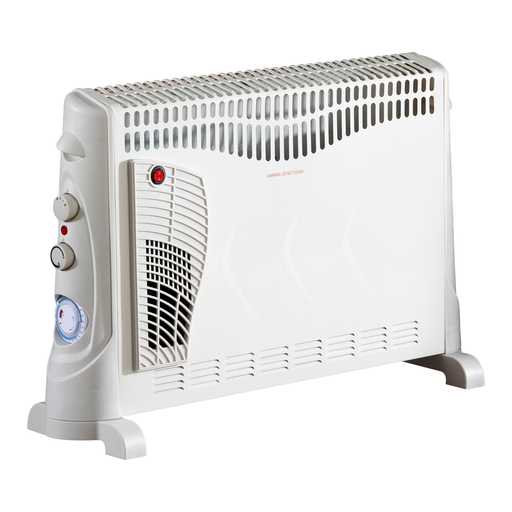 Image unavailable
DAEWOO 2000W Convector Heater with Thermostat and Timer
Consider this for adjustable, supplementary warmth if you have a safe floor position in the bedroom.
The product name lists 750 W, 1,250 W and 2,000 W settings, an adjustable thermostat, a timer and overheat protection. Confirm that the stated controls apply to the exact supplied variant, particularly if timed operation is important.
Follow the listing’s instruction to keep the heater at least 1 metre from combustible materials. Use a wall socket and switch off and unplug it before bed or when leaving.
View on Joybuy
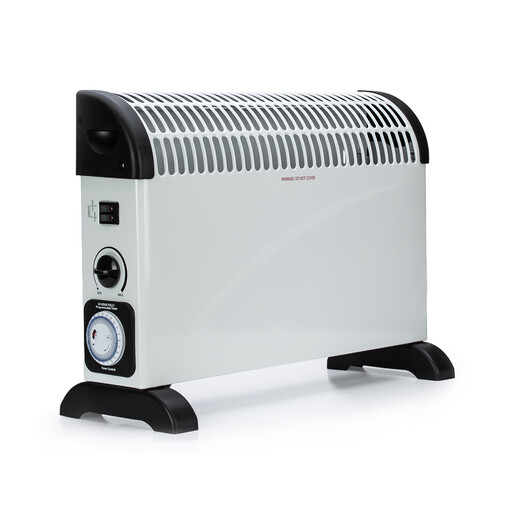 Image unavailable
Status 2000W Convector Heater with Thermostat and Timer
Consider this portable model when you want adjustable top-up warmth and room to position a freestanding heater safely.
Its product name lists three heat settings, an adjustable thermostat and a timer. If heating to a schedule is essential, check the timer’s type and operation for this model before choosing it.
Keep it away from bedding and other combustible materials, and switch it off and unplug it before sleep or when leaving the room.
View on Joybuy
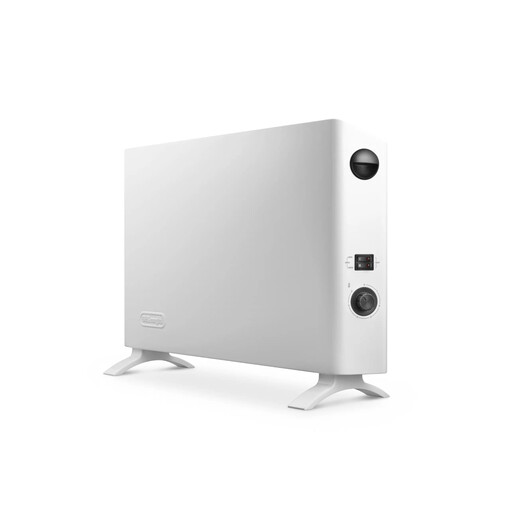 Image unavailable
De'Longhi HSX2320 Slimline Convector Heater
Consider the HSX2320 for simple, thermostat-controlled top-up heat where a slim freestanding body helps with placement.
De'Longhi specifies 800 W minimum and 2,000 W maximum heating power, a room thermostat and a 90 mm product depth for this model. Check the applicable room guidance for your bedroom rather than relying on a room-volume claim alone; if you need scheduling, confirm the controls before buying.
Allow safe clearance from bedding and curtains, plug into a wall socket, and unplug before bed or when leaving.
View on Joybuy
Questions about bedroom use
Will a convector heater solve cold walls or condensation?
No: a convector may warm the room, but it does not resolve the cause of a persistently cold or damp wall. The Ministry of Housing, Communities and Local Government explains that moisture can condense on cold walls when ventilation is ineffective, so investigate recurring moisture or mould as well as your heating needs.
Can I leave a portable convector running while I sleep?
Do not plan to leave a portable heater running while you sleep. Merseyside Fire & Rescue Service advises unplugging electric heaters when you go to bed or go out and keeping them away from bedding; also follow the exact model’s instructions.
Can I use an extension lead for a portable convector?
Plug a portable electric heater into a wall socket rather than an extension lead. This follows Merseyside Fire & Rescue Service’s home-heating guidance; make sure a suitable socket is accessible from the heater’s safe position.
How much electricity does a 2 kW convector use?
A heater drawing its full 2 kW input for one hour uses 2 kWh of electricity. Actual use depends on how long it runs and whether its thermostat or lower settings reduce the input during that time; the 2 kW rating alone does not tell you how much electricity a bedroom routine will use.


