Choose a convector with a thermostat, room-suitability guidance and a safe place to stand in the shared lounge. A timer or remote may make shared controls easier, but a convector warms room air progressively and cannot resolve condensation on cold walls without effective ventilation and moisture management.
Who this is for
People coordinating heat in a shared lounge
When several people use the room, straightforward controls and a stable position away from movement matter alongside warmth. Warwickshire Fire and Rescue Service advises placing portable heaters safely and plugging them directly into a wall outlet.
Households concerned about cold walls and condensation
If moisture gathers on cold surfaces, heating and ventilation need separate attention. Government home-ventilation guidance explains that trapped indoor moisture can condense on cold walls.
People with limited clear floor space
A furnished lounge may leave few suitable positions for a portable heater. Check the appliance dimensions alongside the clear space its instructions require; Electrical Safety First says convection heaters need space above and around them.
What to check before buying
Start with the lounge’s size and available safe position, then decide whether shared controls or a slimmer body would make daily use easier.
| Concern |
What to check |
Who this matters to |
| Warmth across the room |
Compare each model’s stated room suitability with the lounge’s size, insulation and draughts; check its thermostat and output settings. |
I want warmth across the lounge rather than heat aimed at one seat. Around 36% of consumers would put whole-room warmth first. |
| Safe placement |
Find a flat position clear of walkways and furnishings, with enough space around the heater and a direct wall socket. |
People regularly cross the room, so I need somewhere the heater can stand without obstructing them. Safe placement would come first for around 29% of consumers. |
| Shared controls |
Compare thermostat controls and heat settings; consider whether a timer or remote suits the room’s routine. |
Several of us adjust the heat, and I want controls we can use without moving the heater. Around 21% of consumers would make ease of control their primary concern. |
| Limited floor space |
Check the heater’s depth and required clearances together; a slim body still needs unobstructed airflow. |
Furniture leaves little open floor space, but I cannot put a heater tight against it. Compact placement would be the main concern for around 14% of consumers. |
Buying pitfalls
-
Expecting a convector to fix damp
Heating the air does not remove trapped moisture. Government home-ventilation guidance explains why condensation can still form where moist air meets cold walls.
Keep designed ventilation open and unblocked, and address persistent damp or mould separately from the heating choice.
-
Choosing a heater before finding its position
A convenient-looking gap may be too close to furniture or a walkway, or too far from a suitable wall socket.
Check the model’s clearance instructions and identify a flat, stable position. Warwickshire Fire and Rescue Service advises plugging portable heaters directly into a wall outlet rather than an extension lead or power strip.
-
Assuming every 2kW model suits the same lounge
Output alone does not establish how a heater will work in a particular room. Manufacturer room-suitability statements apply to their respective models, while insulation and draughts affect the choice.
Compare the exact model’s guidance with the lounge and choose thermostat and output controls that suit how the room is used.
-
Treating a timer as permission to leave the heater unattended
A timer changes when the heater operates; it does not make an obstructed or unattended portable heater safe.
Follow portable-heater safety guidance and switch off and unplug the heater when leaving the room or going to bed.
Brands to consider for this use
Dimplex
Dimplex lists both straightforward portable convectors and models with additional controls. Its ML2T and DXCV2002 illustrate different choices within the range.
- Dimplex describes the ML2T as a 2kW model with a rotary thermostat and frost protection; it lists app control and a 24-hour timer for the DXCV2002.
- Dimplex says the ML2T is suitable only for well-insulated spaces or occasional use. Do not treat it as a remedy for a persistently cold or damp lounge.
De'Longhi
De'Longhi’s portable-heater range includes slimline convectors; the HSX2320 is a relevant model when floor depth is a constraint.
- De'Longhi lists 800W to 2000W settings, room and safety thermostats, carry handles and a 90mm body depth without castors for the HSX2320.
- A slim body does not reduce the clearance required around a heater. Check the HSX2320’s instructions and the lounge’s heating needs before choosing it.
Russell Hobbs
Russell Hobbs lists portable convectors with selectable heat modes and digital controls, including the RHCVH2003.
- For the RHCVH2003, Russell Hobbs lists 800W, 1200W and 2000W modes, a thermostat, remote, 24-hour timer, overheat protection and a tip-over switch.
- Russell Hobbs states suitability for rooms up to 20m² for that model. Check the actual lounge and its insulation rather than transferring that figure to another heater.
Convector heaters for the lounge
These Joybuy convectors offer adjustable supplementary heat for a shared lounge. Compare their controls and dimensions with the room, and establish a safe position before choosing.
 No image available
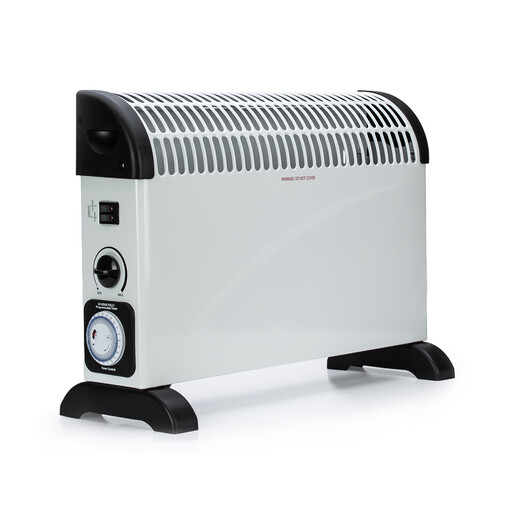
Status 2000W Convector Heater with Thermostat and Timer, White
Consider this portable convector when adjustable supplementary heat is the priority. Its title specifies three heat settings, an adjustable thermostat and a timer; confirm how the timer works if scheduling matters.
Compare the manufacturer’s room guidance with the lounge’s size and heat loss before choosing a position with adequate clearance.
View on Joybuy
 No image available
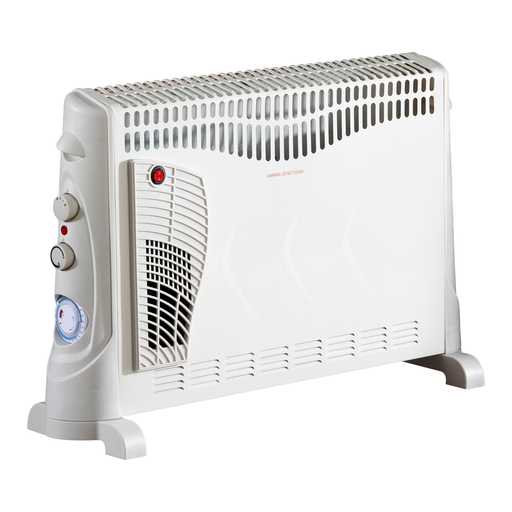
DAEWOO 2000W Convector Heater with Thermostat and Timer, White
Consider this model if a timer and adjustable heat settings suit the lounge’s routine. Its title lists 750W, 1250W and 2000W settings and overheat protection; a timer does not make unattended use safe.
Confirm the exact supplied model and its room and clearance guidance, including whether a suitable direct wall socket is available.
View on Joybuy
 No image available
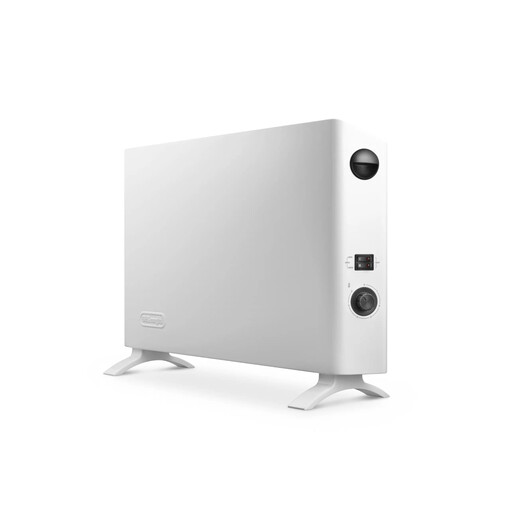
De'Longhi HSX2320 2000W Slimline Convector Heater, White
Consider the HSX2320 where usable floor depth is limited but the heater can still have the clearance its instructions require. De'Longhi specifies a 90mm body depth without castors, 800W to 2000W settings and a room thermostat.
Check its room-suitability guidance against the lounge; a slim profile alone does not establish whole-room heating suitability.
View on Joybuy
Common questions
Will a convector heater fix condensation on a cold wall?
No. A convector can warm the room, but Government home-ventilation guidance explains that trapped indoor moisture can still condense on cold surfaces. Keep designed ventilation open and unblocked, and address persistent damp or mould separately.
Can I plug a portable convector into an extension lead?
Use a direct wall outlet instead. Warwickshire Fire and Rescue Service advises against extension leads and power strips for portable heaters; check that a suitable socket is available at the heater’s safe position.
Does a timer make overnight heating safe?
No. A timer is a scheduling control, not a substitute for attending to a portable heater. Follow portable-heater safety guidance and switch it off and unplug it when going to bed or leaving the room.
Can a slim convector sit against a sofa or wall?
Only place it as close as the exact model’s instructions permit. Electrical Safety First says convection heaters need clear space around and above them; keep airflow unobstructed and furnishings clear even when the heater has a slim body.


