Who needs to check what?

Students in halls with equipment restrictions

Check whether your residence permits a personal heater before comparing models. The University of St Andrews prohibits heaters in study bedrooms unless residences provide them, while the University of Manchester lists portable heaters as banned in halls. Your own provider’s current rules determine what you can use.

Private-rental students seeking background warmth

If your tenancy permits a portable heater, compare a thermostat and selectable settings for temperature control. A timer may be useful when you want to set heating periods, but it does not remove the need to turn the heater off when you leave or go to sleep.

Bedroom users who value quiet, movable heating

A convector may appeal if you want gradual room-air warming rather than a directed blast. Electrical Safety First notes that convection heaters warm a room more slowly and need clear space above and around them; check that your room has a suitable position before choosing a portable model.

What matters when choosing?

Start with permission and a safe place to use the heater. Once those are settled, compare the controls and physical fit against the way you expect to heat the room.

Concern What to check Who this matters to
Accommodation permission Read your current residence or tenancy rules; ask about portable heaters and any appliance or wattage limits. If I live in halls, I need to know whether I can use my own heater before ordering one. Around 36% of consumers put permission first.
Safe bedroom use Look for documented overheat protection and a position with clear airflow, away from bedding, curtains and furniture. In a crowded bedroom, I need a place where a heater will not sit against clothes or furnishings. For around 29% of consumers, safe placement is the primary concern.
Running-cost control Compare selectable wattages, thermostat and timer controls; assess likely use against your own electricity tariff. If I only need warmth while studying, I want control over output and heating time. Around 21% of consumers prioritise electricity use.
Quiet use and portability Check the heater’s size, weight and carrying features, as well as the floor space needed around it. When I need to move a heater between permitted spaces, its fit and ease of carrying matter alongside quiet operation. This is the main priority for around 14% of consumers.

Mistakes to avoid

  • Buying before checking accommodation rules

    A retail heater can still be prohibited in a particular residence. The University of St Andrews and the University of Manchester both publish restrictions affecting heaters in their accommodation.

    Read your current agreement and ask the accommodation team for clarification before ordering if the rule is unclear.

  • Judging electricity use by the heater’s size

    A compact convector may still draw 2 kW on its highest setting. Lower settings and thermostatic cycling change how much electricity it uses over time, but the physical size alone tells you little about running cost.

    Compare the stated wattages and expected heating hours, then use your own tariff when assessing the likely cost.

  • Fitting the heater into a gap beside the bed

    Electrical Safety First says convectors need clear space above and around them. Nearby bedding, curtains, furniture and clothes also create fire hazards; protective cut-outs do not make cramped placement safe.

    Choose a stable, open position, keep vents clear and never use the heater to dry clothes. Follow the exact model’s clearance instructions.

  • Assuming a brand’s models share the same controls

    Timers and safety features vary by model. For example, the Dimplex ML2CE is listed with a tilt switch, while the cited Dimplex ML2T information describes overheat protection without establishing the same tilt-switch feature.

    Check the complete model number and its current specifications for every control you need.

Relevant brands and models

Dimplex

The ML2T and ML2CE illustrate different approaches to freestanding convector controls.

  • Dimplex lists a 2 kW output, rotary thermostat, frost setting, carry handles and overheat protection for the ML2T.
  • Dimplex positions the ML2T for well-insulated spaces or occasional use. The timer and tilt switch listed for the ML2CE should not be assumed to be present on the ML2T.

De'Longhi

The slimline HSX2320 is a model to consider when a lower documented setting matters.

  • De'Longhi lists 800 W minimum and 2,000 W maximum output, a room thermostat and a safety thermostat for the HSX2320.
  • Its 2,000 W maximum still needs to suit your accommodation rules and intended electricity use. The brand’s room-suitability description does not establish that it fits every student room.

Igenix

The IG5250 represents a portable convector with scheduled-operation controls.

  • Igenix lists three heat settings, overheat protection and a 24-hour timer for the IG5250.
  • A timer can help limit operating time, but running cost still depends on the selected power, actual runtime and your electricity tariff.

Heatstore

The HS2020TXN is a freestanding convector example with thermostat and timer controls.

  • CEF lists 750 W, 1,250 W and 2,000 W settings, a thermostat, a 24-hour timer and an overheat safety cut-out for this model.
  • Those specifications apply to the HS2020TXN, not every Heatstore heater; they also do not establish permission to use it in a particular room.

Convector heaters on Joybuy

These freestanding convectors are options to compare if your accommodation permits a portable heater. Check each model’s controls, plug and placement requirements against your room before choosing.
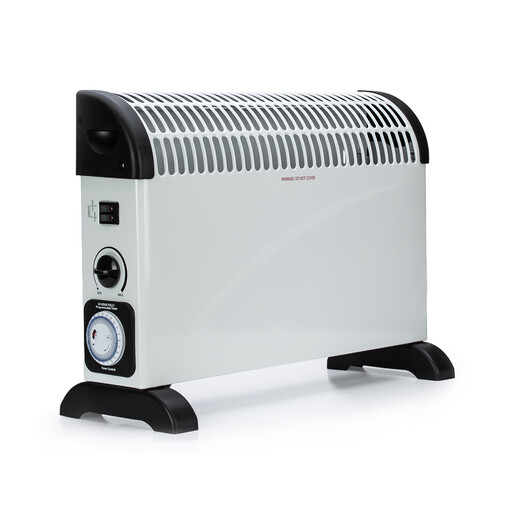
Status 2000 W convector heater in white

Status 2000 W Convector Heater with Thermostat and Timer, White

Consider this model if you want selectable heat and thermostat control in a permitted room.

The product name lists three heat settings, an adjustable thermostat and a timer. Confirm how the timer operates, the supplied plug and the space required around the heater before buying.

Joybuy
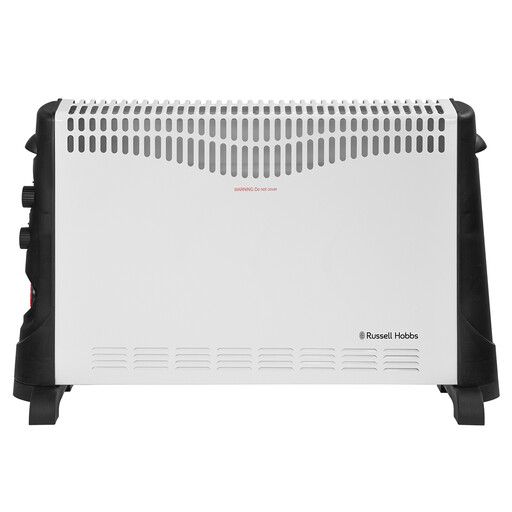
Russell Hobbs RHCVH4002 EU 2 kW convection heater in white

Russell Hobbs RHCVH4002 (EU) 2 kW Convection Heater, White

Consider this freestanding model only if its placement requirements fit the room and its EU variant is suitable for your intended UK use.

The product name identifies a 2 kW heater. Confirm the supplied plug, exact controls and required clearances before buying; do not assume the EU variant has a UK 3-pin plug.

Joybuy
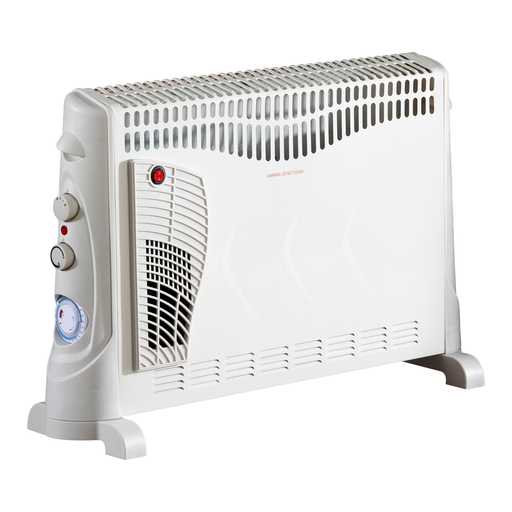
DAEWOO 2000 W convector heater in white

DAEWOO 2000 W Convector Heater with Three Heat Settings, White

This model is worth comparing if you want a choice of output and scheduled operation in a permitted room.

The product name lists 750 W, 1,250 W and 2,000 W settings, an adjustable thermostat, a timer and overheat protection. Check its dimensions, supplied plug and placement instructions against your available space.

Joybuy

Common questions

Can I use a convector heater in student halls?

Only if your accommodation provider permits it. The University of St Andrews prohibits personal heaters in study bedrooms unless supplied by residences, and the University of Manchester lists portable heaters as banned in halls; check your own current residence rules before buying.

Where can a convector heater stand in a small bedroom?

It needs a stable position with the clearance specified for that model, away from bedding, curtains, furniture and clothes. Electrical Safety First says convectors need space above and around them, while London Fire Brigade advises keeping combustible items well away; never use a portable heater to dry clothes or while asleep.

Does a timer make a 2 kW heater cheaper to run?

A timer can reduce electricity use if it prevents unnecessary heating, but it does not reduce the heater’s electrical input while it is actively drawing 2 kW. Compare the selectable settings and thermostat behaviour, then assess likely operating time using your own electricity tariff.

Does a safety marking mean a heater is suitable for my room?

No: a product marking does not grant permission under accommodation rules or make an unsuitable position safe. Check the exact heater’s instructions, your provider’s appliance rules, the supplied plug and the clear space available in your room.