
24/7 Customer Support

Free returns

Same-day & Next-day Delivery

Quality Guaranteed

Unlock Your Welcome Offers: FREE Delivery | Up to 80% OFF | Free 30-day JoyPlus trial
Download the APP
A convertible chest freezer can provide useful flexibility: use it as a freezer for bulk food, then switch to refrigerator mode when you need extra space for drinks or fresh produce. However, the wrong model can quickly become an inconvenient box that is difficult to organise, costly to run or unsuitable for its location.
Before buying, watch for three common traps:
Choose capacity according to how you shop and where the appliance will stand.
Measure doorways, stairwells and the final installation area before ordering. A chest freezer with an external height of approximately 848–872 mm may require careful handling during delivery. Also check whether you can comfortably reach the bottom of the compartment without repeatedly removing the basket.
A removable storage basket helps separate frequently used items from longer-term storage. A defrost drain can make manual defrosting less disruptive, but it does not remove the need to defrost when ice build-up affects usable space.
A switchable fridge freezer should clearly state its operating modes and temperature controls. The AUCMA models listed here provide either refrigeration or freezing operation, with adjustable controls for different storage needs.
A 4-star freezer grade, where specified, is an objective classification associated with freezing performance. Even so, follow the product instructions for loading, temperature settings and food storage. Do not assume that every convertible appliance can operate as both modes simultaneously unless the specification explicitly says so.
For vehicle and outdoor use, a compressor cooler box is a different product category. These portable units can cool and freeze without ice and are designed for 12V or 24V vehicle supplies. Look for:
A portable 12V car fridge freezer may suit campers, RV owners, boat users and lorry drivers more effectively than a household chest freezer.
Use the stated annual consumption as a comparison point. The supplied AUCMA specifications list 165–226 kWh per year, depending on model and capacity. These figures are not guarantees of your household bill: electricity prices, room temperature, loading and temperature settings all influence actual consumption.
The listed AUCMA appliances have an Energy Class E rating and operating noise of 38 dB. A portable EUHOMY model is listed as Energy Class C, while another is listed as Energy Class D. Compare products within a similar size and usage category rather than assuming a class from one category directly predicts the cost of another.
For a garage freezer, place the appliance on a stable, level surface with ventilation around the cabinet. Check the manufacturer’s instructions for permitted ambient temperatures and avoid positioning it beside a radiator, boiler or in direct sunlight. A quiet chest freezer can work well near living areas, but noise remains only one part of suitability.

Why This Fits Their Persona: Its 95-litre capacity and 550 × 475 × 848 mm footprint suit smaller UK kitchens, flats and garages where floor space is limited.
The product specification states both refrigeration and freezer modes, rather than offering freezer-only storage.
38 dB operating noise, seven-level mechanical control, removable basket and stated annual consumption of 165 kWh.
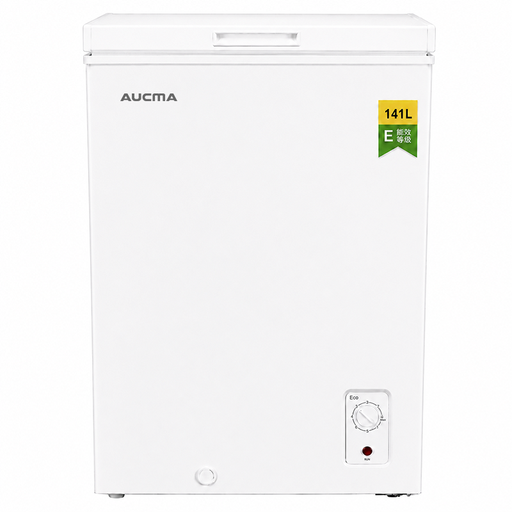
Why This Fits Their Persona: It offers a balanced capacity for households wanting flexible storage without moving to a full-size 197-litre or 291-litre cabinet.
Its listed dimensions, 141-litre capacity and seven-level thermostat make the storage and control specifications clear before purchase.
38 dB operation, defrost drain, adjustable feet and 179 kWh stated annual consumption.

Why This Fits Their Persona: The 291-litre interior is suited to larger households, garage storage, small cafés and convenience stores handling higher food volumes.
The 1,100 × 597 × 872 mm dimensions and stated 226 kWh annual consumption help heavy users plan space and running costs.
Built-in LED lighting, five-level digital control, removable basket and 38 dB listed operating noise.
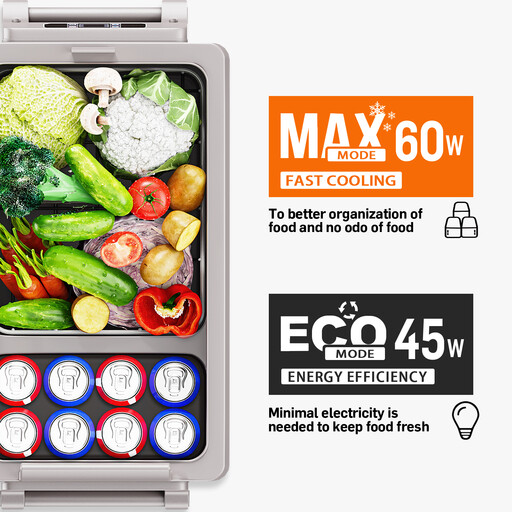
Why This Fits Their Persona: Its 12/24V DC and 240V AC compatibility makes it practical for cars, campervans, boats, camping, fishing and home backup use.
Three battery-protection levels and dual power inputs address common vehicle-use concerns about battery drain and compatibility.
49.4-litre capacity, -20°C to 20°C setting range, dual storage areas and listed 40 dB operation.
We have compiled a complete, real-time list of products that fully satisfy these strict selection criteria and UK safety regulations.
For a household or garage installation, leave the clearance stated in the manual around the cabinet and compressor area. Allow the freezer to stand level before switching it on, then let it reach the required temperature before loading large quantities of food. Avoid packing items tightly against ventilation points.
For a portable camping refrigerator or car freezer, use the supplied cable and select the battery-protection level according to the vehicle battery and journey length. Secure the unit against movement, especially in an RV, boat or lorry. Portable compressor coolers should not be connected directly to household mains unless the supplied or compatible AC adapter is designed for that purpose.
Before purchase, check the seller’s product documentation, delivery terms, warranty details and required conformity markings. Keep the receipt and installation instructions for future reference.
It can be, provided the model’s permitted ambient operating conditions match the garage. Check the manual before installation, particularly if the space becomes very cold in winter or hot in summer. Maintain ventilation and place the appliance on a stable, level surface.
Running cost depends on the appliance’s annual kWh figure and your electricity tariff. For a simple estimate, multiply the stated annual kWh by your price per kWh. Actual consumption can vary with room temperature, loading frequency, thermostat settings and defrosting.
Service life depends on build quality, installation, usage and maintenance. Keep the condenser and vents unobstructed, avoid damaging the lid seal, defrost when ice accumulates and follow the manufacturer’s instructions. A product with a suitable capacity and location is less likely to be overloaded or misused.