Joybuy Insights

A UK Buyer’s Guide to Choosing the Right Cooker Hood

A new cooker hood should be a straightforward purchase, but the market is filled with technical jargon and features that can be misleading. Many UK homeowners find themselves with an appliance that is either too loud, ineffective or simply wrong for their kitchen layout. As a Joybuy Product Recommendation Officer, my role is to help you navigate these choices by focusing on what truly matters for performance and long-term satisfaction.

Before you start browsing, be aware of these common purchasing pitfalls:

  1. The "More Power" Myth: Manufacturers often highlight high extraction rates (measured in m?/h) as the main selling point. While a powerful fan is important, an excessively high rate can result in a noise level that makes your kitchen unusable for conversation. In a typical UK open-plan living space, a deafening extractor fan is a significant drawback.
  2. The Ducted vs. Recirculating Mistake: Not all homes can accommodate a ducted kitchen extractor fan that vents air outside. This requires an external wall and professional installation. Buying a ducted-only model for a flat or terraced house without this access is a costly error. A recirculating cooker hood is often the only practical solution.
  3. The Hidden Cost of Filters: The initial price of the hood is only part of the story. Models that rely solely on disposable carbon filters for recirculation will incur ongoing replacement costs. Hoods with washable metal grease filters offer a more economical and lower-maintenance solution over the appliance's lifespan.

Core Factors to Check Before You Buy

To avoid these traps, focus on three core parameters. Getting these right ensures your new cooker hood will be a functional and fitting addition to your home.

1. Extraction Type: Ducted or Recirculating?

This is the most critical decision and depends entirely on your property.

  • Ducted Extraction: This method physically removes steam, smoke and odours from your kitchen by venting them outside through ductwork. It is generally more effective at removing moisture. You must have a route to an external wall for the ducting pipe.
  • Recirculating Extraction: This method draws air through filters to remove grease and odours before releasing the cleaned air back into the kitchen. A grease filter (usually metal and washable) captures oil particles, while a carbon filter (often disposable) neutralises smells. This is the ideal solution for properties where external ducting is not possible. Many modern hoods offer both options.

2. Size and Style: Matching Your Hob and Cabinetry

The size of your cooker hood should correspond to the size of your hob to ensure effective capture of steam and fumes.

  • Width: A 60cm cooker hood is the standard for a typical 60cm-wide four-ring hob. For larger range cookers or five-ring hobs, a 90cm cooker hood or wider is necessary for proper coverage.
  • Style: The type of hood affects both aesthetics and installation.
    • Chimney Cooker Hood: A popular wall-mounted style with a visible flue. Available in materials like stainless steel extractor hood or a modern black cooker hood finish.
    • Integrated Cooker Hood: Designed to be built into and hidden by an overhead cabinet, creating a seamless, minimalist look.
    • Under Cabinet Extractor Fan: A compact unit that fits directly underneath an existing kitchen cabinet.
    • Telescopic Cooker Hood: A space-saving integrated model that slides out from a cabinet when in use.

3. Extraction Rate vs. Noise Level

A good cooker hood balances effective air cleaning with comfortable noise levels.

  • Extraction Rate (m?/h): For a standard UK kitchen (around 4m x 4m), an extraction rate of 300-500 m?/h is generally sufficient for everyday cooking. Higher rates are useful for intensive cooking like frying or wok cooking.
  • Noise Level (dB): This is often listed for the maximum fan speed. A level below 60 dB is relatively quiet (similar to a normal conversation). Anything approaching 70 dB will be intrusive. Look for models that specify their noise level, as this is a key indicator of quality and comfort.

Our Top Product Recommendations

Based on these practical criteria, here are a few models suited to distinct UK household needs.
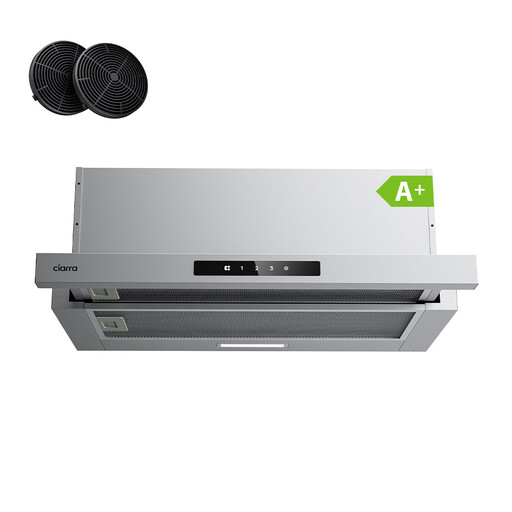
MATCH FOR: The Space-Savvy Urbanite
CIARRA 60cm Built-in Telescopic Cooker Hood 600m?/h, Powerful Pull-Out Kitchen Extractor Hood with Touch Control, 3-Speed Ventilation, LED Lighting, Energy Class A+, Silver Finish

CIARRA 60cm Built-in Telescopic Cooker Hood 600m?/h, Silver Finish

Why This Fits Their Persona: This is ideal for those in flats or with compact kitchens who want powerful extraction without sacrificing cabinet space. The pull-out design is discreet and functional, perfect for a minimalist aesthetic.

How It Avoids the Trap

It supports both ducted and recirculating installation, eliminating the risk of buying an incompatible model for a property without external vent access.

Key Advantage & Pros

The space-saving telescopic cooker hood design and high A+ energy efficiency rating make it a smart, modern choice.
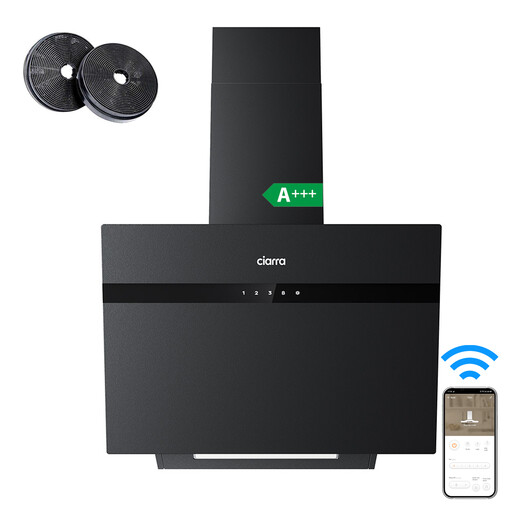
MATCH FOR: The Modern Design Enthusiast
Ciarra Convection Headless Slanted Hood, Matte Black Glass 60CM, Writable, App/Wi-Fi Control, A+++

Ciarra Convection Headless Slanted Hood, Matte Black Glass 60CM

Why This Fits Their Persona: For those who view their kitchen as a design statement, this angled glass hood offers a striking visual focus. Its smart features and premium finish appeal to the tech-savvy homeowner.

How It Avoids the Trap

It solves the power-versus-noise dilemma by providing a strong 650 m?/h extraction rate while maintaining a low noise level of 58 dB, making it suitable for open-plan living.

Key Advantage & Pros

Features smart Wi-Fi/App control for modern convenience and an exceptional A+++ energy rating for very low running costs.
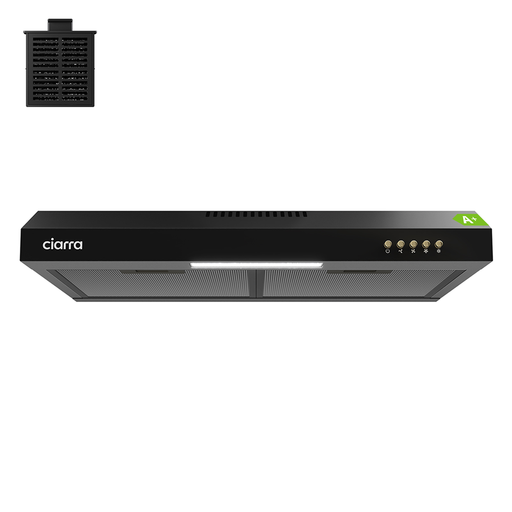
MATCH FOR: The Pragmatic Home Manager
Ciarra Slimline 60cm Cooker Hood for Cabinet Mounting – Black Housing, Compact Build, Dual Venting Option, Push-Button Control

Ciarra Slimline 60cm Cooker Hood for Cabinet Mounting, Black

Why This Fits Their Persona: This is a practical, no-frills choice for landlords, rental properties or anyone needing a reliable and affordable solution. Its simple design focuses on core functionality and durability.

How It Avoids the Trap

It features a washable metal grease filter, which eliminates the recurring expense and hassle of buying disposable filters, directly addressing the hidden cost pitfall.

Key Advantage & Pros

The straightforward push-button controls are durable and easy for anyone to use. Its compact under cabinet extractor fan design is versatile for many kitchen layouts.

Looking for More Options?

We have compiled a complete, real-time list of products that fully satisfy these strict selection criteria and UK safety regulations.

Frequently Asked Questions

How often should I clean or replace cooker hood filters?

For hoods with washable metal grease filters, it is advisable to clean them every 2-4 weeks, depending on your cooking habits. Most are dishwasher-safe, making maintenance simple. If you are using a recirculating cooker hood, the carbon filters that neutralise odours are not washable and will need to be replaced. This is typically required every 3 to 6 months, and the manufacturer's instructions will provide specific guidance.

What's the minimum height a cooker hood should be from the hob?

Safety and performance are key here. As a general rule in the UK, there should be a minimum clearance of 650mm between the cooker hood and an electric hob. For a gas hob, this increases to a minimum of 750mm to prevent fire risk. Always check the specific installation manual for your appliance, as requirements can vary.

Is a more expensive cooker hood always better?

Not necessarily. A higher price might reflect a designer brand, advanced features like Wi-Fi connectivity or premium materials like curved glass. However, it does not always guarantee better core performance (extraction and noise levels). A mid-range model from a reputable brand that meets the key criteria—correct size, suitable extraction type for your home and a good balance of power and noise—is often a more practical investment.