
24/7 Customer Support

Free returns

Same-day & Next-day Delivery

Quality Guaranteed

Unlock Your Welcome Offers: FREE Delivery | Up to 80% OFF | Free 30-day JoyPlus trial
Download the APP
Cooking creates more than aroma. Steam, grease and airborne particles can settle on cupboards, walls and soft furnishings, while lingering odours are particularly noticeable in open-plan homes. The right cooker hood can help manage these everyday problems, but choosing by appearance or headline airflow alone can lead to an unsuitable purchase.
This guide explains the practical details to check before buying cooker hoods, including size, ventilation method, noise, filters and installation requirements.
A cooker hood should generally cover the cooking area effectively. A 60cm extractor hood is designed for a standard 60cm hob, while 90cm cooker hoods and 100cm cooker hoods are more appropriate for wider hobs or range cookers. A narrow hood positioned over a larger cooking surface may not capture steam and grease from the outer burners as effectively.
Measure the hob, available wall or cabinet space and the hood’s actual dimensions before ordering.
Manufacturers often highlight the highest extraction figure, but this may only apply to boost mode. Noise can also increase at the same setting. For example, the Belling COOKCENTRE CHIM 90T BLK is listed at 580m³/h on maximum speed, with a lower-speed figure of 250m³/h and noise ranging from 46dB to 65dB.
Compare airflow alongside the speed settings and sound level. A quieter low or medium setting may be more useful for simmering, while boost is reserved for frying or cooking several pans.
A ducted cooker hood sends air outside through a suitable duct, while a recirculating cooker hood passes air through grease and carbon filters before returning it to the room. Recirculation is useful where external ventilation is unavailable, but carbon filters usually need periodic replacement.
Look for washable grease filters, which can be removed and cleaned rather than replaced. Always check whether carbon filters are included, optional or sold separately.
The minimum clearance above a gas or electric hob varies by product and installation instructions. Some models specify 650mm, while others require 700mm above a gas hob. Check the supplied manual rather than relying on a general measurement.
A ducted system can discharge steam and cooking odours outside, provided there is a suitable route and correctly sized ducting. Check the outlet diameter, bends and total duct length because restrictive or poorly fitted ducting can reduce practical airflow.
A recirculating system is often more suitable for flats, rented homes or kitchens without an external wall route. It does not remove moisture from the room, however, so opening a window or using other ventilation may still be necessary during high-steam cooking.
Noise is measured in decibels, usually at specific fan speeds. A quoted maximum of 64–65dB does not describe the sound at every setting. If your kitchen opens into a living room, look for a model with a clearly stated low-speed noise figure.
An integrated LED cooker hood light can improve visibility over the hob without needing a separate fitting. Energy labels also help compare consumption, but annual usage depends on how often and how long the hood is operated. Features such as A+, A++ or A+++ should be checked against the product specification and current label information.
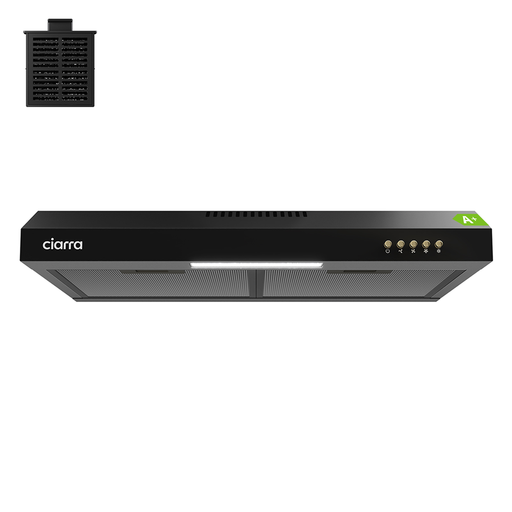
Why This Fits Their Persona: Its 596mm width and compact under-cabinet format suit smaller kitchens, flats and rental properties where wall space is limited.
The specification states both ducting and recirculation options, so buyers are not restricted to one installation method. It also includes two washable aluminium filters.
A+ energy class, three fan speeds, integrated lighting and a maximum listed airflow of 184m³/h.
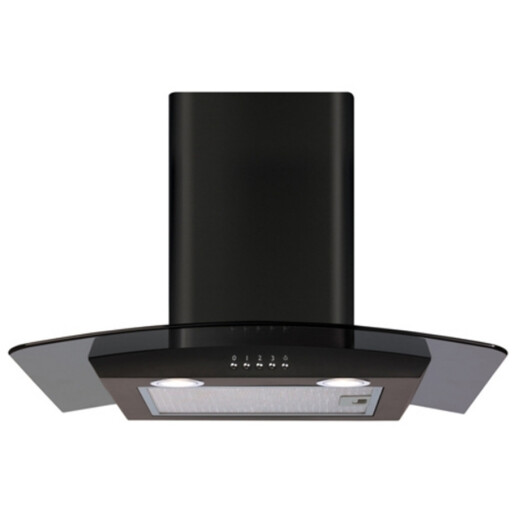
Why This Fits Their Persona: The curved black glass and touch controls suit contemporary kitchens where the extractor is part of the room’s visual design.
The listing gives separate low-speed and boost noise figures, plus ducted and recirculation modes. This makes the performance details easier to assess than a single headline figure.
Three speeds plus boost, two LED lights, washable filters and a listed boost airflow of 600m³/h.
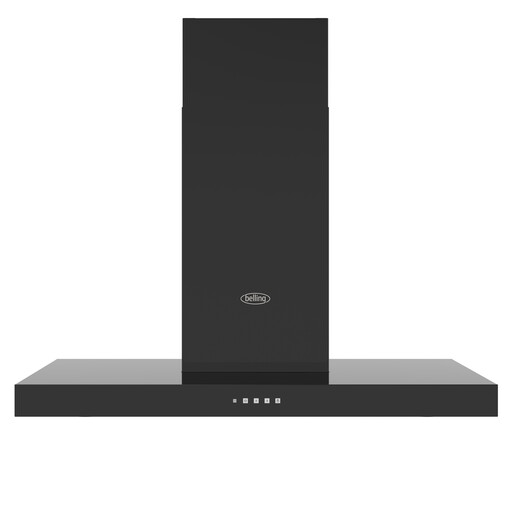
Why This Fits Their Persona: The 100cm chimney format is intended for larger cookers and broad cooking zones, with an adjustable chimney for different ceiling heights.
Its 100cm width avoids the coverage problem associated with fitting a compact hood over a wide range cooker. The product also supports both ducted and recirculating installation.
Three speeds, LED lighting, aluminium grease filters and an adjustable chimney section.
Before ordering, confirm:
Clean grease filters regularly, following the manufacturer’s instructions. A build-up of grease can reduce airflow and create a fire risk. Switch off and isolate the appliance before cleaning, and never obstruct the air outlet.
We have compiled a complete, real-time list of products that fully satisfy these strict selection criteria and UK safety regulations.
No. A ducted cooker hood vents air outside, while a recirculating model filters and returns air to the kitchen. Recirculation is useful where external ducting is impractical, but it does not remove moisture from the room as effectively as external extraction.
For regular home cooking, clean washable grease filters approximately every two to four weeks, adjusting the frequency for frequent frying or heavy use. Carbon filters used in recirculation generally require replacement according to the product manual.
Running cost depends on motor power, energy rating, selected speed and usage time. Using a lower setting when cooking gently, switching on the LED light only when needed and choosing an energy-efficient extractor hood can help limit electricity consumption.