
24/7 全天候客户支持

免费退货

当日/次日达

品质保障

开启新人专享福利: 全场免邮 | 低至 2 折 | 免费试用 30 天 JoyPlus 会员
下载 Joybuy
As warmer weather approaches, a reliable cooling fan becomes less of a luxury and more of a necessity for comfort at home, in the office or even during the daily commute. However, the market is flooded with options, and it is easy to end up with a product that is noisy, ineffective or simply stops working after one season.
This guide cuts through the marketing clutter to help you identify the key features that matter. We will highlight common purchasing pitfalls and show you how to select a fan that genuinely meets your needs, whether you are looking for a whisper-quiet bedroom companion or a powerful solution for a stuffy car.
Many fans look good on the box but fail in practice. Being aware of these common issues can save you from disappointment and wasted money.
quiet fan. The issue often stems from a poorly balanced motor or flimsy housing that vibrates during operation.To avoid the traps above, focus on a few core specifications that determine a fan's performance, noise level and longevity.
This is perhaps the most important, yet often overlooked, feature.
The type of fan you choose should match the space you need to cool.
tower fan is a great space-saver for corners or smaller rooms. They oscillate to distribute air over a wide area, and their bladeless exterior can be a safer option in homes with children or pets.USB fan or rechargeable fan for ultimate portability.car fan typically plugs into a 12V/24V socket. Key features include secure mounting (suction cup or vent clip) and adjustable heads to direct air to the driver and passengers.Consider how and where you will use the fan. A mains-powered fan is fine for static use, but a rechargeable fan offers the freedom to place it anywhere without being tied to a socket. For added convenience, look for a fan with remote control, a timer function for overnight use and different modes like 'natural breeze' which varies the airflow for a less artificial feel.
Based on these practical considerations, here are a few options tailored to specific UK lifestyles and needs.

Why This Fits Their Persona: Ideal for anyone who spends time in a car without effective air conditioning. The dual-head design provides cooling for both the driver and a passenger, making commutes or family trips in summer far more comfortable.
Its purpose is targeted airflow in a small space, not silent, whole-room circulation. The design focuses on functional cooling and secure mounting, avoiding the instability issues of flimsy home fans.
Features dual adjustable heads for shared comfort and two built-in USB ports, so you can still charge your phone while the fan is running.
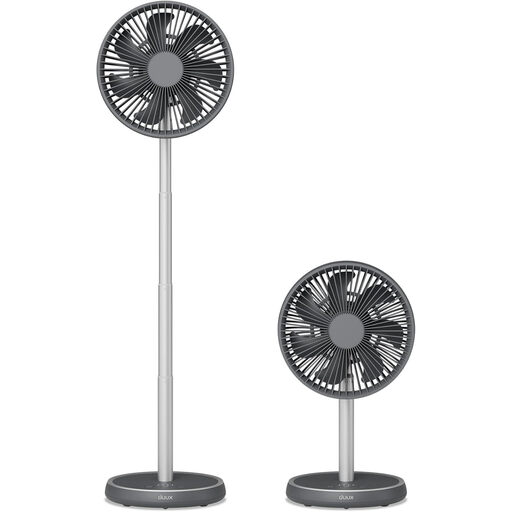
Why This Fits Their Persona: A highly versatile solution for those who need cooling in multiple locations. Use it as a compact desk fan while working, then extend it and place it by the sofa or bed in the evening, all without worrying about cables.
It directly counters the "ultra-quiet" myth with a low noise level starting from just 28dB and Quiet Mark approval. The cordless design and solid build quality provide stability and true portability.
Transforms from a 34cm desk fan to a 75cm standing fan. The rechargeable battery lasts up to 15 hours, providing all-day or all-night cordless cooling.
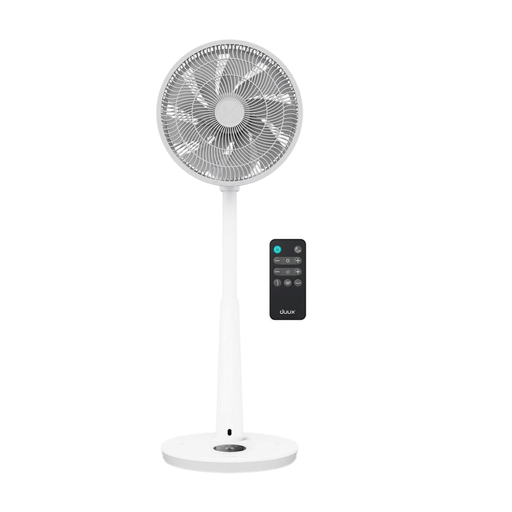
Why This Fits Their Persona: For those who want to cool a larger living space or bedroom without compromise. This fan combines powerful airflow, near-silent operation and smart features for the ultimate in customised comfort.
It features a high-quality DC motor, making it exceptionally quiet (from 13dB) and energy-efficient. The 26 speed settings provide granular control, ensuring you can find a truly silent level, unlike basic 3-speed AC fans.
Offers 26 wind speeds for precise control, a remote for convenience and a powerful airflow that reaches up to 15 metres. The height-adjustable design adds to its versatility.
We have compiled a complete, real-time list of products that fully satisfy these strict selection criteria and UK safety regulations.
The running cost depends on the fan's power consumption (wattage) and your electricity tariff. A modern, energy-efficient DC motor fan might use as little as 2-20W, while an older AC fan could use 50-70W. For example, running a 20W DC fan for 8 hours at an electricity price of 25p per kilowatt-hour (kWh) would cost approximately 4 pence. An older 60W fan would cost around 12 pence for the same period. Over a summer, the savings from a DC fan can be substantial.
Both can be excellent choices, but they suit different preferences. A pedestal fan often provides a more powerful, concentrated stream of air and can be adjusted in height to blow directly over a bed. A tower fan has a smaller footprint, making it ideal for tight spaces, and its wide oscillation can cool a room more broadly. For bedroom use, the most critical factor is the noise level. Prioritise a model with a DC motor, regardless of whether it is a tower or pedestal type, to ensure it is a genuinely quiet fan.
For most standard USB fan models, it is perfectly safe to leave them plugged into a suitable power source like a laptop or a USB wall adapter during operation. If you have a rechargeable fan, it is generally good practice to unplug it once it is fully charged to help preserve the long-term health of the battery. Always refer to the manufacturer's specific instructions for guidance on charging and continuous use.