
24/7 全天候客户支持

免费退货

当日/次日达

品质保障

开启新人专享福利: 全场免邮 | 低至 2 折 | 免费试用 30 天 JoyPlus 会员
下载 Joybuy
A corded upright vacuum cleaner can provide consistent cleaning power without battery charging, but the specifications can be confusing. Product listings often highlight motor wattage or suction figures while leaving out practical details such as filter care, cord storage and attachment compatibility.
Before buying, watch for three common pitfalls:
An 800W vacuum cleaner can be suitable for routine household cleaning when paired with an effective floor head and clear airflow path. Wattage should be treated as one part of the specification rather than a direct measurement of dust removal.
Suction is commonly shown in kilopascals (kPa), which indicates pressure difference. A listed 17.5kPa suction strength provides a useful comparison between products, but it does not show how the vacuum behaves across carpets, tiles, upholstery or hard floors. Look for a model that also states its floor compatibility and includes more than one attachment.
For homes with rugs, carpeted stairs or pet hair, check whether the floor head can collect debris without becoming difficult to push. For hardwood and tiled floors, a head that glides without harsh bristles may be more practical.
A bagless vacuum cleaner avoids the recurring purchase of disposable dust bags. A 1.1-litre container is suitable for regular cleaning, although households with pets or larger floor areas may need to empty it more frequently.
Check whether the container has a clear maximum-fill line and can be removed without spreading dust. Empty it before debris reaches the marked limit, as overfilling may restrict airflow.
A washable filter vacuum cleaner can be convenient because the filter may be rinsed and reused according to the manufacturer’s instructions. Always unplug the appliance first, use cold water if instructed and allow the filter to dry completely before reinstalling it. A damp filter can affect performance and may damage the appliance.
A vacuum cleaner with attachments should include tools that match the way you clean. A wide floor head is useful for carpets and hard floors, while a crevice tool can reach skirting boards, corners and gaps beside furniture. A soft brush attachment is more suitable for shelves, upholstery and delicate surfaces.
An automatic cord rewind vacuum is helpful in UK homes where cupboard space is limited. It allows the cable to retract into the main body after use, but the plug should be held during rewinding to prevent it from whipping.
For safety, use a corded vacuum only with a suitable earthed socket and keep the cable away from heat, sharp edges and damp areas. These appliances are designed for dry debris only: do not use one to collect water or wet spills.
The product below is the relevant vacuum option supplied for this guide. Its specifications make it suitable for different household profiles, provided the user follows the care and safety instructions.
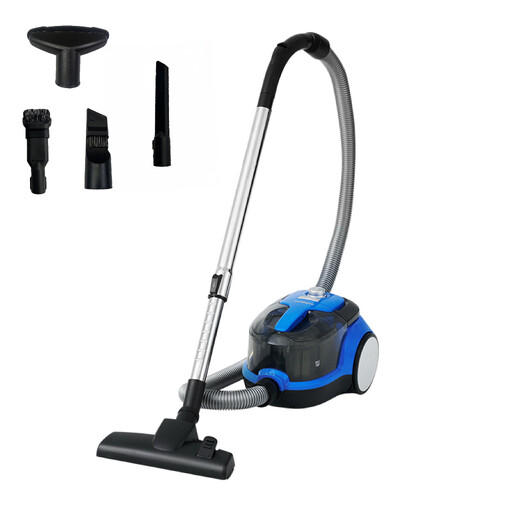
Why This Fits Their Persona: A practical option for tenants, students and first-time buyers who want one appliance for carpets, hardwood, tiles and upholstery without buying separate cleaning tools.
The listing provides both the 800W rated power and 17.5kPa suction figure, while also specifying a bagless 1.1L container and washable removable filter.
Automatic cord rewind, multiple brush heads and a clear 1.1L dust container support straightforward everyday cleaning.
Why This Fits Their Persona: Suitable for homeowners who value reusable components, tidy storage and a flexible tool set for several rooms and surfaces.
The washable filter reduces reliance on replacement filter purchases, while automatic cord rewind helps prevent loose cable storage.
The model has a 1.1L bagless cyclonic system, washable removable filter and attachments for floors, carpets and furniture.
Why This Fits Their Persona: A reasonable match for pet owners and larger households that need repeated dry cleaning across mixed flooring and upholstery.
Multiple brush heads allow the user to change tools for floor edges, furniture and confined areas instead of relying on one universal head.
The stated 17.5kPa suction, 800W motor and floor compatibility for carpets, hardwood, tile and upholstery cover several common cleaning tasks.
Good maintenance is as important as the original specification. Empty the dust container at the MAX line, inspect the floor head for hair and remove visible blockages. If the thermal overload protection activates, unplug the appliance, clear the obstruction and allow it to cool for at least 30 minutes before use.
The filter should be rinsed only as directed and must be fully dry before refitting. Do not use the appliance on wet materials and avoid carrying it by the power cord. These steps can help prevent avoidable interruptions and protect the motor during routine household use.
We have compiled a complete, real-time list of products that fully satisfy these strict selection criteria and UK safety regulations.
Running cost depends on electricity usage, cleaning frequency and maintenance. A corded model does not require a replacement battery, but it uses mains electricity during operation. An 800W appliance uses 0.8 kilowatt-hours per hour of continuous use; your actual cost depends on your tariff and usage time.
Yes, if the floor head is suitable and the manufacturer lists hard floors among the compatible surfaces. Use the appropriate attachment and avoid dragging grit across delicate flooring. The referenced model lists hardwood and tile compatibility alongside carpets and upholstery.
There is no universal lifespan. Longevity depends on build quality, frequency of use, filter care, dust-container maintenance and whether blockages are cleared promptly. Checking the filter, floor head, cable and hose regularly is a practical way to identify wear before it affects cleaning performance.