Families serving snacks at home
If drinks will be prepared at home throughout half term, compare the convenience of sealed cans with a concentrate that needs water and a cup or bottle.


For drinks prepared at home, a bottle of concentrated squash suits repeated servings if you can follow its dilution instructions. Choose ready-to-drink multi-pack cans when sealed individual portions matter more, but check the exact drink rather than treating canned soft drinks as cordial. For children, NHS and Healthier Together guidance identifies water and milk as routine choices and says well-diluted sugar-free squash can be an option.
If drinks will be prepared at home throughout half term, compare the convenience of sealed cans with a concentrate that needs water and a cup or bottle.
Check the drink type, ingredients and dilution directions alongside NHS and Healthier Together guidance on children’s drinks. Water and milk remain the routine choices described in that guidance.
Compare the exact bottle’s strength, dilution directions, ingredients and instructions for use after opening. A no-added-sugar label does not replace those checks.
Decide whether each drink needs to be ready to serve, then check the label details that matter for the people drinking it.
Choose when: You can prepare drinks with water at home and expect to use the concentrate for repeated servings.
Bear in mind: It needs dilution and a cup or bottle; follow the exact product’s mixing and storage directions.
Choose when: Sealed individual portions without mixing are the reason for buying a multi-pack.
Bear in mind: The canned drinks in Sainsbury’s search results are listed separately from bottled squash and cordial; check each can’s own label.
| Priority | What to check | Your needs |
|---|---|---|
| Pack format | Confirm whether the item is a concentrate or ready to drink. Check whether a multi-pack contains cans or bottles and how much each holds. | I need sealed portions to take out, or I can make drinks as needed at home. |
| Dilution | Use the exact squash label’s mixing directions. Waitrose & Partners lists 1 part concentrate to 9 parts water for Robinsons double-strength Apple & Blackcurrant, but 1 part to 4 parts water for its single-strength Orange example. | If I am serving several drinks at home, I can measure the concentrate and water each time. |
| Sugar and drink type | Read the exact drink’s nutrition declaration and ingredients, whether it is squash or a canned soft drink. NHS guidance distinguishes sugary drinks from water, milk and no-added-sugar options. | For children’s regular drinks, I want to follow NHS and Healthier Together guidance, which identifies water and milk as routine choices. |
| Ingredients | Check the current label for sweeteners and ingredients relevant to dietary or allergy needs. The Robinsons products listed by Waitrose & Partners contain sweeteners and sodium metabisulphite. | I need to check the particular flavour and strength before serving it, rather than rely on a claim about the brand. |
| After opening | Check the bottle’s storage instructions and when it should be consumed after opening. The two Robinsons examples listed by Waitrose & Partners say within 4 weeks. | A bottle only suits our plans if we expect to use it within its stated post-opening period. |
Supermarket listings place concentrated squash and cordial in bottles, while the canned examples are ready-to-drink soft drinks. Buying by the search phrase alone could leave you with a drink that needs mixing when you wanted individual portions.
Check the exact listing for product type, container and pack contents before choosing.
The Robinsons no-added-sugar examples listed by Waitrose & Partners contain sweeteners and sodium metabisulphite. The label claim does not answer every ingredient or dietary question.
Read the current label for the particular flavour and strength, especially where an ingredient matters to someone drinking it.
NHS guidance advises limiting sugary drinks, while Healthier Together identifies water and milk as routine drinks for children and discusses well-diluted sugar-free squash as an option.
Keep those distinctions in mind when choosing what to serve regularly; do not assume every cordial or canned drink has the same composition.
The Robinsons single-strength and double-strength examples listed by Waitrose & Partners both say to consume within 4 weeks of opening. That matters if a large bottle will be used only occasionally.
Check the chosen bottle’s storage directions and post-opening period against how often you expect to prepare drinks.
These bottled-drink references help distinguish squash and cordial from ready-to-drink cans; they do not establish that the ranges contain cordial in cans.
Waitrose & Partners lists Robinsons no-added-sugar squash in bottled single-strength and double-strength examples.
Tesco Groceries lists Stockwell & Co no-added-sugar squash among its bottled squash and cordial products.
Sainsbury’s search results distinguish its bottled squash products from separately listed canned ready-to-drink soft drinks.
Waitrose & Partners lists bottled own-label squash alongside other squash and cordial products.
These concentrates suit the at-home mixing route discussed above. The selection includes individual bottles and a multi-pack of bottles, rather than ready-to-drink cans.
 No image available
A bottled concentrate for drinks mixed at home, not individual ready-to-drink portions. Check the pack’s dilution and ingredient directions; the product information says to refrigerate after opening, use within 4 weeks and not serve it to children under 3.
 No image available
A bottled squash for preparing drinks at home. Follow this pack’s own dilution instructions rather than a ratio from another Robinsons product; its product information says it is unsuitable for children under 36 months and should be refrigerated and consumed within 4 weeks of opening.
 No image available
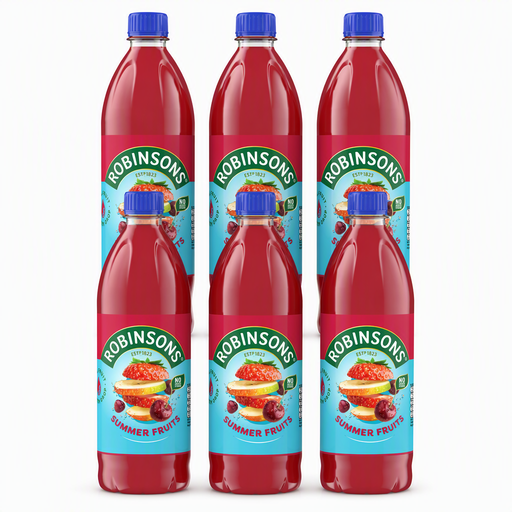
Six bottles of concentrate for repeated preparation at home, not six ready-to-drink cans. Check the individual bottle’s dilution, ingredient and post-opening storage directions before choosing this pack for half term.
No. The Sainsbury’s, Tesco Groceries and Waitrose & Partners listings cited here show concentrated squash or cordial in bottles, separately from ready-to-drink canned soft drinks. Check an exact product listing if its name or search result leaves the format unclear.
Follow the directions on the exact bottle. Waitrose & Partners lists 1 part concentrate to 9 parts water for Robinsons double-strength Apple & Blackcurrant, but 1 part to 4 parts water for its single-strength Orange example; those ratios should not be transferred to another product.
NHS and Healthier Together guidance identifies water and milk as routine choices for children. Healthier Together also discusses well-diluted sugar-free squash as an option; check the exact product’s directions and ingredients rather than assuming all cordials or cans are alike.
No. The Robinsons no-added-sugar examples listed by Waitrose & Partners contain sweeteners and sodium metabisulphite. Read the current label of the particular drink for ingredients relevant to dietary or allergy needs.
Check that bottle’s own instructions. The Robinsons single-strength Orange and double-strength Apple & Blackcurrant examples listed by Waitrose & Partners both say to consume within 4 weeks of opening; another product’s directions may differ.