Households making drinks regularly
A concentrated squash is worth comparing if several people will use it and there is room to keep plain sparkling water. Check the exact squash’s mixing directions before planning fizzy serves.


For regular household drinks, compare no-added-sugar squash to mix with sparkling water, provided the bottle permits that use and the family likes the flavour. A fruit cordial can suit occasional meals or guests, but check its diluted nutrition and how long it keeps after opening. Ready-to-drink flavoured sparkling water avoids mixing, while requiring enough bottles for the household.
A concentrated squash is worth comparing if several people will use it and there is room to keep plain sparkling water. Check the exact squash’s mixing directions before planning fizzy serves.
The NHS suggests water or sugar-free, diet or no-added-sugar drinks instead of sugary fizzy drinks or sugary squash. Compare labels for the drink as prepared; a no-added-sugar name does not replace checking the ingredients.
A fruit cordial offers a different flavour choice for sparkling-water drinks. The Belvoir examples listed by Waitrose & Partners and Sainsbury’s use a 1:10 dilution; consider whether an opened bottle will be used within its stated period.
Choose the form of drink that fits how it will be served, then compare prepared servings and the exact bottle labels.
| Priority | What to check | Your needs |
|---|---|---|
| Sugar and nutrition | Compare sugars per 100ml of prepared drink and check the stated dilution. Waitrose & Partners lists 3.9g sugars per 100ml for diluted Belvoir Raspberry & Lemon; Sainsbury’s lists 3.8g for diluted Belvoir Rhubarb & Apple. | I’m choosing drinks for repeated family servings, so I want to compare what ends up in the glass rather than judge a cordial by its fruit flavour. |
| Prepared volume | Use each bottle’s dilution directions and serving size. At 1:10, 500ml of cordial makes approximately 5.5L; Waitrose & Partners and Sainsbury’s each list 22 diluted 250ml servings for their respective Belvoir examples. | Will one bottle cover the number of drinks we plan to serve, or would ready-to-drink bottles be simpler to organise? |
| Sparkling-water use | Look for an explicit instruction permitting sparkling water. Check whether plain sparkling water must be bought and stored separately. | I’d like to make fizzy drinks at home without assuming that every squash has the same mixing instructions. |
| Storage after opening | Read the exact bottle’s refrigeration and use-after-opening instructions. Sainsbury’s says to refrigerate Belvoir Rhubarb & Apple and use it within three weeks; Joybuy gives a four-week use period for Robinsons Crushed Lime & Mint. | For occasional drinks, I’d rather open a flavour we expect to finish within its stated period. |
| Ingredients and allergens | Check the delivered label, including on repeat purchases or substitutions. Morrisons lists sulphur dioxide/sulphites for Robinsons Crushed Lime & Mint and cautions that ingredient information can change. | If someone in the household needs to avoid an ingredient, I need to check the bottle we actually receive. |
A 500ml concentrate and a 500ml ready-to-drink bottle provide different amounts of finished drink. At 1:10, the Belvoir examples listed by Waitrose & Partners and Sainsbury’s provide 22 diluted 250ml servings per bottle.
Use the stated ratio and serving size to work out how much prepared drink the household needs.
The Belvoir examples listed by Waitrose & Partners and Sainsbury’s contain sugar, so their flavour descriptions cannot tell you the sugar content of a prepared glass.
Read the ingredients and compare nutrition on the same diluted, per-100ml basis.
An opened bottle may have a shorter stated use period than expected: Sainsbury’s specifies three weeks for Belvoir Rhubarb & Apple, while Joybuy specifies four weeks for Robinsons Crushed Lime & Mint.
Check each bottle’s instructions and consider how often that flavour will be served before opening another.
Morrisons lists sulphur dioxide/sulphites for Robinsons Crushed Lime & Mint and warns that ingredients and allergens may change.
When an allergy or intolerance matters, check the label on every delivered bottle, including substitutions.
These examples show different drink formats and label details; they do not imply that every product from a brand has the same ingredients or preparation instructions.
Robinsons has both no-added-sugar squash and a fruit cordial intended for still or sparkling water.
Its Raspberry & Lemon and Rhubarb & Apple cordials are listed for dilution with sparkling water.
Marks & Spencer describes its cordial range as suitable for dilution with still or sparkling water.
Sainsbury’s lists cordials, plain sparkling water and ready-to-drink flavoured sparkling water.
Waitrose & Partners lists Belvoir Raspberry & Lemon Cordial for mixing with still or sparkling water.
These concentrates represent the no-added-sugar squash option for a large family shop. Check each bottle’s directions before using it with sparkling water.
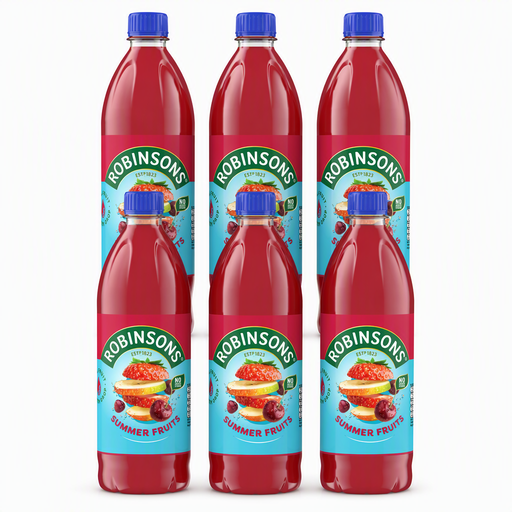 No image available
The six-bottle concentrate pack is an option when several people will make drinks at home. Check the delivered bottle for sparkling-water directions, prepared-drink nutrition, allergens and storage instructions; the product information identifies sulphites and a source of phenylalanine.
 No image available
This 1.5L concentrate offers a single-bottle option for planned household servings. Check the delivered label for sparkling-water directions and nutrition for the prepared drink. The listing identifies sodium bisulphite and says the product is not recommended for children under 3; follow the bottle’s dilution and storage instructions.
Yes, when the particular cordial’s directions allow it. Waitrose & Partners lists Belvoir Raspberry & Lemon for 1:10 dilution with still or sparkling water, and Sainsbury’s gives the same options for Belvoir Rhubarb & Apple. Check other bottles individually.
A 500ml bottle mixed at one part cordial to ten parts water makes approximately 5.5L of prepared drink. Waitrose & Partners and Sainsbury’s each list 22 diluted 250ml servings for their respective Belvoir examples; use a different yield if your bottle specifies a different ratio.
If limiting sugary drinks is the priority, start by comparing a no-added-sugar squash and its exact label. The NHS suggests water or sugar-free, diet or no-added-sugar drinks instead of sugary fizzy drinks or sugary squash. A fruit cordial may suit occasional servings, but compare its nutrition as prepared.
Follow the instructions on the exact bottle. Sainsbury’s says to refrigerate Belvoir Rhubarb & Apple after opening and use it within three weeks; Joybuy states a four-week period for Robinsons Crushed Lime & Mint.
Compare drinks on the same prepared, per-100ml basis, using each product’s stated dilution. The NHS explains that nutrition information is given per 100g or 100ml and sometimes per portion; a concentrate’s bottle size alone does not show the nutrition of a served glass.