
24/7 Customer Support

Free returns

Same-day & Next-day Delivery

Quality Guaranteed

Unlock Your Welcome Offers: FREE Delivery | Up to 80% OFF | Free 30-day JoyPlus trial
Download the APP
Buying one of the many beard trimmers available online can seem straightforward until you compare battery claims, cutting ranges and attachment bundles. A low-priced model may look suitable for daily stubble, while a multi-purpose kit may promise to handle beards, hair and body grooming. However, the wrong choice can lead to uneven results, awkward cleaning or accessories that remain unused.
Before choosing a cordless beard trimmer, look beyond promotional wording and check the practical specifications that affect everyday use.
A product may advertise dozens of length settings, but the important details are the actual range and adjustment increments. For example, settings from 0.5–20 mm in 0.5 mm steps offer a different trimming experience from a shorter 0.5–10 mm range. Fine increments can help when maintaining a particular stubble length or shaping a gradual beard.
Check whether the length is controlled by a dial, fixed combs or several interchangeable guides. A large attachment set is not automatically more useful if the combs are difficult to fit or store.
A waterproof beard trimmer may be suitable for rinsing or wet and dry grooming, but charging components and cables still need to remain dry. Always disconnect the appliance before cleaning and follow the supplied instructions. A USB rechargeable trimmer should be connected only to a suitable power source, such as the specified 5V USB supply.
Also check the exact wording. “Washable head” may refer only to a detachable blade assembly, whereas a fully washable body is a broader feature.
Self-sharpening blades can reduce the need for regular oiling, but they still need cleaning. Hair and skin oils can accumulate around the cutting head, affecting smooth movement over time. A washable design is convenient, yet the device should be dried properly before storage or charging.
For cutter systems that use replaceable blades, include replacement costs in your budget. A bundle containing an extra blade, such as the Philips OneBlade Pro option below, may be practical for regular users.
For short stubble, look for a minimum setting around 0.4–0.5 mm and a stable comb that does not shift during use. Full-beard users may prefer a beard and hair trimmer reaching 20 mm or more. Rounded blade edges can be useful around facial contours, while T-blades are often selected for outlining and detailing.
Ceramic and stainless-steel blades have different characteristics. Ceramic blades are used in models such as the BarberBoss QR-2082, while several Philips and Braun options specify metal or stainless-steel cutting systems. The product’s guide-comb design, motor and cleaning instructions matter just as much as the blade material.
A rechargeable beard trimmer is most convenient when its runtime matches your routine. Around 50–60 minutes may be sufficient for occasional beard maintenance. Frequent users, households sharing a device or people travelling without regular charging access may prefer models offering 100–180 minutes.
A quick-charge function can be useful before work or travel. Some models provide one trim after five minutes of charging, while USB charging is helpful when using a laptop, power bank or compatible travel adaptor. Check whether a charger, USB-A cable or charging stand is included.
A wet and dry beard trimmer can offer more flexible grooming and easier rinsing. If you intend to use shaving foam or gel, confirm that the product description specifically supports wet use rather than assuming that a washable head is suitable for it.
For body grooming, look for a dedicated body groomer for men with suitable combs and skin-protection features. Facial beard trimmers and body groomers are not always interchangeable, so read the intended-use instructions carefully.
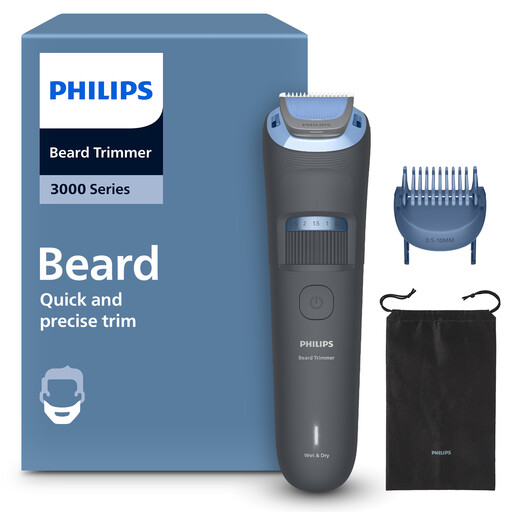
Why This Fits Their Persona: A straightforward choice for UK users maintaining short stubble or a shorter beard without needing a large accessory collection.
Its stated 0.5–10 mm range and 20 settings make the usable adjustment range clear rather than relying only on a large setting count.
Self-sharpening stainless-steel blades, cordless operation and up to 60 minutes of runtime.
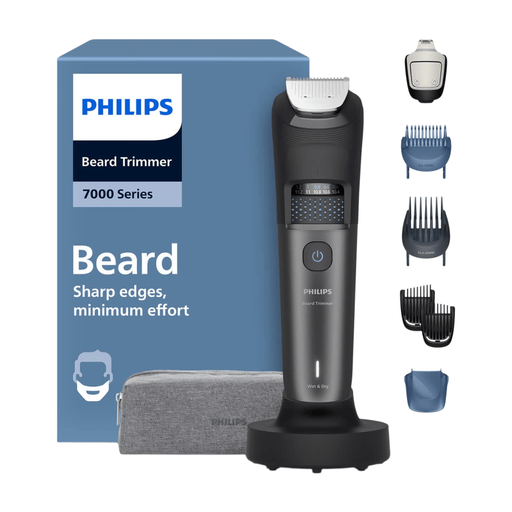
Why This Fits Their Persona: Suitable for users who value fine length control, tidy grooming and organised storage for home or travel.
The 40 settings are specified in 0.2 mm increments, and the supplied hair collector addresses the mess often overlooked in marketing descriptions.
0.4–20 mm range, wet and dry washable design, up to 120 minutes’ runtime and a travel pouch.
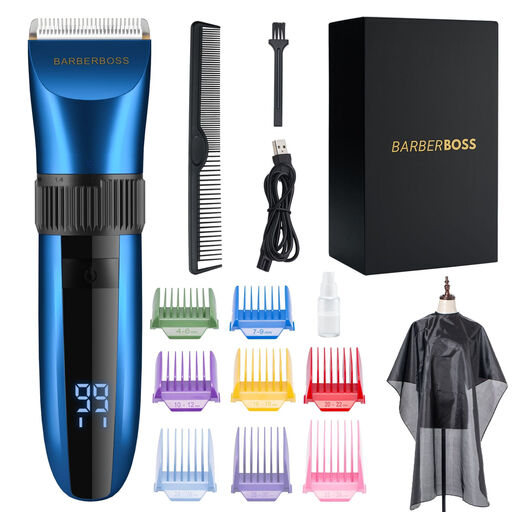
Why This Fits Their Persona: A practical match for users wanting one cordless tool for beards, haircuts, fades and regular home grooming.
The stated specifications identify eight colour-coded combs, two speeds and five 0.8–2 mm adjustment settings, making the accessory range easier to assess.
Self-sharpening ceramic blades, LED battery percentage display, wet and dry design and up to 180 minutes of cordless use.
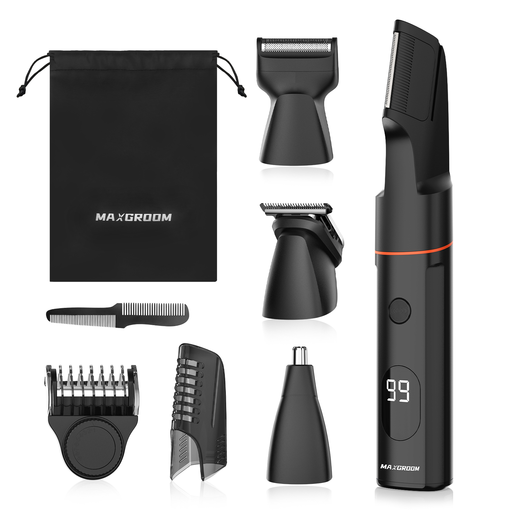
Why This Fits Their Persona: Designed for shoppers seeking one USB-charged kit for facial hair, body hair, nose hair and broader grooming tasks.
The IPX6 rating, 1–9 mm adjustable comb and named interchangeable heads clarify its intended multi-area use.
Seven grooming functions, LED indicators, magnetic heads, USB charging and up to 90 minutes of operation.
We have compiled a complete, real-time list of products that fully satisfy these strict selection criteria and UK safety regulations.
Running costs depend on the initial purchase price, charging frequency and whether blades or accessories need replacing. Electricity use is generally modest, but replacement cutting parts can become the larger ongoing expense. Check compatibility and availability before buying a system with replaceable blades.
Only if the manufacturer specifies wet use or an appropriate water-resistance rating. A waterproof beard trimmer may be rinsed or used in the shower, but never charge it in a wet environment. Keep the charging cable and plug dry.
Lifespan varies with build quality, battery care, cleaning and frequency of use. Regularly removing hair, avoiding damaged combs and following the charging instructions can help maintain performance. A long battery-runtime figure is useful for convenience, but it does not by itself guarantee a longer product lifespan.