
24/7 Customer Support

Free returns

Same-day & Next-day Delivery

Quality Guaranteed

Unlock Your Welcome Offers: FREE Delivery | Up to 80% OFF | Free 30-day JoyPlus trial
Download the APP
Achieving a flawless, showroom-quality finish on your car's paintwork is incredibly satisfying. A quality cordless car polisher can make the difference between a good result and a great one, saving you hours of manual effort. However, the market is filled with tools that promise professional results but often fall short. Navigating the technical jargon and marketing hype can be a challenge.
As the Joybuy Product Recommendation Officer, my role is to help you understand what truly matters. We'll look past the flashy advertisements to identify the key features that deliver real performance and value, helping you avoid the common pitfalls that lead to a disappointing purchase.
Many promising-looking tools hide design flaws or rely on misleading specifications. Here are three common traps to watch out for:
To make an informed choice, focus on these three non-negotiable specifications. They are the true indicators of a capable and safe car detailing buffer.
This is the single most important factor for most users.
For a battery car polisher, the power system dictates both performance and convenience.
The ability to adjust the tool's speed is not a luxury; it's essential for different stages of detailing. A good car waxing machine should offer multiple speed settings.
Based on these practical criteria, we've matched several cordless polishers to different user needs. These selections prioritise reliable performance and user-friendly design over marketing gimmicks.
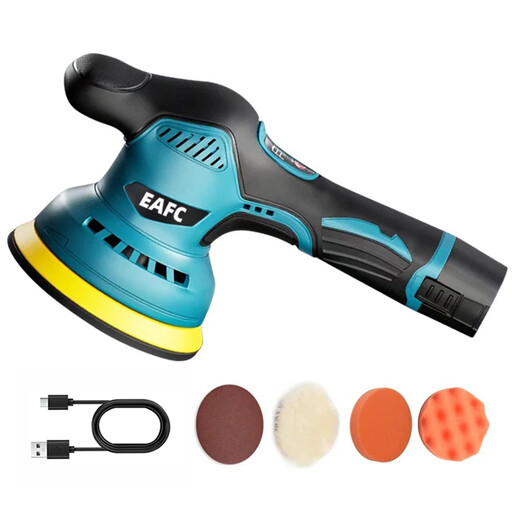
Why This Fits Their Persona: This is a great starting point for someone who wants to step up from hand polishing. It offers the safety of an orbital action with a versatile speed range, making it suitable for both applying wax and tackling light paint imperfections without a steep learning curve.
It avoids the "high RPM" trap by focusing on a user-safe eccentric orbital action (0.9cm path), which prevents paint burn. The eight adjustable speeds provide genuine control, unlike single-speed "buffers".
Features a wide 2800-5500 RPM speed range and a standard 125mm disc size, making it compatible with a wide variety of commonly available polishing pads.

Why This Fits Their Persona: For the user who details their car multiple times a year and needs to tackle everything from light swirls to full paint correction. This tool is built for longer sessions and delivers consistent performance without being tethered to a cord.
It directly counters the "unrealistic battery life" trap by including two high-capacity 5.0Ah batteries. This allows for continuous work, as one battery can be charged while the other is in use, providing a practical runtime of around 60 minutes per battery.
The onboard LCD screen provides real-time speed and battery status, giving the user precise control. Its 8mm eccentric orbit offers a good balance between cutting power and finishing ability.
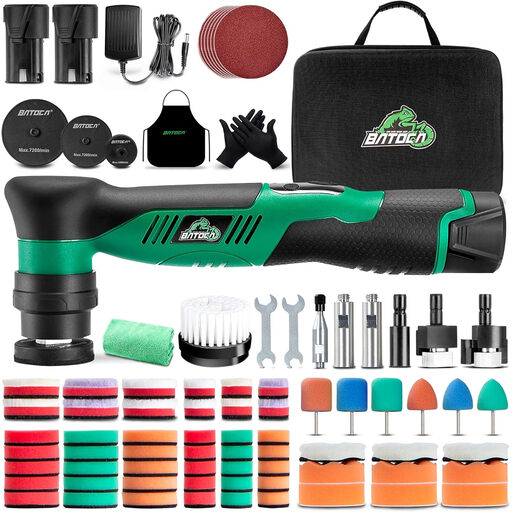
Why This Fits Their Persona: This user obsesses over the details—polishing around badges, intricate grille work and tight body lines. A standard polisher is too large and clumsy. They need a compact, versatile tool designed for precision.
It avoids the "one-size-fits-all" kit fallacy by providing a highly specialised toolset. Instead of dozens of generic pads, it includes multiple backing plates (25mm, 50mm, 75mm) and interchangeable shafts for rotary, 3mm and 12mm orbital actions.
Its 3-in-1 functionality (rotary and dual-action) and multiple small pad sizes make it exceptionally versatile for reaching areas inaccessible to standard polishers, such as around door handles, headlights and emblems.
We have compiled a complete, real-time list of products that fully satisfy these strict selection criteria and UK safety regulations.
This varies significantly based on the battery's capacity and the intensity of the work. A battery's capacity is measured in Amp-hours (Ah). A smaller 2.0Ah battery might last 25-35 minutes under a consistent load, whereas a larger 5.0Ah battery could run for 60 minutes or more. For polishing an entire vehicle, it is highly recommended to choose a model that includes two batteries.
Yes, absolutely, but it is crucial to select the right type of tool. A dual action (DA) polisher is the recommended choice for beginners. Its random oscillating motion distributes heat and abrasive force, which significantly reduces the risk of burning through paint or creating swirl marks. A more aggressive rotary polisher should only be used by experienced professionals.
The terms are often used interchangeably, but there is a functional difference. A dedicated car waxing machine is typically a low-powered orbital tool designed solely for applying a final layer of wax or sealant. A cordless car polisher, especially a dual action model, is a more versatile and powerful tool. Thanks to its variable speed settings, it can handle more intensive tasks like removing scratches and oxidation (polishing) as well as the gentler job of applying wax.