
24/7 Customer Support

Free returns

Same-day & Next-day Delivery

Quality Guaranteed

Unlock Your Welcome Offers: FREE Delivery | Up to 80% OFF | Free 30-day JoyPlus trial
Download the APP
A cordless car polisher can make waxing, paint refinement and detail work more convenient, particularly when you are working on a driveway, in a garage without convenient sockets or as a mobile valeter. However, not every battery-powered car polisher suits every task.
Marketing often focuses on speed, battery capacity or the number of included pads. Those details matter, but they do not tell the whole story. The drive system, pad size, speed control and battery arrangement can determine whether a machine is practical or frustrating to use.
A high RPM figure does not automatically mean faster or safer paint correction. A rotary polisher spins the pad directly around a central axis and can provide focussed cutting, but it requires careful pressure and movement to help prevent heat build-up. An orbital polisher moves the pad in an eccentric path and is often more forgiving for general polishing and waxing.
Some products advertise a wide RPM range without explaining the orbit size or drive type. Check whether the machine is a rotary, dual-action or random orbital model, and whether the speed range is suitable for your intended compound, polish or wax.
Battery runtime is often measured with no load. Actual use can vary according to speed, pressure, pad type, surface resistance and battery condition. A compact mini car polisher may be convenient for short detailing jobs but less suitable for polishing an entire vehicle on one charge.
For longer sessions, look for replaceable batteries, a second battery or a clearly stated charging time. A dual-battery kit can reduce interruptions, although you should still allow time for charging and cooling.
A large 125 mm pad is useful for broad panels, but it may not reach mirror edges, wheel spokes, door jambs or narrow body lines. Conversely, a mini car polisher with only small pads may take longer on a bonnet or roof.
Before buying, check the backing plate sizes, attachment method and replacement-pad availability. A practical car polishing kit should include pads for the work you actually expect to do rather than a large quantity of accessories with no clear purpose.
For general DIY polishing, an orbital polisher or dual-action machine can offer a balanced approach for applying polish, wax and sealant. A dual-action polisher combines rotation with an eccentric movement, while a rotary design offers direct spinning for more controlled spot work.
Stroke size also affects handling. Smaller orbits are useful for precision; larger eccentric movement can cover more area. For example, the BATOCA S2 uses an 8 mm eccentric action, while the BATOCA S5 and S4 offer interchangeable systems, including 3 mm and 12 mm orbital options.
Variable speed is more useful than a single high-speed setting. Lower speeds are generally more appropriate for spreading wax or sealant, while medium settings may suit routine polishing. Higher settings should be approached cautiously when working near edges, delicate trim or heat-sensitive surfaces.
Look for clearly defined speed levels, soft start and accessible controls. The BATOCA S2 provides six settings from 2,000 to 4,500 RPM with an LCD speed and battery display. The EAFC 21V model lists eight levels between 2,800 and 5,500 RPM.
A lightweight body can help when working on vertical panels or detailed areas, but a smaller tool may have a more compact battery. Compare battery capacity in Ah, the number of batteries supplied, charging time and whether replacement batteries are available.
Also check the charger and instructions for compatibility with UK mains power. Look for appropriate safety information, battery protection and product markings such as UKCA or CE, where applicable. Do not use a battery polisher in wet conditions unless the instructions specifically permit it.
The right car polishing machine depends on whether you need a portable tool for occasional waxing, a larger pad for full-vehicle work or a precision headlight polishing machine for confined areas. The following options are matched by use profile rather than broad marketing claims.
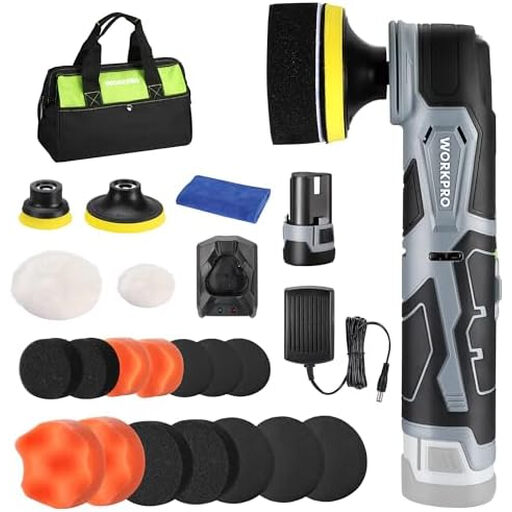
Why This Fits Their Persona: A compact option for UK drivers handling occasional waxing, spot polishing and small-area detailing without storing a full-size machine.
The five speed settings provide more control than a single-speed buffer, while the battery indicator makes remaining charge easier to monitor.
0.85 kg stated weight, 2,000 mAh battery and a kit containing pads, sandpaper, charger and carrying bag.

Why This Fits Their Persona: Suited to users wanting a larger 125 mm cordless car buffer for routine work across full-vehicle panels.
Its two replaceable 5 Ah batteries address the short-runtime issue, while the display shows speed and battery information during use.
Six speeds from 2,000 to 4,500 RPM, LCD display, 8 mm eccentric action and approximately 60 minutes stated runtime per battery.
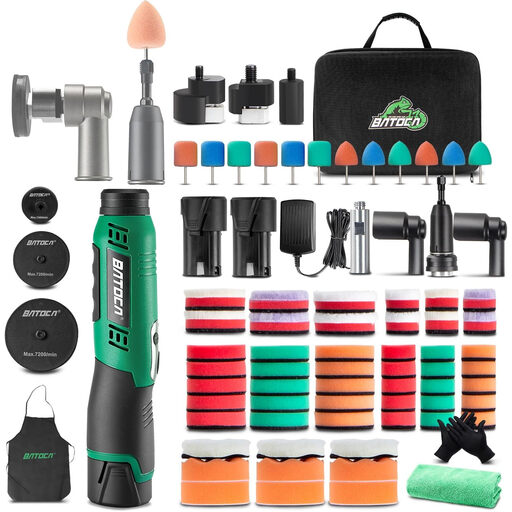
Why This Fits Their Persona: Designed for motorcycle owners, detailers and hobbyists working around wheels, emblems, mirror housings and other confined areas.
It does not rely on one pad size: the kit includes 25 mm, 50 mm and 75 mm backing plates plus rotary and orbital systems.
Switchable DA and RO operation, 3 mm and 12 mm eccentric drives and separate mini polishing speeds up to 21,000 RPM.
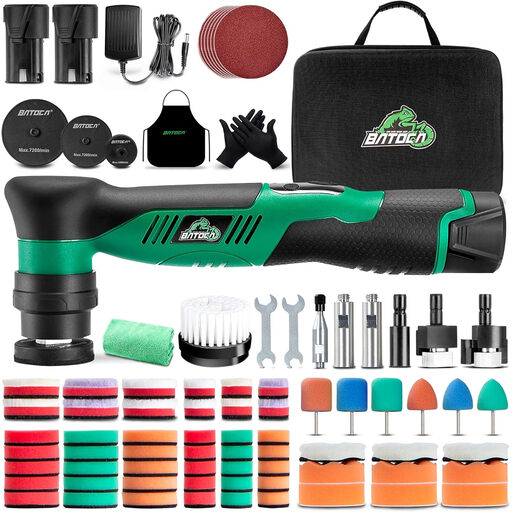
Why This Fits Their Persona: A flexible choice for users moving between paint correction, waxing and precision work on cars, wheels and headlights.
The interchangeable shafts offer rotary, 3 mm orbital and 12 mm orbital modes, reducing the need to buy separate machines.
Six speed levels from 2,000 to 5,500 RPM, two 12 V 2 Ah batteries and 25 mm, 50 mm and 75 mm polishing pads.
We have compiled a complete, real-time list of products that fully satisfy these strict selection criteria and UK safety regulations.
Before using a car detailing polisher:
A cordless polisher can support waxing, paint refinement and localised correction, but deep scratches may extend beyond the top clear coat. Avoid treating a polishing machine as a guaranteed repair solution.
It can be, provided the battery capacity, pad size and ergonomics match the job. A 125 mm orbital machine is generally more practical for broad panels, while mini polishers are suited to edges and detail areas. Two batteries can help reduce downtime.
A dual-action or orbital polisher is usually easier to control for general polishing and waxing because its eccentric movement can be more forgiving. A rotary polisher offers direct rotation for focussed work but needs careful speed, pressure and movement management.
Electricity use for charging is typically only one part of the ownership cost. Also consider replacement batteries, compatible pads, backing plates and compound. Choosing a machine with replaceable batteries and standard-size accessories may make ongoing ownership more practical.