
24/7 Customer Support

Free returns

Same-day & Next-day Delivery

Quality Guaranteed

Unlock Your Welcome Offers: FREE Delivery | Up to 80% OFF | Free 30-day JoyPlus trial
Download the APP
A cordless handheld vacuum cleaner can be useful for clearing crumbs from a car, pet hair from a sofa or dust from a keyboard. However, compact designs vary considerably. Some are intended only for light debris, while others are converted stick vacuums suitable for floors and carpets.
The main buying mistake is choosing by a large suction number alone. Before ordering, consider runtime, attachments, filtration, charging and the surfaces you actually need to clean.
Manufacturers may list suction in Pa, kPa or air watts. These measurements are not always presented under identical conditions, so a higher number does not automatically mean better real-world cleaning. Airflow, nozzle design, brush type and filter condition also affect performance.
A mini vacuum cleaner with a high advertised figure may still be designed for sand, crumbs and loose dust rather than embedded carpet debris. Check the intended use and included tools before buying.
Runtime is usually measured in the lowest power mode. A portable cordless vacuum may run for much less time on its strongest setting. For example, the Fanttik Slim V8 APEX provides up to 40 minutes in Eco Mode but up to 13 minutes in Max Mode.
This may be sufficient for a car interior or desk, but it is not the same as cleaning a whole home. If you need longer sessions, consider a stick model with a larger battery or detachable battery.
A blocked filter or dust cup can reduce airflow. Washable filters also need to be completely dry before refitting. Several compact models use USB-C charging, but charging speed and adapter requirements differ. The Fanttik model specifies a charger of 15W or higher, while other products may include their own charging equipment.
For a car vacuum cleaner, check whether the cable can connect to a suitable car adapter or power bank. Never use a vacuum to collect liquids, hot ash, burning materials or flammable substances.
For light car detailing, desks and keyboards, a 4-in-1 vacuum cleaner with a crevice nozzle, brush and flexible hose can be more useful than a powerful floor head. Pet owners should look for a dedicated pet brush or anti-tangle roller, particularly for upholstery and carpets.
A larger stick vacuum is more appropriate for floors. The MONSGA ME03/MV3 lists a 550W brushless motor, up to 55kPa suction and a tangle-reducing brushroll. These figures indicate a different product class from a small handheld car vacuum.
Compare both power modes and charging time. A rechargeable vacuum cleaner that offers 10–15 minutes on maximum power can suit quick jobs, but larger homes may require 40–60 minutes in a lower mode.
Type-C charging is convenient for offices, student rooms and vehicles. It also makes it easier to share a cable, although the correct power output still matters.
Weight affects how comfortable the vacuum is when cleaning stairs, ceilings or a car dashboard. Models weighing around 0.3–0.5 kg are easy to hold, but they usually have smaller dust cups.
A vacuum cleaner with HEPA filter can help capture fine dust, subject to the product’s stated filtration specification. Look for washable or replaceable filters and a simple emptying mechanism. Useful accessories include:
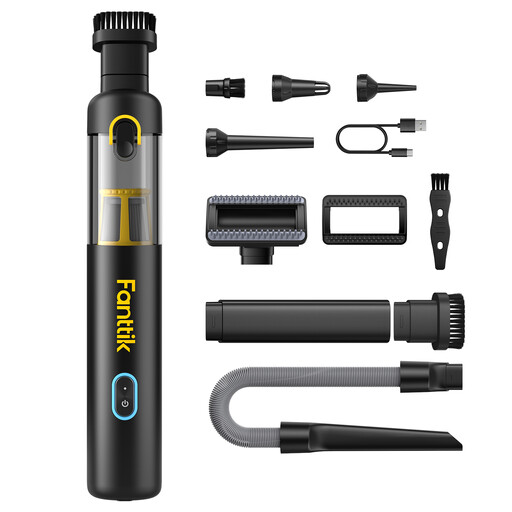
Why This Fits Their Persona: A compact choice for UK drivers, renters and students who need occasional cleaning for a car, office desk or keyboard rather than whole-home floor care.
Its two stated modes make the runtime distinction clear: up to 40 minutes in Eco Mode and 13 minutes in Max Mode, rather than presenting one unspecified figure.
498g weight, USB-C charging, two suction modes, HEPA filter and accessories for vacuuming, blowing, inflating and pumping.
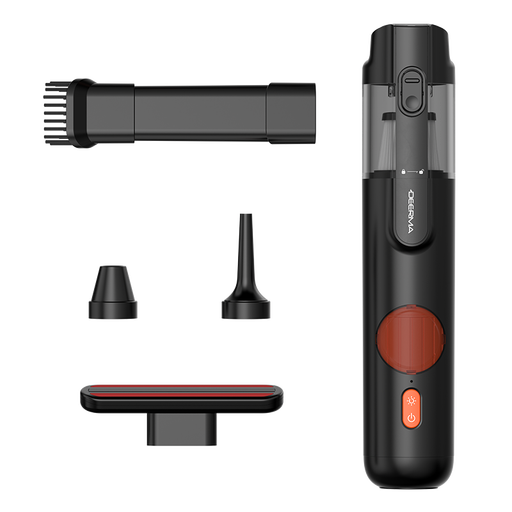
Why This Fits Their Persona: Suits buyers who value a light, organised device with several functions for car interiors, furniture and small household jobs.
The listed 30-minute runtime and 434g weight give clearer expectations for portable cleaning than a full-size floor vacuum.
Six functions, Type-C charging, one-touch dust disposal and a green light intended to make hidden dirt easier to see.

Why This Fits Their Persona: Designed for households with carpets, hard floors and pet hair where a small car vacuum alone would not cover the cleaning routine.
Its specifications separate Bare Floor and Carpet modes, with up to 55 minutes stated for Bare Floor Mode rather than implying identical runtime at maximum suction.
0.7-litre dustbin, five-stage filtration, anti-tangle brushroll, LED display and a detachable battery.
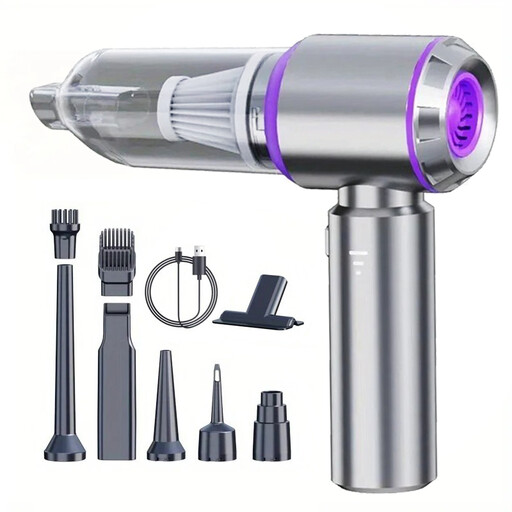
Why This Fits Their Persona: A practical match for users who want one tool for car cleaning, household surfaces, blowing and inflation tasks.
The product listing identifies a 6000mAh battery and battery quantity indicator, helping users monitor charge during longer jobs.
16,000Pa stated suction, brushless motor, three speeds and four functions including suction, blowing, pumping and charging.
We have compiled a complete, real-time list of products that fully satisfy these strict selection criteria and UK safety regulations.
Yes, if it includes a crevice tool, flexible hose or brush attachment and has enough runtime for the vehicle’s interior. Compact models are easier to store in a boot, but they may not replace a full-size vacuum for heavily soiled carpets.
It depends on the power mode, battery capacity, brush head and surface. Use the manufacturer’s Eco and Max figures as separate measurements. For occasional spot cleaning, 10–15 minutes at higher power may be adequate; regular household cleaning calls for a longer-rated model.
Charging a small cordless vacuum generally uses little electricity, but the exact cost depends on battery capacity, charging losses and local electricity tariffs. Keeping filters clean and avoiding blocked air passages can also help maintain airflow and reduce unnecessary repeat cleaning.