
24/7 Customer Support

Free returns

Same-day & Next-day Delivery

Quality Guaranteed

Unlock Your Welcome Offers: FREE Delivery | Up to 80% OFF | Free 30-day JoyPlus trial
Download the APP
As a Joybuy Product Recommendation Officer, my role is to help you navigate the crowded market of car care tools. When it comes to achieving a flawless finish, a cordless mini car polisher is an indispensable tool for any serious enthusiast or professional detailer. However, the market is filled with models that promise much but deliver little, leading to frustration and wasted money.
This guide cuts through the clutter. We will look at the common pitfalls to avoid and the essential features that define a truly effective car detailing polisher, ensuring you invest in a tool that delivers precision and performance where it counts.
Before you add a polisher to your basket, be aware of these common issues that can turn a promising purchase into a workshop paperweight.
To ensure your new tool is an asset, not a liability, focus on these three non-negotiable parameters.
Understanding the drive mechanism is crucial for paint safety and finish quality.
For maximum versatility, a machine that offers both switchable RO and DA modes provides the benefits of both worlds in one tool.
For a cordless tool, the battery system is its heart. A 12v car polisher is the standard for this category, offering a good balance of power and weight. However, you must look deeper:
A mini polisher's effectiveness is defined by its ability to get where larger tools cannot. The included attachments are therefore vital.
We have identified models that address the common pitfalls by delivering on the core features that matter. Instead of a generic list, we have matched our recommendations to specific user needs.
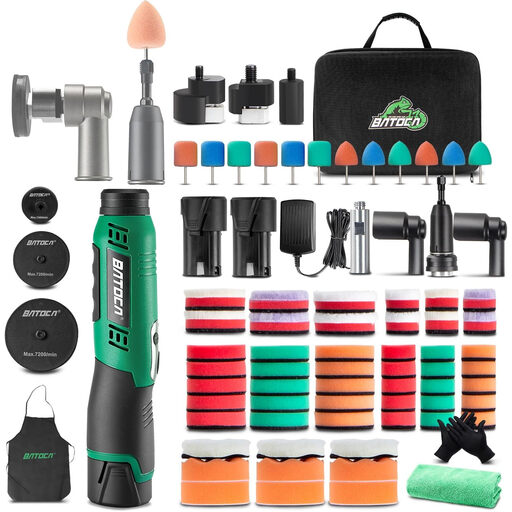
Why This Fits Their Persona: The professional detailer needs a complete, versatile system that can handle any task without compromise. This kit is built for efficiency and adaptability on client vehicles.
It includes two 2.0Ah batteries to eliminate downtime. The kit also provides a full suite of functional attachments, including switchable 3mm and 12mm DA drives, a rotary drive and multiple backing plates (25mm, 50mm, 75mm).
The ability to switch between rotary and dual action modes in one compact machine makes it a highly versatile tool for both heavy correction and fine finishing.
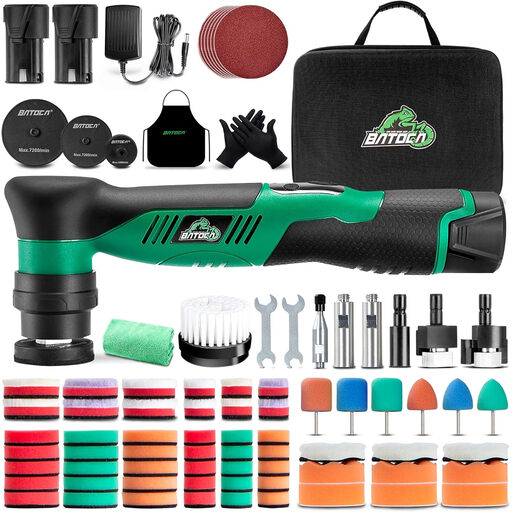
Why This Fits Their Persona: This user is passionate about maintaining their own car or motorcycle to a high standard. They need a reliable, precise tool for detailed work without necessarily requiring every professional-grade attachment.
It directly solves the battery life and versatility problems. The kit includes two batteries for continuous polishing and offers a 3-in-1 system (rotary, 3mm DA, 12mm DA) to handle a wide range of detailing tasks safely.
The tool-free quick-change system for swapping between drive shafts is a major convenience, allowing the user to switch from rotary cutting to DA finishing in seconds without interrupting their workflow.
We have compiled a complete, real-time list of products that fully satisfy these strict selection criteria and UK safety regulations.
While manufacturers often quote a "no-load" runtime of 30 minutes or more, you should expect around 20-40 minutes of real-world polishing time per battery. The actual duration depends heavily on the speed setting, the pressure you apply and the size of the pad. This is precisely why a kit with two swappable batteries is essential for any task that takes longer than half an hour.
Technically yes, but it would be incredibly inefficient. A small polisher for tight spaces is a specialist tool designed for precision. It excels on A/B/C pillars, bumpers, spoilers, side skirts and around badges. For large, flat panels like a bonnet, roof, or doors, a full-size polisher will save you a significant amount of time and effort.
For anyone new to machine polishing, a dual action polisher kit is the recommended choice. The random orbital motion is far more forgiving and distributes heat more effectively, drastically reducing the risk of burning through paint or leaving holograms. A rotary polisher is a powerful tool, but it requires a steady hand and experience to be used safely. A mistake with a rotary polisher can be very costly to fix.