
24/7 Customer Support

Free returns

Same-day & Next-day Delivery

Quality Guaranteed

Unlock Your Welcome Offers: FREE Delivery | Up to 80% OFF | Free 30-day JoyPlus trial
Download the APP
A portable cordless tyre inflator can be useful for routine pressure checks, topping up a slow leak or dealing with a flat tyre away from home. It can also serve as a bicycle pump, motorcycle tyre pump or inflator for sports balls. However, headline figures do not always tell the full story.
Before buying a cordless tyre pump, watch for three common pitfalls:
For UK drivers, an inflator is a convenient top-up tool rather than a replacement for checking tyre condition. It cannot repair a puncture, and a tyre that repeatedly loses pressure should be inspected by a qualified garage or breakdown service.
For occasional car use, look beyond the maximum pressure. Airflow measured in litres per minute (L/min) gives a more practical indication of how quickly air can be delivered. The claimed result may vary between products, so treat inflation times as guidance rather than a guarantee.
A 150 PSI tyre inflator is generally suitable for cars, motorcycles, bicycles and balls, provided the product’s stated compatibility matches your requirements. It is not automatically suitable for large commercial vehicles, trailers or specialist equipment. Some compact units are specifically unsuitable for trucks, RVs or off-road vehicles.
Also check whether the instructions require cooling pauses. Continuous operation can create heat, particularly when inflating a low car tyre. A portable air compressor designed for small top-ups may not be appropriate for inflating several large tyres from empty.
A rechargeable air compressor should be fully charged before it is stored in the car. USB-C charging is convenient at home or from a vehicle adapter, while a dual-power model may also connect to a 12V socket.
Battery capacity is normally shown in mAh, but capacity alone does not indicate the exact number of inflations. Consider:
Electric vehicle drivers may particularly value a cordless design because it avoids relying on a nearby 12V outlet. Even so, a charged battery remains essential for roadside use.
An automatic shut-off tyre inflator lets you set a target pressure before inflation. This can reduce the risk of overfilling, but you should still use the pressure specified in your car handbook, driver’s door frame or fuel flap. Do not use the maximum PSI printed on the pump as your vehicle’s target.
Useful features include:
A compact design is helpful, but very small pumps may be slower on car tyres. Match the size and airflow to your actual use rather than choosing solely by weight.
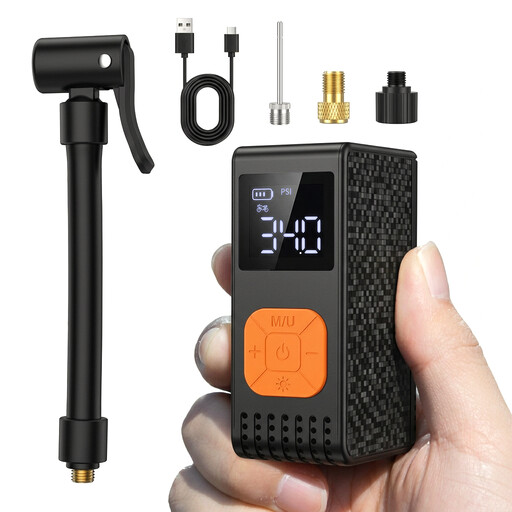
Why This Fits Their Persona: A compact option for cyclists, motorcyclists and households that mainly inflate smaller tyres or sports balls.
Its listed use modes are motorcycle, bicycle and ball, so buyers can assess its limitations instead of assuming it is designed for repeated car-tyre inflation.
1600mAh battery, USB-C charging, LED lighting and a stated bicycle inflation time of approximately 70 seconds from 0 to 2.06 BAR.

Why This Fits Their Persona: A lightweight choice for UK car owners wanting a compact emergency roadside air pump with multiple preset modes.
The listed specification includes 17L/min airflow, a 4000mAh battery and a stated limit excluding off-road vehicles, RVs, trucks and trailers.
150 PSI maximum pressure, five inflation modes, four pressure units, automatic shut-off, LED modes and USB-C input/output.

Why This Fits Their Persona: Suitable for drivers, EV users and outdoor travellers who want higher stated airflow and a larger battery for varied inflating tasks.
Its stated 35L/min airflow and 7500mAh battery provide clearer information for comparing heavier use, while the product still lists suitable vehicle and valve limitations.
160 PSI maximum pressure, four preset modes, manual settings from 4 to 160 PSI, automatic shut-off, LED lighting and power-bank functionality.
We have compiled a complete, real-time list of products that fully satisfy these strict selection criteria and UK safety regulations.
Many models are designed for car tyres, but suitability depends on airflow, battery capacity, tyre size and the manufacturer’s stated compatibility. A compact car air pump is usually intended for pressure top-ups rather than inflating several completely flat tyres.
There is no universal figure. Runtime changes with tyre size, starting pressure, temperature and the condition of the battery. Check the manufacturer’s stated number of tyres or operating minutes, then recharge the unit after use so it is ready for an emergency.
Automatic shut-off stops inflation when the preset value is reached, but it is not a substitute for checking the correct pressure or ensuring the hose is attached securely. Confirm the reading after removing the connector and follow the vehicle manufacturer’s guidance.