Radiator-gap cleaning prioritiser
If reaching behind radiators and around pipes is the main task, the shape and compatibility of the crevice tool matter more than a floor-head claim.


Choose the crevice tool to fit the radiator gap before comparing headline vacuum figures. A long, narrow nozzle needs to reach the dust; pipework or a blocked approach may call for a compatible flexible or angled tool. If the vacuum will also clean the rest of the holiday let between stays, consider handheld use and the tools needed for floors and furnishings.
If reaching behind radiators and around pipes is the main task, the shape and compatibility of the crevice tool matter more than a floor-head claim.
If one cordless vacuum must cover radiator dust, floors and furnishings, consider how readily it switches to handheld use and whether its tools and battery arrangement suit repeated cleans.
If avoiding dispersed dust is a priority, collect settled dust with a vacuum rather than blowing it out of the gap. Equipment used regularly in a letting operation also needs appropriate upkeep.
Measure the radiator access first, then decide whether the same machine must handle the rest of the turnover clean.
| Concern | What to check | Who this matters to |
|---|---|---|
| Reaching the radiator gap | Measure the narrowest opening and depth; check the exact tool’s profile, reach and compatibility. | If the nozzle cannot get past the pipes, floor-cleaning figures make little difference to me; around 42% of consumers put access to the radiator gap first. |
| Whole-property turnover | Check handheld conversion and the included tools for floors and furnishings; compare runtime in the mode you expect to use. | When I clean the whole let between stays, I need the vacuum to handle more than radiators; around 25% of consumers chiefly prioritise a practical turnover routine. |
| Dust containment | Use vacuum collection rather than compressed air; assess any filtration claim for the exact model. | If I disturb dust just before guests arrive, I want to collect it rather than blow it into the room; around 17% of consumers put dust containment first. |
| Equipment upkeep | Check the condition of the vacuum, battery and charger; plan maintenance appropriate to how the appliance is used. | If the vacuum is used repeatedly or supplied to guests, I need to keep it safe and working; around 16% of consumers prioritise equipment upkeep. |
A vacuum cannot collect dust it cannot reach, even if it works well on open floors.
Measure the accessible gap and the route past pipework, then check the attachment’s dimensions and shape.
Included accessories can differ between variants of the same vacuum range.
Check both the exact model’s contents and the accessory’s compatibility list before ordering.
Blowing dust out of a gap can disperse it instead of collecting it.
The Health and Safety Executive advises vacuuming hard-to-reach dust and not using compressed air. Where vacuuming is impractical, follow its guidance on dampening dust before removal.
The Health and Safety Executive says annual portable appliance testing is not automatically a legal requirement; the equipment and its environment determine appropriate inspection and testing.
Include visual checks of the appliance and charging equipment in a maintenance routine suited to its use.
The Unlimited range is worth considering when a long flexible crevice nozzle is central to reaching around radiator pipework.
Its angled and illuminated gap tools address different access problems for compatible cordless machines.
The Triflex HX2 configuration is relevant when radiator cleaning is part of a wider holiday-let turnover routine.
These cordless stick vacuums suit consideration when radiator cleaning is part of a wider floor and furnishing clean. Check whether each model’s crevice tool can enter and reach through your radiator gap before choosing either one.
 Image unavailable
Consider this model for cleaning floors and furnishings between stays if its crevice tool fits the radiator access.
The product name states 55KPa, 550W and up to 55 minutes of runtime; the stated runtime applies to Bare Floor Mode.
Measure the gap and confirm the tool’s reach and shape, particularly where pipes block a straight approach.
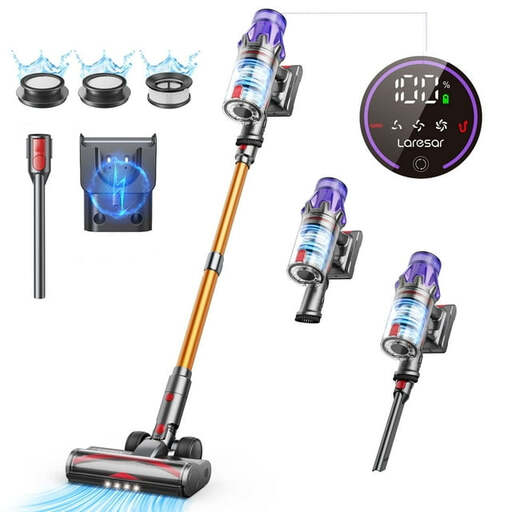 Image unavailable
Consider this model when radiator dust is one task within a wider clean, provided its crevice tool can reach through the measured gap.
The product name states 50KPa, 500W and a 60-minute runtime claim. Runtime varies by operating mode.
Check the tool’s profile around pipework and choose a cleaning mode suited to the work you need to finish.
Measure the smallest accessible opening, the depth to the dust and the route around pipes, then compare those measurements with the exact tool. Dyson UK specifies its Light Pipe Crevice Tool for spaces as small as 19.2 mm and reach up to 225 mm; those dimensions do not describe every crevice tool.
Do not use compressed air to blow radiator dust into the room. The Health and Safety Executive advises collecting dust with a vacuum, including in hard-to-reach places, and gives dampening guidance where vacuuming is impractical.
No: check compatibility against the exact model, not just the brand. Dyson UK lists different compatible machines for its Awkward Gap Tool and Light Pipe Crevice Tool, and Bosch advises checking appliance compatibility for its flexible crevice nozzle.
Annual portable appliance testing is not an automatic legal requirement. The Health and Safety Executive says electrical equipment with potential to cause injury must be maintained safely, while inspection and testing should reflect the equipment and its environment; visual checks remain important.
If the vacuum is supplied to guests, keep it and its charging equipment safe and check the obligations applicable to the accommodation. Bath and North East Somerset Council’s guidance says electrical equipment supplied with rented accommodation must be safe; check how the relevant rules apply to your property.