
24/7 Customer Support

Free returns

Same-day & Next-day Delivery

Quality Guaranteed

Unlock Your Welcome Offers: FREE Delivery | Up to 80% OFF | Free 30-day JoyPlus trial
Download the APP
A corner shelving unit can turn an unused angle into useful storage, but the wrong model may create new problems. A shelf that looks spacious online can be too shallow for everyday items, while a tall unit may feel unstable if it is not properly secured. Renters, students, homeowners and small businesses should check more than appearance before buying.
Three common buying pitfalls deserve attention:
The right choice depends on where the unit will stand, what it will hold and how much room you have for assembly and access.
Measure the corner from floor to ceiling, then allow clearance for skirting boards, sockets, windows and cupboard doors. A narrow space-saving storage shelf may fit a bedroom or home office, but its shelves might not accommodate deep folders or large toiletries.
For a corner bookshelf, check whether the shelf width and depth suit your books. In a bathroom, consider the size of bottles and whether the material is suitable for regular wiping. A kitchen corner organiser should leave enough space to reach stored items without knocking nearby handles or worktop accessories.
Tall designs also need careful positioning. A unit measuring 180 cm high can provide substantial vertical storage, but it may be unsuitable beneath low windows or sloping ceilings.
Look for a clearly stated maximum static weight capacity per shelf. This figure should be treated as a limit for evenly distributed, stationary items, not as permission to overload one point with a heavy object.
Books, cookware and storage boxes can create concentrated weight. Place heavier items on lower shelves where possible and avoid climbing, sitting or leaning on shelving. For heavy-duty corner shelving, compare both the per-shelf capacity and the construction of the frame, brackets and boards.
The SRD unit lists a capacity of up to 10 kg per shelf, while the JOYFURNOS floating model lists up to 6 kg per shelf. These figures provide a more useful comparison than phrases such as “strong” or “sturdy” on their own.
Common materials include particleboard, MDF and metal. MDF corner shelves offer a smooth, uniform board surface, while particleboard can provide a practical option for lighter display storage. Metal frames are often suitable for utility rooms, garages and workplace storage, but the finish and shelf boards still need consideration.
For a wall-mounted corner shelf, inspect the fixing system and confirm that the supplied hardware is appropriate for your wall type. Plasterboard, brick and masonry may require different fixings. Do not rely solely on decorative concealed brackets if the wall cannot support the load.
Freestanding industrial corner racking should stand on a level surface. Feet and corner protectors can help protect floors and walls, while an anti-tip kit offers an additional stability measure where supplied. Follow the assembly instructions and avoid modifying the frame.
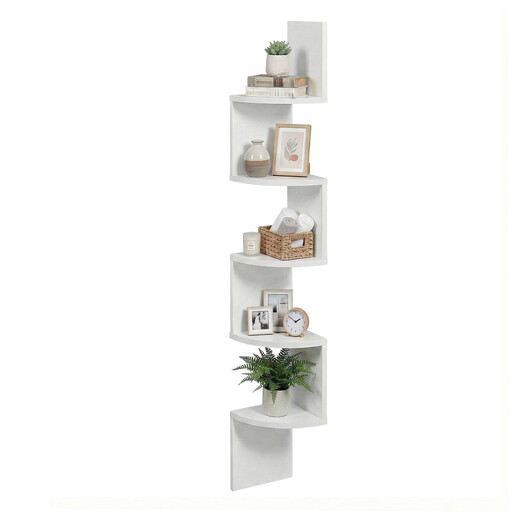
Why This Fits Their Persona: Its 20 x 20 x 126 cm vertical format suits renters, students and home-office users who want display storage without taking up floor space.
The listed dimensions and 6 kg per-shelf static capacity make it easier to plan for books, ornaments, plants or toiletries instead of guessing from photographs.
Five curved particleboard shelves, a zigzag layout and a concealed fixing system provide vertical display storage with a white finish.
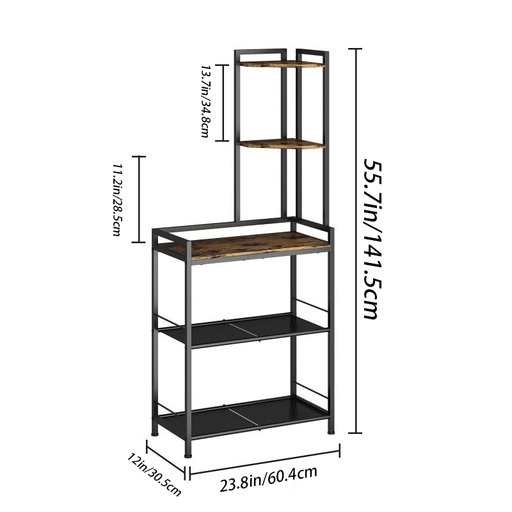
Why This Fits Their Persona: The combination of a metal frame, MDF shelves and rustic brown-and-black finish suits buyers furnishing a living room, bedroom, office, bathroom or kitchen with one adaptable unit.
Its stated 10 kg capacity per shelf and included anti-tip kit address the risks of relying on appearance or leaving a tall freestanding unit unsecured.
It has five shelves, a 90-degree corner design, metal framing and dimensions of 58.4 x 27.9 x 127 cm. Assembly instructions and a video guide are included.
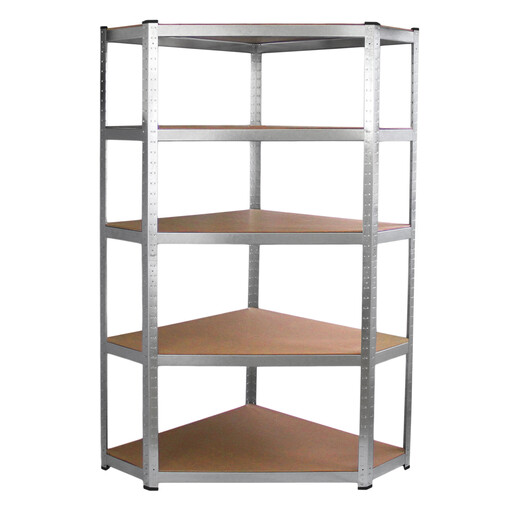
Why This Fits Their Persona: Its larger footprint suits garages, stockrooms, workshops, utility areas and small businesses that need practical vertical storage rather than decorative display space.
The 90 x 30 x 180 cm dimensions, 0.7 mm galvanised steel and 5 mm MDF boards give clearer information for planning heavier storage than vague strength claims.
Five MDF shelves, boltless assembly, feet and corner protectors are specified. It can also be used alongside other compatible storage shelves to create a wider racking arrangement.
We have compiled a complete, real-time list of products that fully satisfy these strict selection criteria and UK safety regulations.
Assembly varies. Floating designs require accurate marking and wall fixing, while freestanding units often involve connecting frames and boards. Boltless racking can reduce the need for tools, but it still needs careful alignment. Read the instructions before starting and allow enough floor space to lay out parts.
Lifespan depends on load, moisture, installation and everyday handling. Keeping within the stated capacity, protecting boards from prolonged dampness and tightening fixings when necessary can help maintain stability. A metal-frame unit may suit demanding storage, while particleboard or MDF display shelves are more appropriate when used within their specified limits.
No. A standard corner shelf has no electricity cost. The main expenses are the purchase price, any additional wall fixings and, where required, professional installation. Measure carefully before ordering to avoid the cost and inconvenience of returning an unsuitable unit.