
24/7 Customer Support

Free returns

Same-day & Next-day Delivery

Quality Guaranteed

Unlock Your Welcome Offers: FREE Delivery | Up to 80% OFF | Free 30-day JoyPlus trial
Download the APP
Choosing the first proper bed for your child is a significant milestone. As they grow from a tiny newborn into an active toddler, their sleeping needs change. You're likely looking for a solution that is safe, practical and will last for more than just a few months. A cot bed is often the answer, offering a versatile and cost-effective bridge between their first cot and a single bed.
Navigating the options can be confusing. From different materials and safety features to integrated storage, there is a lot to consider. This guide is designed to cut through the clutter, offering clear, practical advice to help you find a sleeping solution that works for your child and your home.
Before exploring specific models, it's helpful to understand the key features that make a good investment. Keeping these points in mind will help you assess your options objectively.
Safety is the number one priority. In the UK, cots and cot beds must comply with specific safety standards, such as BS EN 716-1. This governs aspects like the distance between bars (to prevent a child's head from getting trapped) and the overall structural integrity. Look for sturdy frames, typically a wooden cot bed, made from solid wood like pine or beech and finished with non-toxic paint. The base should be strong and, ideally, adjustable to different heights.
The primary advantage of a cot bed is its ability to convert into a toddler bed. This is usually achieved by removing one or both of the side rails and lowering the frame. This feature not only saves you money in the long run but also provides your child with a familiar sleeping environment during the transition. Some models are designed specifically as a first kids bed with guardrails, offering a low-to-the-ground frame for easy access.
Space is often at a premium. A cot bed with storage can be incredibly useful, featuring integrated drawers underneath the frame. This is perfect for stowing away extra bedding, sleepsuits or toys, helping to keep the nursery tidy. Also, consider bundles that include a cot bed with mattress. This ensures a perfect, gap-free fit, which is crucial for safety.
Here are a few recommendations that balance safety, functionality and design to suit different family needs.

Why It Stands Out: This bed is designed specifically to make the move from a cot to a 'big bed' feel exciting rather than daunting. Its low-profile frame and built-in guardrails provide security, while the cheerful lion design makes bedtime more fun.
Pros:
Who is it for?: This is an excellent choice for parents of children aged 3-8 who are ready to leave their cot behind. It’s particularly suited for those who want to encourage independence with a bed that feels safe, accessible and playful.
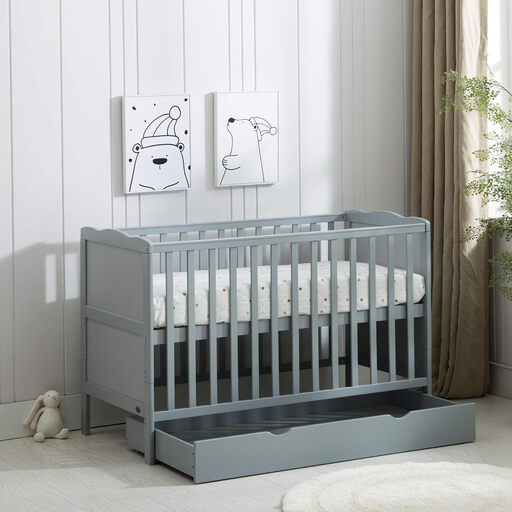
Why It Stands Out: This is a complete, all-in-one solution for a new nursery. It combines a stylish wooden cot bed with a large rollaway storage drawer and an included mattress, offering great value and convenience.
Pros:
Who is it for?: Ideal for new parents who want a practical, space-saving solution from day one. The combination of a cot, storage and mattress in one package simplifies shopping and ensures all components work together perfectly.

Why It Stands Out: This model focuses on longevity and comfort. It’s a classic wooden cot bed that easily converts into a toddler bed, but its main feature is the high-specification mattress, designed for comfort and hygiene.
Pros:
Who is it for?: This is a great fit for parents prioritising a long-term investment that grows with their child. It's especially suitable for those who place a high value on the quality and properties of the mattress their child will be sleeping on.
A bed frame is only half of the equation for a good night's sleep. If you have a frame you love but need the right mattress or if you're looking for different features, it's worth exploring your options. You can browse our full range of children's mattresses to find the perfect fit for your new bed.
1. At what age should my child move to a cot bed? There is no fixed age, but most children transition between 18 months and 3 years. The key sign is safety: if your child is starting to climb out of their cot, it is time to move them to a bed. A cot bed in its toddler bed configuration is lower to the ground and removes this risk.
2. What size mattress does a cot bed need? The most common size for a cot bed mattress in the UK is 140cm x 70cm. It is vital that the mattress is a snug fit inside the frame, with no gaps around the edges where a child could get trapped. If you buy a cot bed with a mattress included, you can be sure the fit is correct.
3. Is a cot bed with storage worth it? For most families, especially those in smaller homes or flats, a cot bed with storage is extremely practical. The under-bed drawers provide a significant amount of space for items you need close at hand, like bedding, nappies and clothes, without taking up extra floor space with another piece of furniture.