Occasional student-house presser
You press one or a few covers at a time and want an iron that is ready quickly, stores easily and has auto-off as an additional safeguard.


Choose a conventional steam iron if you want to press removable cotton cushion covers flat, but set the temperature and use steam according to each cover’s care label, not its fibre description alone. For occasional use in a student house, compact storage and auto-off are useful priorities; a larger tank and scale-management features become more relevant if you regularly iron several covers or other laundry. A handheld steamer is a compromise when saving space matters more than a pressed finish.
You press one or a few covers at a time and want an iron that is ready quickly, stores easily and has auto-off as an additional safeguard.
You also iron bedding, clothes or several covers, making sustained steam, tank capacity and scale-management features more relevant.
You have little storage space and would accept de-wrinkling instead of a fully pressed finish. A handheld steamer may suit that narrower task, but it is a compromise for cotton covers.
Start with the finish you want and the cover’s care label. Then weigh shared-house safety and storage against the capacity and upkeep needed for more frequent ironing.
| Concern | What to check | Who this matters to |
|---|---|---|
| Flat pressing and fabric care | Look for temperature controls and a suitable soleplate; compare stated continuous steam output. Follow the individual cover’s care label for heat and steam. | If I want flat panels and neat edges, I need an iron I can set for this particular cover rather than assuming all cotton takes the same heat. Around 40% of consumers would make pressing performance their primary concern. |
| Shared-house safety | Check for auto-off and a UK 3-pin plug and fuse. If an extension lead is necessary, check its rating and do not chain leads together. | When I might be interrupted in a shared home, I want an extra safeguard without treating it as a reason to leave the iron plugged in. Roughly 30% of consumers would put shared-house safety first. |
| Storage and occasional use | Consider the iron’s size, tank and stated heat-up time, along with space to let the iron cool safely after use. | If I press only a cover or two, I want the appliance to fit into limited storage between sessions. Around 20% of consumers would prioritise that convenience. |
| Steam upkeep | For regular use, compare tank capacity and the exact model’s anti-calc, self-clean or removable scale-collector features. | When I iron several items regularly, refilling and dealing with scale matter more to me than they would for a single cover. Approximately 10% of consumers would make upkeep their main priority. |
GINETEX advises selecting the maximum ironing temperature from the care label. A cover’s lining, print or trim may need different care from its outer fabric.
Read the label on each removable cover before choosing the temperature or using steam.
Philips says a garment steamer does not give the same results as an iron, particularly on thick cotton or linen.
Choose an iron for flat pressing; consider a handheld steamer if touch-ups and compact storage matter more than a crisp finish.
Auto-off is an additional feature, not a reason to leave a hot iron unattended. Electrical Safety First also warns against overloaded or chained extension leads.
Unplug the iron after use. Use a sound wall socket where possible; if you need an extension lead, check its rating and fully unwind a cable reel when its full rating is needed.
A larger tank and scale-management features are more relevant to repeated household ironing than to pressing an occasional cover.
Decide how often you will iron other laundry before giving those features priority over storage and the temperature controls you need.
A larger iron also needs storage space between uses.
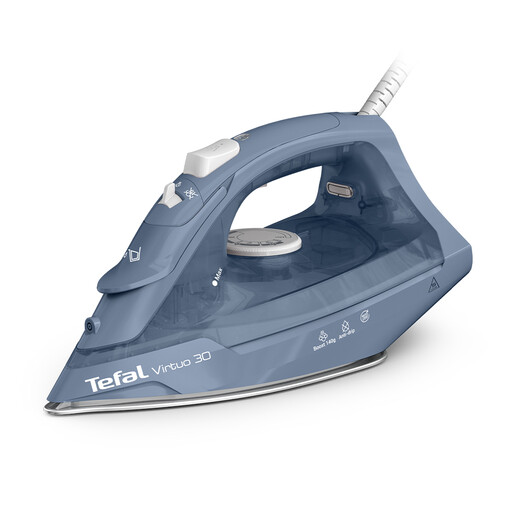
Tefal’s Virtuo 30 FV2C64G0 illustrates a compact, occasional-use steam iron, while the Ultraglide+ FV5872 illustrates a higher-output model with a removable Scale Collector.
The Mineral Glide 26261 is a model to consider for more regular ironing rather than as a measure of every Russell Hobbs iron.
Philips provides a higher-output conventional-iron example in the refurbished 7000 Series DST7020/20R1, as well as guidance on how garment steamers differ from irons.
These conventional steam irons are choices to consider if your aim is to press removable cushion covers flat. Check the cover’s care label and each iron’s temperature controls before use.
 No image available
Consider this compact model for occasional cover pressing where storage space matters.
The listed variant is 2200 W with a 240 ml tank and 30 g/min continuous steam; Tefal also lists a ceramic soleplate, a 30-second heat-up and auto-off for the FV2C64G0.
Check its temperature controls and UK plug and fuse before buying. Confirm the steam-boost rating if you intend to rely on it, as the stated figures differ.
 No image available
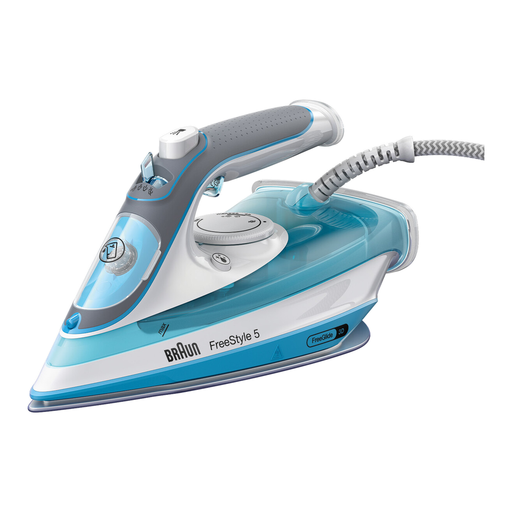
Consider this conventional steam iron if you want to press covers flat and are comparing soleplate and steam-iron features.
The listed variant is 2600 W and names a SuperCeramic soleplate, FreeGlide 3D and anti-drip protection.
If continuous steam output or auto-off is important to your choice, confirm those details for the SI5008BL. Check the UK plug and fuse before buying, and follow each cover’s care label during use.
No. GINETEX advises choosing the maximum ironing temperature from the cover’s care label, not its fibre content alone. Check the label particularly carefully if the cover has a lining, print, trim or blended construction.
A handheld steamer may suit touch-ups, but choose an iron if you want a flat, pressed finish. Philips says steamers do not give the same results as irons, especially on thick cotton or linen.
Check that the iron has a UK 3-pin plug and fuse and that its plug and cable are undamaged, then unplug it after use. Electrical Safety First advises checking an extension lead’s rating, avoiding chained leads and fully unwinding a cable reel when its full rating is needed.