Hosts pressing several dresses at changeover
When several cotton dresses need pressing in a short window, steady steam, fewer refill breaks and a manageable cleaning routine become important.


Choose a conventional steam iron if you press a modest number of cotton dresses between stays and need compact storage. If changeovers regularly involve larger batches and refilling interrupts the work, consider a steam generator—but check where its separate base will fit and how you will maintain it. Auto-off is a useful feature, not a substitute for managing fire and electrical risks at the property.
When several cotton dresses need pressing in a short window, steady steam, fewer refill breaks and a manageable cleaning routine become important.
If the iron has to fit in a small cupboard, the appliance’s overall format matters. Which? describes conventional steam irons as more compact to store than steam generators with separate tanks.
Scale care may be a deciding factor with regular use. Philips notes that scale forms faster in harder water; follow the cleaning procedure for the model you choose.
Choose it when: Dress batches are modest and a single appliance is easier to store.
Allow for: Which? notes that a conventional iron has a smaller integrated tank than a steam generator, so longer runs may involve more refills.
Choose it when: Repeated changeover batches make refill breaks a practical concern.
Allow for: The separate base needs space for use and storage; a higher stated steam output does not guarantee a better finish on every dress.
| Concern | What to check | Who this matters to |
|---|---|---|
| Changeover time | Compare stated continuous steam output in g/min and tank capacity in ml or L; check whether a generator base fits the work area. | When several dresses need pressing in one session, stopping to refill breaks up the work. Around 42% of consumers put uninterrupted batch pressing first. |
| Dress details and finish | Read garment care labels, then consider steam adjustment and access around buttons, seams or pleats. | For dresses with fastenings or shaped sections, I want control around the details rather than relying on maximum steam alone. Around 33% of consumers make that pressing control their primary concern. |
| Maintenance and safe use | Check the model’s descaling method, auto-off behaviour and how its cable, plug and storage condition will be monitored. | If the iron sees frequent use or the water is hard, I need a cleaning routine I can keep up with and a way to manage it safely between stays. Around 25% of consumers prioritise maintenance and safe use. |
A burst is intermittent. For several dresses in succession, the stated continuous-steam rate, tank capacity and refill routine are more useful points to compare.
Compare figures in g/min alongside tank size and the cleaning instructions. Treat manufacturer steam figures as specifications, not independent crease-removal rankings.
Auto-off does not replace safe storage, appliance maintenance or appropriate fire-risk controls. Home Office guidance for small paying-guest accommodation in England addresses fire-risk management separately from an appliance’s features.
Plan how the iron will be checked, used and stored after cooling, and consider it in the property’s fire-risk arrangements where applicable.
A separate base changes how much room the appliance needs at the ironing station and in storage.
Check both locations before choosing a generator, and decide whether fewer refill interruptions justify handling a two-part appliance.
The Health and Safety Executive says electrical-safety regulations do not prescribe a universal annual portable appliance test. Visual inspection and maintenance remain relevant to the appliance and its use.
Check the cable, plug and casing for visible damage, and arrange inspection or testing at intervals appropriate to the property and appliance. Check any applicable licence or insurer conditions separately.
Tefal has relevant conventional irons and steam generators for comparing a compact single-unit format with a separate-base format.
Selected Philips irons offer scale-release and fabric-handling features worth checking against the exact model’s instructions.
The Powersteam Ultra 20630 is a conventional steam-iron reference for hosts comparing single-unit appliances.
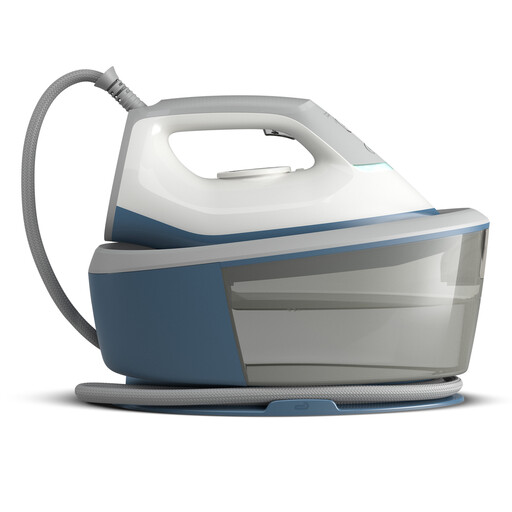
This steam generator is relevant if repeated dress-pressing batches make a separate-base iron worth considering. Compare its storage needs and maintenance routine with the simpler conventional-iron route before deciding.
 No image available
Consider this separate-base format for repeated pressing sessions if it fits your worktop and storage space. The product name states 2400 W; check the tank capacity, descaling instructions, auto-off behaviour and electrical suitability for your property before buying.
Yes, an iron supplied or used at a holiday let should be considered in the property’s practical fire-risk controls. Home Office guidance addresses fire safety in small paying-guest accommodation in England; check the requirements for the property’s UK nation, premises and any local conditions rather than assuming the same rules apply everywhere.
The Health and Safety Executive says electrical-safety regulations do not prescribe universal annual portable appliance testing. Set inspection and testing intervals according to the equipment and its environment, while checking for any applicable property-specific, licensing or insurer requirements.
Follow the instructions for the exact Philips model and the water conditions where it is used. Philips says harder water accelerates scale formation; for compatible 8000 Series DST80xx irons, its Quick Calc Release instructions call for cleaning monthly or as needed.
Use vertical steam for an appropriate hanging-garment touch-up, but do not assume it gives the same finish as flat pressing. Selected irons offer the feature, while Which? discusses clothes steamers as a quick way to remove creases; choose the method according to the dress’s care label and the finish required.