Small-home waistcoat pressers
You want the waistcoat laid flat so you can work around buttons, seams and edges, but need an iron and pressing surface that can be put away afterwards.


Choose a compact steam iron if you need to press a cotton waistcoat flat around its buttons, seams and front edges, and have room for a stable, heat-safe tabletop surface. A handheld steamer suits quick refreshes when you cannot set up a pressing surface; a steam station makes more sense for regular multi-garment sessions if you can store its separate base. Whichever route you choose, follow the whole waistcoat’s care label, including any limits relevant to its lining or trim.
You want the waistcoat laid flat so you can work around buttons, seams and edges, but need an iron and pressing surface that can be put away afterwards.
You mainly want to refresh one waistcoat shortly before wearing it and cannot set up a pressing surface. A handheld steamer is the lower-setup option if the garment and steamer instructions permit its use.
You press several garments in a session and have storage room for a separate steam-station base and tank.
Choose it when: a flat, controlled press matters more than avoiding all setup.
Allow for: a stable, heat-safe pressing surface, even if you use a tabletop board rather than a full-size one.
Choose it when: a quick refresh without a board is enough.
Allow for: less control over sharp front edges and detailed flat pressing than a conventional iron provides.
Choose it when: you regularly iron several garments in one session.
Allow for: storage and setup space for both the iron and its separate base.
| Concern | What to check | Who this matters to |
|---|---|---|
| Precise flat pressing | Look for a slim or pointed soleplate tip and temperature controls that let you follow the garment’s care label. | If I want defined waistcoat fronts and careful work between buttons, I need the control of a flat press. Around 34% of consumers would put that precise finish first. |
| Minimal setup and storage | Check stored dimensions and whether the model’s instructions support the way you intend to use it on a hanger. | With nowhere to set up a board, I would accept a refresh rather than a crisp press. For around 33% of consumers, avoiding a pressing-surface setup would be the priority. |
| Tidy iron storage and upkeep | Check cord storage and the model-specific cleaning instructions before choosing a conventional iron. | I still want an iron, but putting away its cable and keeping up with cleaning must fit my routine. Around 20% of consumers would make that everyday practicality their main concern. |
| Longer ironing sessions | Check tank capacity and whether both the iron and any separate base will fit in your cupboard. | When I press several garments together, stopping to refill matters more to me than owning the smallest appliance. This would be the leading need for around 13% of consumers. |
A handheld steamer avoids board setup, but it does not give you a pointed soleplate or the same flat pressing action around buttons and seams.
If a defined front edge is the goal, choose a compact iron and make room for a safe pressing surface; use a steamer when a hanger refresh is enough.
The lining, interfacing or trim of a waistcoat may need more care than its outer fabric.
Read the garment’s complete care label before selecting an iron setting, and follow any instructions for delicate details.
A steam station still has a separate base to set up and store, even when its name describes it as compact.
Measure the space for both parts, and favour the larger tank only if you regularly press several garments.
A small iron may still be awkward to put away if its cable is loose; steam models also have model-specific cleaning requirements.
If cupboard tidiness matters, check the cord arrangement, then read the manual’s cleaning and storage instructions before buying.
Its DST1030/20 and DST5030/26 illustrate two conventional-iron sizes to consider for this task.
Its range includes the foldable Access Steam Pocket DT3030 handheld steamer and the Power Pro Compact 200 SV6212G0 steam station.
The Easy Store Pro Plug & Wind Iron 26731 is relevant when a loose cable makes cupboard storage awkward.
These choices cover two different needs: a compact conventional iron for flat waistcoat pressing and a handheld steamer for lighter touch-ups where a crisp press is not essential.
 No image available
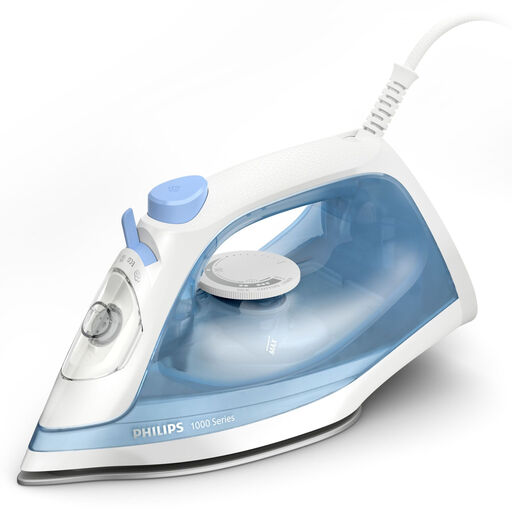
A conventional iron for pressing a waistcoat flat, with a slim tip for working around buttons and seams.
Philips specifies dimensions of 26.0 × 11.1 × 13.6 cm; the listing gives an approximate weight of 0.88 kg and a 250 ml tank.
You will still need a stable, heat-safe pressing surface. Check the iron’s temperature settings against the waistcoat’s care label before use.
 No image available
A handheld option for a quick waistcoat refresh when a sharp, flat press is not essential.
The product name specifies a 1600 W rating, 300 ml tank and UK plug.
If hanger use or a particular storage space is essential, confirm the operating instructions and stored dimensions before buying.
A handheld steamer can replace an iron for a quick refresh, but choose a conventional iron if you need to press the waistcoat flat around buttons, seams and front edges. Good Housekeeping UK notes the adjustable heat settings of traditional irons; Tefal describes its handheld route as hanger-based.
A suitable tabletop board can provide a compact pressing surface for an iron, provided it is stable and used safely. John Lewis & Partners lists tabletop boards as an alternative to full-frame boards. If you cannot set up a pressing surface, consider a handheld steamer for a refresh rather than a flat press.
Use the setting permitted by the waistcoat’s complete care label, not a setting chosen from its cotton outer fabric alone. Check the instructions for any lining or trim before applying heat.
A separate-base steam station is easier to justify if you also press several garments regularly and have space to store both parts. For an occasional single waistcoat, a compact conventional iron avoids accommodating the station’s separate base.