Solo mug users without fixed plumbing
If you mainly wash dishwasher-safe mugs, glasses and a few everyday items, a manual-fill tank may suit a worktop without a permanent water inlet. You will still need a workable drain route.


For one person mainly washing dishwasher-safe mugs, a tank-fed mini dishwasher suits a kitchen without a practical permanent water inlet, provided you can fill it and route its drain. If you have suitable plumbing and want room for occasional plates and bowls, consider a six-place-setting tabletop model, but allow for its larger worktop footprint and check that your mugs fit its rack.
If you mainly wash dishwasher-safe mugs, glasses and a few everyday items, a manual-fill tank may suit a worktop without a permanent water inlet. You will still need a workable drain route.
If plates and bowls sometimes join your mugs, look beyond the smallest rack. A larger tabletop machine offers more stated place-setting capacity, provided it fits your worktop and connections.
If you have suitable connections but limited counter space, a compact two-place-setting model with a mug shelf is another option. Check the exact machine's connection and clearance requirements before choosing its position.
Choose when: A permanent inlet is impractical and your usual load is a few mugs and other small items. The Comfee CDWMT201DW-UK listing describes a built-in 5-litre tank.
Trade-off: Manual filling remains part of the routine, drainage still needs planning, and a two- to three-place-setting rack leaves less room for mixed dishes.
Choose when: Suitable plumbing is nearby. The Russell Hobbs RH2TTDW101W offers two stated place settings and a mug shelf; the six-place-setting Candy CP 6E51LW-80 gives more capacity for mixed loads.
Trade-off: You need a suitable connection, and extra capacity takes worktop space: the listed Candy model is 55 cm wide, compared with 42 cm for the Russell Hobbs model.
| Concern | What to check | Who this matters to |
|---|---|---|
| Water supply and drainage | Check the exact model's filling or inlet arrangement and where its drain hose must go. | If I have no practical water inlet, I need a way to fill the dishwasher and drain it safely. Around 37% of consumers put inlet flexibility first. |
| Footprint and mug fit | Measure the available width, depth and door-opening space; check the rack against your mugs' height and diameter. | With little counter space, I need the door to open and my usual mugs to fit. Around 27% of consumers make a compact footprint their primary concern. |
| Mixed-load capacity | Compare rack layouts as well as place settings, and check for a half-load option if small loads are frequent. | If plates and bowls sometimes join the mugs, I want space for them in the same load. Around 18% of consumers put flexible loading first. |
| Programmes and operating details | Compare the energy label and product information sheet on the same stated basis; check programme choices and noise. | If the machine will run near where I sit, I want to weigh noise alongside the available wash programmes. Around 18% of consumers put operating details first. |
A manual-fill tank can avoid a permanent water inlet, but the dishwasher still needs power, space and a workable drainage arrangement.
Measure the intended position and check the exact model's manual for its drain hose, inlet or adaptor, electrical requirements and clearances.
Place settings describe standard crockery and cutlery, not whether a tall mug, travel cup or bulky pan fits a particular rack.
Check the rack layout and maximum item dimensions for your mugs before choosing between a small two- or three-place-setting machine and a larger tabletop model.
Which? cautions that compact dishwashers can involve energy and water compromises; appliance size alone does not establish consumption for your routine.
Compare each model's energy label, stated consumption and programme information on the same basis, then consider how often you would run it for a small mug load.
The CDWMT201DW-UK is a mini countertop option for a mug-led load where a manual-fill water supply is useful.
The RH2TTDW101W is a compact two-place-setting tabletop model with a mug shelf for kitchens with suitable connections.
The CP 6E51LW-80 is a six-place-setting tabletop option for someone who also expects occasional plates and bowls.
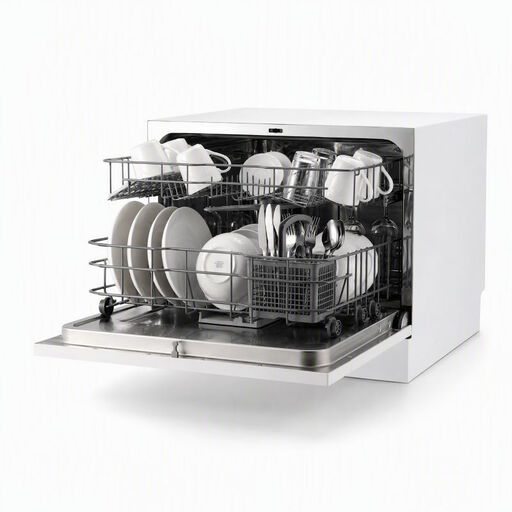
This six-place-setting countertop model is worth considering if mugs are your everyday load but you also want room for occasional dishes. Check its worktop fit, mug clearance and water connections before ordering.
 No image available
A countertop option for a mug-led routine that sometimes includes plates or bowls.
The product name states six standard place settings, a 30-minute quick wash and a 24-hour delayed start.
Check the exact dimensions and required clearances, water inlet and drain-hose arrangement, rack fit for your mugs, and energy information before buying.
It can be worthwhile if you want machine washing for small loads and have space for the appliance, its door and its drainage arrangement. Which? notes that compact dishwashers can involve compromises in loading, energy and water use, so compare the practical routine rather than assuming a small machine uses fewer resources.
Yes, if you choose a model designed for manual filling: the Joybuy listing for the Comfee CDWMT201DW-UK describes a built-in 5-litre tank and an optional tap connection. Check the exact manual for drainage, electrical placement and any adaptor needed.
Not necessarily if you also want to wash occasional plates and bowls, but it takes more counter space than the compact examples here. The product information gives the Candy CP 6E51LW-80 a width of 55 cm and depth of 50.1 cm; measure your available space and check the rack against your mugs.
Compare the energy labels and product information sheets for the exact models on the same stated programme basis. In Great Britain, GOV.UK guidance says in-scope products must display an energy label at the online point of sale; an energy class alone does not tell you what your own pattern of small loads will use.