Choose a manually filled countertop dishwasher if a permanent water connection is not practical or permitted and the lunchbox load is small. For repeated shared loads, a tap-connected or plumbed model avoids refilling a tank, but it needs a suitable water supply, drainage and enough worktop space. Check the largest lunchbox and lid against the machine’s loading guidance: a place-setting rating alone cannot establish whether they will fit.
Who is this for?
Small-load users without plumbing freedom
If you wash a small number of dishwasher-safe lunchboxes and cannot arrange a permanent water connection, a manual-fill model is a starting point. Cookology lists its MCDW2WH as a two-place-setting model with an internal tank.
People washing regular shared loads
If lunchboxes, lids and cutlery accumulate between washes, consider how much can fit in one load alongside the available water connection, drainage route and worktop space.
Shared-kitchen organisers
If you choose an appliance for a managed household or workplace, agree where it will sit and who will clean its filter, check for leaks and report faults.
What matters when choosing?
For shared-kitchen lunchboxes, establish which water and drainage arrangements are acceptable before choosing a capacity.
Manual-fill compact model
Consider when: A permanent water connection is not practical and daily loads are small; Cookology lists the MCDW2WH as a manually filled, two-place-setting example.
Trade-off: You must refill the tank, and its place-setting rating does not establish lunchbox clearance.
Tap-connected model
Consider when: A suitable tap and drain route are available for regular shared loads; Cookology lists the six-place-setting CTTD6WH as connecting to a standard kitchen tap or fixed mains supply.
Trade-off: The connection and drain must work in the shared space, and this model measures W550 × D500 × H438 mm.
Larger plumbed model
Consider when: Several users need a larger stated load and the kitchen can accommodate it; Cookology lists the CTTD8WH at eight place settings.
Trade-off: That model measures W550 × D524 × H595 mm and requires a cold-water supply with a ¾-inch threaded connection and suitable drainage.
| Concern | What to check | Who this matters to |
|---|
| Permission and connections |
Confirm permission to use the appliance and check its required inlet, drainage route and effect on shared sink access. |
If I cannot alter the kitchen or tie up its sink, I need a water arrangement everyone can accept. Around 31% of consumers put permission and connections first. |
| Lunchbox load and fit |
Measure the worktop and the largest base and lid; check loading guidance and internal clearance rather than relying only on place settings. |
When several containers pile up, I need them to fit without taking over the worktop. For around 25% of consumers, load and physical fit are the primary concern. |
| Cycles and clean-item handling |
Check the model’s cycle and drying instructions against the lunchbox maker’s dishwasher guidance. |
If clean lunchboxes wait for their owners, I want a suitable cycle and a practical way to handle them afterwards. Around 19% of consumers prioritise cycles and clean-item handling. |
| Safe siting and upkeep |
Plan for a suitable wall socket away from the sink, a secure drain route and an agreed filter-cleaning and fault-reporting routine. |
In a busy communal kitchen, I need the appliance to be safely placed and someone to take responsibility for upkeep. Safe siting and upkeep come first for around 25% of consumers. |
Buying pitfalls
-
Assuming place settings tell you whether lunchboxes fit
Lunchbox bases and separate lids do not necessarily load like standard tableware. The HOMCOM product listing, for instance, states a 20 cm maximum plate diameter.
Measure your largest components and check the model’s internal dimensions and loading instructions before ordering.
-
Choosing capacity before checking the water route
Cookology specifies a cold-water ¾-inch threaded connection and drainage for its CTTD8WH, while its MCDW2WH uses a manually filled tank.
Confirm which connection and drainage arrangements are permitted and workable, then choose a capacity within those constraints.
-
Using an extension lead to reach a convenient worktop
Electrical Safety First warns that dishwashers can overload extension leads, particularly when other large appliances share them.
Choose a position with a suitable wall socket, keep electrical equipment away from the sink and follow the appliance’s installation instructions.
-
Treating hygiene features as a substitute for material checks
Steam, high-temperature and similar wording on individual product pages does not establish that every lunchbox component tolerates every cycle.
Follow the lunchbox maker’s dishwasher guidance and the appliance instructions for cycle selection, detergent and filter cleaning.
Brands to consider for these routes
Cookology
Cookology lists manual-fill, tap-connected and more installation-dependent tabletop models, making its named models useful points of reference for the three connection routes.
- The MCDW2WH is listed as manually filled; the CTTD6WH can connect to a standard kitchen tap or fixed mains supply.
- The CTTD8WH specifically requires a cold-water ¾-inch threaded connection and suitable drainage. Do not assume all Cookology models install alike.
Comfee
The Joybuy listing for Comfee CDWMT201DW-UK describes a compact model with a 5-litre tank and an optional tap connection.
- The listing gives dimensions of W420 × D435 × H435 mm and describes approximately two to three place settings.
- Check the model instructions and lunchbox material guidance rather than relying on the listing’s sanitation or storage claims.
HOMCOM
The Joybuy listing for HOMCOM 800-268V70WT describes a manual-tank tabletop model with a stated four-place-setting load.
- Its listed 6-litre tank and 20 cm maximum plate diameter give specific details to check against the intended load.
- A place-setting rating or maximum plate diameter does not establish that a particular lunchbox and lid will fit; check the loading instructions.
Joybuy products for shared-kitchen lunchbox washing
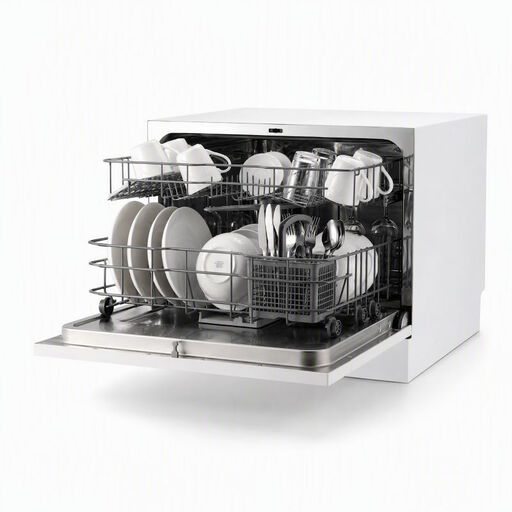
This freestanding countertop model is a choice to consider for recurring shared-kitchen loads. Confirm its water and drainage arrangements and lunchbox clearance before deciding whether it suits your space.
 No image available
ochama Mini Tabletop Dishwasher, 6 place settings
For recurring lunchbox washes in a shared kitchen, use the stated six-place-setting load as a starting point, then check that your containers fit.
- Freestanding countertop design; eight washing programmes are listed.
- The product name states a 30-minute quick wash and a 24-hour delayed start.
- Confirm the required water supply, drainage, external dimensions and internal loading clearance before purchase.
View on Joybuy
Common questions
Should I use an extension lead for a countertop dishwasher?
No. Electrical Safety First warns that dishwashers can overload extension leads, particularly when used alongside other large appliances; plan for a suitable wall socket instead.
What should I check before the first wash?
Check the model’s water-supply requirements, secure its drainage route and follow its installation instructions. Make sure the wall socket is accessible, then check water flow and drainage during an initial cycle.
Can I assume a smaller countertop dishwasher uses less energy?
No. Compare the exact models’ energy labels and product information rather than judging energy use from size alone; also check whether the stated capacity meets your regular load.
Does a high-temperature or steam feature suit every dishwasher-safe lunchbox?
No. Follow the lunchbox maker’s instructions for each base, lid and seal, and check the dishwasher’s cycle guidance. A product-page hygiene claim does not override a material’s stated limits.


