Family-meal mug clearers
If several dishwasher-safe mugs need washing after a shared meal, count the mugs and any accompanying dishes before choosing a capacity. Check the rack and available worktop space as well as the stated place settings.


For mugs after a family meal, start by checking whether a six- or eight-place countertop dishwasher can hold your actual mugs and any dishes sharing the rack. An eight-place model offers more stated capacity than the smaller examples here, but the Cookology CTTD8WH needs a cold-water connection and drainage; a manually filled two-place model avoids permanent plumbing at the cost of much smaller loads. If meals regularly leave more than mugs to wash and you have floor space, consider a slimline dishwasher too.
If several dishwasher-safe mugs need washing after a shared meal, count the mugs and any accompanying dishes before choosing a capacity. Check the rack and available worktop space as well as the stated place settings.
If a permanent water connection is impractical, a manually filled model may suit a temporary kitchen, caravan or rental setting. Cookology lists its MCDW2WH as a two-place model that can be filled without permanent plumbing, so consider whether smaller loads and repeated cycles are acceptable.
Tall mugs, broad handles and delicate decoration make physical fit and care instructions particularly important. Measure the mugs, inspect the basket layout and check for a suitable programme where the mug maker recommends gentler washing.
Count and measure the mugs from a typical family meal, then check whether the dishwasher can be connected and positioned where you intend to use it. Place settings help compare stated capacities, but they are not a mug count.
| Concern | What to check | Who this matters to |
|---|---|---|
| One-load capacity | Count the mugs and other items washed together; compare their dimensions with the rack layout, not just the place-setting rating. | If I want to clear the mugs after one family meal without running another batch, usable rack space matters most. Around 42% of consumers put one-load capacity first. |
| Installation and space | Measure the worktop and door-opening space; confirm the exact model’s fill method, water connection and drainage route. | Where a fixed water connection or enough worktop room is difficult to arrange, I need to settle installation before choosing a capacity. For around 33% of consumers, fitting and connecting the machine is the primary concern. |
| Mug fit and care | Measure mug height and handle width; check secure rack placement, spray-arm clearance and a suitable programme against the mug maker’s instructions. | With taller mugs or delicate decoration, I need them to sit securely and use an appropriate wash cycle. Mug fit and care come first for around 25% of consumers. |
Countertop models differ: Cookology says its CTTD8WH requires a cold-water supply and suitable drainage, while its MCDW2WH can be filled manually without permanent plumbing.
Check the exact model’s inlet or fill method, drain route, hose lengths, socket location and worktop measurements before ordering.
A place-setting rating does not tell you whether tall mugs or wide handles will fit, especially when plates share the rack.
Measure the mugs used at family meals and inspect the basket and any stated item-clearance limits for the exact model.
A two-place model may solve a plumbing problem but leave a family-meal mug load needing multiple runs.
If this is a recurring load, compare larger countertop models and, where there is floor space, a slimline dishwasher.
Manual filling and managing the drain hose also add work each time you run a cycle.
A compact footprint does not establish how much energy or water a particular programme will use.
Compare the exact model’s energy label and product information sheet with the programme and load pattern you expect to use.
Its named tabletop models illustrate the choice between manual filling and larger plumbed capacity.
The Amazonia 6 is a six-place tabletop model for households considering a conventional inlet-and-outlet-hose setup.
The RHTTDW6B is a six-place countertop example with Eco, Glass and Quick programmes listed by a UK retailer.
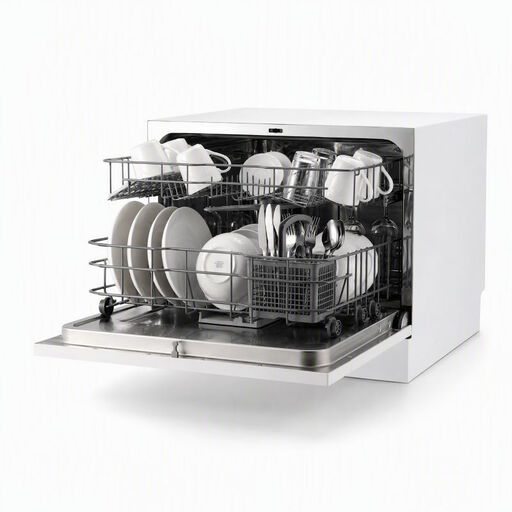
This six-place countertop model is worth considering if you want to wash several mugs together, provided its rack fits your mugs and its installation requirements suit your kitchen.
 No image available
The stated six-place capacity makes this a countertop option for several mugs, but check how your mugs fit alongside any other dishes.
The product title lists a 30-minute quick wash, 24-hour delayed start and eight functions. Confirm the fill method, water connection and drainage requirements for your intended position.
Start with the number and dimensions of mugs you normally wash together, including any plates or bowls sharing the load. Cookology lists an eight-place countertop model, while named six-place models from Klarstein and Russell Hobbs offer less stated capacity; none of those ratings guarantees that your particular mugs will fit in one cycle.
Yes, if the exact model is designed for manual filling. Cookology says its two-place MCDW2WH has an internal tank and needs no permanent plumbing, whereas its eight-place CTTD8WH needs a cold-water supply and suitable drainage.
No. Check the mug maker’s care instructions and make sure each mug sits securely without obstructing the spray arms; a Glass programme does not solve a physical-fit problem.
Compare the energy label and product information for the exact dishwasher and the programme you expect to run, rather than judging running use by its footprint. UK guidance from the Department for Energy Security and Net Zero and the Office for Product Safety and Standards says products within its energy-labelling rules must be supplied with an accurate printed label.