What matters when choosing?
Choose the format that fits both the breakfast load and the kitchen setup before comparing programmes. If dishes regularly exceed a tabletop rack, consider whether a slimline or full-size dishwasher is feasible instead.
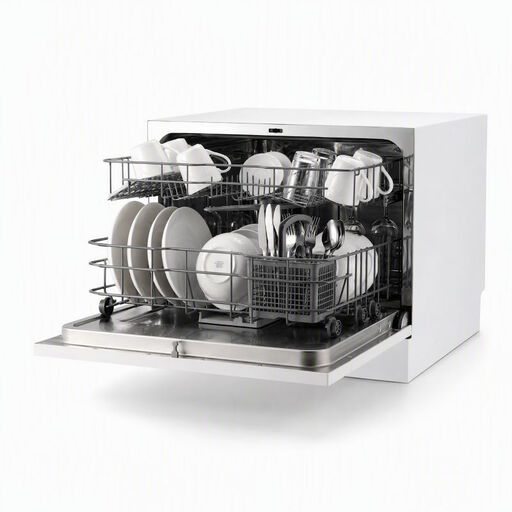
Six-place-setting tabletop model
Choose when: You want to try to clear several people’s breakfast dishes in one cycle and can provide suitable counter space, water and drainage connections.
Trade-off: A place-setting rating does not establish how your particular bowls will fit; allow room for connections as well as the appliance.
Tank-fed countertop model
Choose when: A permanent water connection is impractical and your breakfast dishes can fit a smaller rack or be washed in separate loads.
Trade-off: You must fill the tank and arrange drainage; the tank does not make the machine self-contained.
Slimline or full-size dishwasher
Consider when: Breakfast dishes routinely exceed a tabletop rack, or you also need room for larger dinnerware and pans.
Trade-off: This route needs suitable floor space and plumbing, so it may not work where a worktop is the only possible location.
| Concern |
What to check |
Who this matters to |
| Load size and bowl fit |
Compare your largest bowls and mugs with the exact model’s dish clearance and rack layout; use place settings as a starting point. |
I want everyone’s breakfast dishes washed together, without a bowl blocking the rack or spray arms. Around 36% of consumers put fitting the whole load first. |
| Water and counter space |
Check inlet and drain arrangements, appliance dimensions and door access. For a plumbed installation, allow an additional 5–7 cm of depth for piping. |
A permanent inlet is impractical in my kitchen, so the filling and drainage routine has to work where the machine will sit. For around 29% of consumers, a workable setup is the primary concern. |
| Quick reuse |
Check the quick programme’s intended load and whether its stated duration includes drying. |
We need the bowls and cups again soon after breakfast, and waiting for them to dry could matter as much as the wash time. Around 21% of consumers prioritise that turnaround. |
| Energy information and water marks |
Compare energy labels and product information sheets; check water-softener and drying features on the exact model. |
Water marks are a nuisance at home, and I want to understand the programme information before choosing. Documented energy details and hard-water management come first for around 14% of consumers. |
Joybuy countertop dishwasher choices
This six-place-setting countertop model is worth comparing with your family’s breakfast load; check bowl fit and kitchen connections before deciding whether it suits a one-cycle routine.
 No image available
ochama Mini Tabletop Dishwasher, 6 place settings
Consider it if you want to try washing several breakfast bowls, cups and pieces of cutlery together: Joybuy lists capacity for six standard place settings.
The listed features include a 30-minute quick wash, 24-hour delayed start and eight functions. Check your bowls against the rack and dish clearance, and confirm the water, drainage and space requirements for this model.
View on Joybuy
Frequently asked questions
Can a countertop dishwasher wash a whole family breakfast in one cycle?
It can if the bowls, cups, cutlery and any plates fit its usable rack together. Six-place-setting models are a sensible starting point, but measure your largest dishes and check the exact model’s clearance and rack layout; a smaller tank-fed machine may require split loads.
Does a countertop dishwasher need plumbing?
The connection depends on the model: some use a water inlet, while tank-fed machines can be filled manually and some also offer a tap connection. Both arrangements still need suitable drainage, so check the exact inlet, drain and power requirements before buying.
How much counter space should I allow?
Allow for the machine’s stated width, height and depth as well as door opening, filling access and any hoses. For piping, add 5–7 cm to the depth measurement; check the installation instructions for the model you choose.
What energy information should I compare?
Compare the energy label and product information sheet for the specific models you are considering, alongside their capacity and relevant programme data. Do not use a general comparison with hand washing in place of model-specific information.
Do I need a water softener in a countertop dishwasher?
It is worth considering if limescale or water marks are a particular concern, but it is a model-specific feature rather than a requirement for every kitchen. HAVA lists an integrated water softener for its R09; check the exact model’s instructions for its settings and maintenance.


