Who each format suits

Households washing regular cutlery loads

If dishwasher-safe cutlery builds up alongside small dishes and you can accommodate an inlet hose, drainage and power, a six-place-setting tabletop model with a cutlery basket is a practical starting point. The electriQ EQDWTTW and Russell Hobbs models illustrate this format; check the loading layout of the exact model.

Small-space users without permanent plumbing

If a permanent water connection is impractical, a manually filled tank model may suit lighter loads. The electriQ EQDWTTGF is specified for two place settings, so compare that capacity with the cutlery and dishes you usually need to wash, and plan where its drain hose will go.

What matters when choosing

Plumbed tabletop model

Choose when: Regular cutlery and small-dish loads make a six-place-setting format useful, and suitable water, waste and power connections are available.

Trade-off: The inlet and drain hoses need a workable installation route; a compact appliance is not necessarily plumbing-free.

Tank-fed portable model

Choose when: Manual filling solves a water-connection problem and your usual load fits a smaller machine.

Trade-off: The electriQ EQDWTTGF has two stated place settings and still needs space to open its door and manage drainage.

Concern What to check Who this matters to
Load size and cutlery layout Compare stated place settings and check whether the exact model has a cutlery basket that accommodates your usual utensils. If cutlery and small dishes build up regularly, I need room to wash my normal load without assuming every six-place-setting layout works alike. Around 42% of consumers would put routine-load capacity first.
Space and connections Measure width, height, depth and door-open clearance; check the required water inlet, drain-hose route and power connection. When a permanent water connection is impractical, I need to know whether manual filling will work in the space I have. For around 33% of consumers, plumbing-free placement is the primary concern.
Running information and upkeep Compare exact-model energy-label and product-sheet figures on the same basis, and check the manual’s filter-cleaning instructions. If I expect to use the machine regularly, I want to understand its stated cycle information and the cleaning it requires. Around 25% of consumers would prioritise running information and upkeep.

Mistakes to avoid

  • Choosing by the word “compact” alone

    A small closed footprint does not tell you whether there is room to open the door and load cutlery. electriQ lists the tank-fed EQDWTTGF as 43.5 cm deep when closed but 75 cm deep with its door open.

    Measure the worktop, overhead and forward clearance, as well as the drain-hose route, before ordering.

  • Assuming every tabletop model is plumbing-free

    The electriQ EQDWTTW requires inlet and drain-hose connections; the EQDWTTGF offers a tank for manual filling but still needs drainage and power.

    Decide which connection arrangement your kitchen can accommodate before comparing capacities and programmes.

  • Comparing energy classes without checking the model

    An energy class alone does not describe a particular dishwasher’s stated capacity, water use or cycle duration.

    Use each exact model’s energy label and product information sheet to compare the figures that matter to your normal load.

  • Overlooking filter cleaning for cutlery loads

    Food debris can clog a dishwasher filter even when cutlery is the main load. Beko recommends cleaning filters weekly or when they become clogged.

    Check the shortlisted model’s manual for filter access and cleaning instructions.

Relevant brands to consider

electriQ

The EQDWTTW and EQDWTTGF illustrate different countertop formats rather than interchangeable versions of the same installation.

  • The EQDWTTW is specified for six place settings and includes a cutlery basket.
  • The EQDWTTW needs inlet and drain-hose connections; the manually filled EQDWTTGF has a smaller, two-place-setting stated capacity.

Russell Hobbs

Six-place-setting tabletop models include the RHTTDW6B and RH6TTDW0D1W; check specifications against the particular model name.

  • The RHTTDW6B has a lift-out cutlery basket and six wash programmes.
  • Features and programme details for one model should not be assumed to apply to the other.

Bosch

The SKS62E32EU provides a compact-dishwasher format reference, but Bosch marks this exact model as no longer available.

  • Bosch specifies dimensions of 450 × 551 × 500 mm and 8.0 litres of water per eco cycle for the SKS62E32EU.
  • If considering another Bosch model, check its own dimensions, loading arrangement and availability rather than carrying over these figures.

Joybuy product choices

This tabletop model is a choice to consider for regular cutlery and small-dish loads. Check its fit and connection requirements against your kitchen before deciding whether it suits the plumbed or tank-fed route.
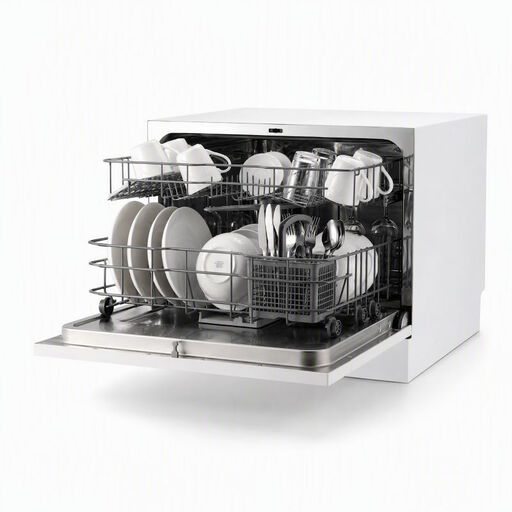
ochama Mini Tabletop Dishwasher

ochama Mini Tabletop Dishwasher, 6 place settings

Consider this model for routine dishwasher-safe cutlery and small-dish loads if its loading layout fits your utensils.

The product title states six standard place settings, a 30-minute quick wash and a 24-hour delayed start.

Before ordering, confirm the cutlery arrangement, closed and door-open dimensions, inlet and drain requirements, and exact-model energy information.

Joybuy

Common questions

Can every countertop dishwasher run without plumbing?

No: connection requirements vary by model. electriQ says the EQDWTTW needs inlet and drain hoses, while the tank-fed EQDWTTGF can be filled manually but still has a drain hose and needs power. Read the exact model’s installation instructions before choosing a position.

How much space should I allow around a tank-fed model?

Allow for the appliance with its door open, not just its closed footprint, plus any space needed for hoses. electriQ lists the EQDWTTGF at H43.5 × W42 × D43.5 cm when closed and 75 cm deep with the door open.

Can all cutlery go in a countertop dishwasher?

Only put an item in if its maker identifies it as dishwasher-safe. Check the dishwasher’s basket layout and loading instructions too, particularly for sharp or long utensils.

Should I check the energy label for a new dishwasher?

Yes. GOV.UK states that dishwashers within Great Britain’s energy-information rules must have an accurate energy label and an accompanying product information sheet, with the label displayed at the point of sale, including online. Compare the documents for the exact models you are considering.

Does a mainly cutlery load still require filter cleaning?

Yes, the filter still needs checking and cleaning according to the appliance manual. Beko recommends cleaning dishwasher filters weekly or whenever they become clogged to help prevent odours and protect the appliance.