
24/7 Customer Support

Free returns

Same-day & Next-day Delivery

Quality Guaranteed

Unlock Your Welcome Offers: FREE Delivery | Up to 80% OFF | Free 30-day JoyPlus trial
Download the APP
Tired of finding empty ice trays just when you need them? A countertop ice maker seems like the perfect solution for an endless supply of ice for your drinks, parties or daily iced coffee. However, the market is flooded with models that promise the world but often fall short. Many buyers find themselves with a noisy, inefficient or unhygienic appliance.
As a Joybuy Product Recommendation Officer, my role is to help you see past the marketing jargon. Before you buy, be aware of these common pitfalls that can lead to disappointment:
To find a reliable ice machine for home use, focus on the specifications that truly matter, not just the headline features.
Instead of focusing on the "minutes-per-cycle" claim, look for the daily ice production capacity, measured in kilograms per 24 hours (kg/24h). This figure gives you a much clearer picture of the machine's overall performance. For a typical family or for hosting small gatherings, a model with a 12 kg/24h output is a solid benchmark. This ensures you have a steady supply without the machine constantly struggling to keep up. A fast ice cube maker is one that can sustain its output over time, not just for the first cycle.
The type of ice a machine produces significantly impacts its use. Most countertop models produce "bullet" ice, which is cylindrical with a hollow centre. It's quick to produce and great for cooling drinks rapidly.
However, for spirits like whisky or bourbon, you might consider a machine that creates large, clear ice spheres. These melt much more slowly, chilling the drink without diluting its flavour. Consider which type of ice best suits your lifestyle. Many machines also offer two different sizes of bullet ice, adding a layer of versatility for different types of drinks.
A kitchen ice maker should be convenient, not cumbersome. Before purchasing, measure your available counter space. An ice machine with a small footprint is ideal for compact kitchens, offices or caravans. If you plan to use it for parties or take it on the road, look for a portable ice maker that is lightweight and features a sturdy carrying handle for easy transport. Also, ensure there is adequate clearance (usually around 15 cm) on all sides for proper ventilation, which is crucial for the appliance's efficiency and lifespan.
Here are a few models that align with different user needs, selected based on their practical features and ability to avoid the common pitfalls.
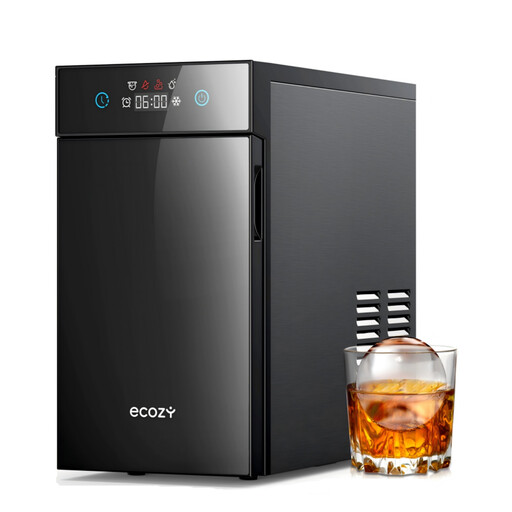
Why This Fits Their Persona: For those who appreciate the craft of a good drink, this machine produces large, 60mm crystal-clear ice spheres. It's designed for home bar enthusiasts who want to elevate their whisky or cocktails without the dilution caused by standard bullet ice.
Its double-layer insulated body is designed to reduce melting, preserving the clarity and shape of the ice spheres for longer. This addresses the poor insulation pitfall common in other models.
Specialised Ice Shape: Creates slow-melting clear spheres, ideal for spirits.
Small Footprint: One of the smallest spherical ice makers, fitting well in home bars or kitchens.
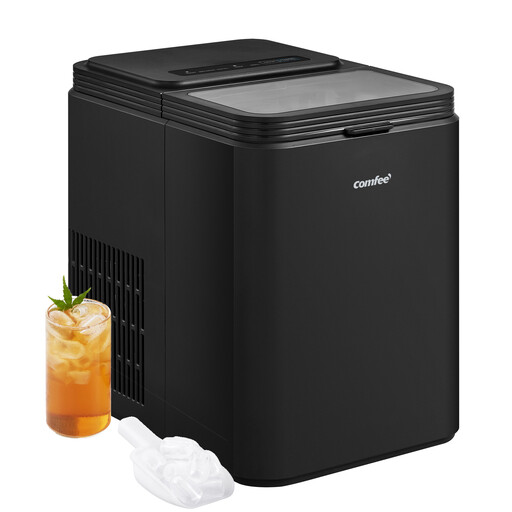
Why This Fits Their Persona: This is a practical, all-round choice for daily use. It's ideal for families needing a reliable supply of ice for soft drinks, water bottles and occasional gatherings without requiring specialised ice shapes.
It provides a clear, reliable daily output figure of 12 kg per 24 hours, moving beyond the misleading "ice in 6 minutes" claim and giving a realistic expectation of its performance for an active household.
Two Ice Sizes: Offers small and large bullet cubes for versatility.
Self-Cleaning Cycle: Includes a cleaning function to help with regular maintenance, though manual cleaning is still advised.
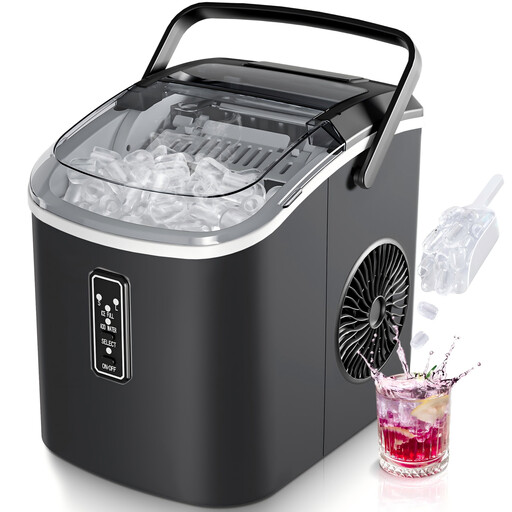
Why This Fits Their Persona: This model is built for convenience and mobility. Its lightweight design (6.3 kg) and integrated handle make it an excellent choice for caravan owners, small offices or for moving from the kitchen to the patio for a barbecue.
It operates at a noise level under 45 dB, addressing the common issue of loud, disruptive appliances. This makes it suitable for use in shared living or working spaces without causing a disturbance.
Highly Portable: Features a sturdy handle and weighs only 6.3 kg.
Quiet Operation: The low noise level makes it less intrusive than many competing models.
We have compiled a complete, real-time list of products that fully satisfy these strict selection criteria and UK safety regulations.
The running cost depends on the model's power rating and how often it runs. Most countertop ice makers use between 100-150 watts of power. If a 120W machine runs for 12 hours a day, it would use approximately 1.44 kWh. Based on average UK electricity prices, this would equate to roughly 40-50 pence per day. Costs will be lower if the machine is well-insulated and not running constantly.
Even with a self-cleaning function, manual cleaning is essential for hygiene. It is advisable to wipe down the interior and wash the basket and scoop weekly. A full descaling and sanitising clean should be performed every 3-6 months or more frequently if you have hard water. The "self-clean" cycle is useful for a quick rinse between deeper cleans but should not be relied upon as the sole method of maintenance.
While you can, it is not recommended. These appliances are not freezers, so the ice in the basket will slowly melt. The melted water is then recycled to make new ice, causing the machine to cycle on and off. This increases energy use and wear on the components. For efficiency and to prolong the appliance's life, it is better to run it when you need ice, then transfer the ice to your freezer for storage and turn the machine off.