
24/7 Customer Support

Free returns

Same-day & Next-day Delivery

Quality Guaranteed

Unlock Your Welcome Offers: FREE Delivery | Up to 80% OFF | Free 30-day JoyPlus trial
Download the APP
A countertop ice maker can solve a familiar UK household problem: the freezer tray is empty before guests arrive, the fridge cannot produce enough ice for a party, or you need a compact supply for a caravan, home bar or office. However, impressive-looking specifications can be misleading if you do not check what they mean in everyday use.
Joybuy Product Recommendation Officer guidance: focus on practical capacity, ventilation, cleaning and the type of ice produced rather than choosing solely by headline speed.
A product may state that it produces 12 kg of ice in 24 hours, but that does not mean it stores 12 kg at once. Compact machines usually have a smaller removable basket, often around 0.4–0.9 kg. Ice can also melt gradually because a portable ice maker generally makes ice but does not replace a freezer.
For parties, check both the production rate and basket capacity. You may need to transfer finished ice to a freezer or insulated container regularly.
“First ice in six minutes” usually refers to one small cycle under suitable conditions. The first batch may be smaller, while warmer rooms, insufficient ventilation or large ice settings can extend production time.
A countertop ice machine is designed for convenient, repeated batches rather than instant bulk production. Read the stated cycle quantity, ice size and daily output together.
A self-cleaning ice maker can circulate water through internal parts, but it does not remove every mineral deposit or replace wiping the basket, lid and accessible surfaces. UK tap water varies in hardness, so limescale may build up over time.
Use clean, drinkable water, empty residual water after use and follow the supplied manual. Always unplug the machine before manual cleaning, and do not immerse the main unit or power cord.
Most compact models use a compressor and produce bullet-shaped ice. This format is practical for soft drinks, iced coffee, beer and mixed drinks, but it is different from the large, slow-melting cubes or spheres often used for whisky.
For everyday use, look for:
If you specifically want large, clear ice for a home bar, choose a dedicated ice ball maker rather than a standard bullet ice maker.
Measure the available worktop before ordering. A compact ice maker still needs clear space around its ventilation openings. Some supplied guidance recommends approximately 15 cm clearance, so avoid placing the machine tightly between cupboards or directly beside a heat source.
For camping, caravans and motorhomes, also check:
Do not operate an appliance with blocked vents, on an unstable surface or in direct sunlight.
A quiet ice maker is useful in an open-plan kitchen, office or living room. Published noise figures such as below 45 dB or around 48 dB provide a useful comparison, although surrounding noise and room acoustics affect how the machine sounds in practice.
Also look for ADD WATER and ICE FULL indicators, a removable basket, an included scoop and a simple cleaning cycle. These features reduce routine handling and make the machine easier to use during gatherings.
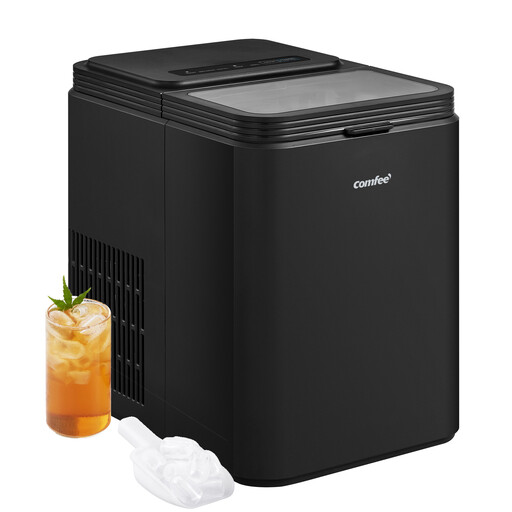
Why This Fits Their Persona: A straightforward option for UK kitchens, offices and occasional entertaining, with a compact footprint of 295.7 × 213 × 295 mm.
Its stated 1.3 L tank, two ice sizes and self-cleaning function make the key operating details clear rather than relying only on a speed claim.
Produces up to 12 kg per day; includes a removable 0.4 kg basket and ice scoop.
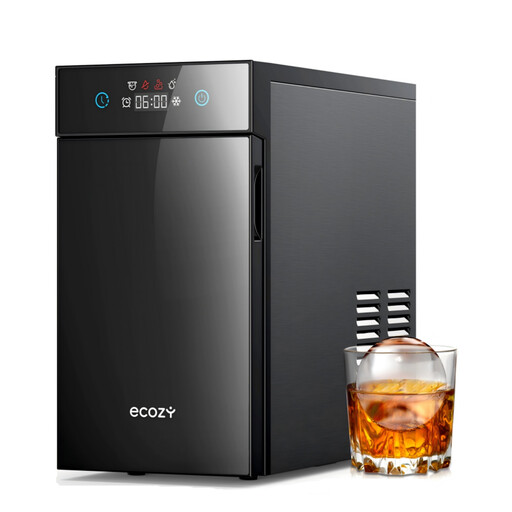
Why This Fits Their Persona: Designed for whisky and bourbon drinkers who want spherical ice rather than standard bullet-shaped cubes.
Its stated 40-minute production time sets a more realistic expectation than fast-cycle countertop models.
Makes 60 mm ice spheres; includes an eight-hour timer and self-cleaning function.
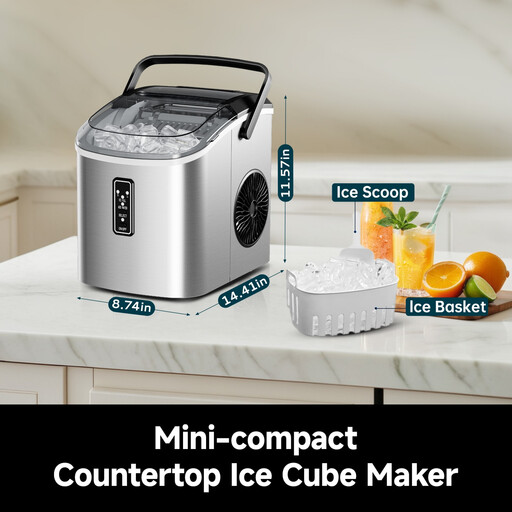
Why This Fits Their Persona: Suitable for parties, camping, motorhome trips and busy households that value portability and repeated ice production.
The handle, low-water and full-basket indicators address the practical problems of moving and monitoring a portable ice maker.
Produces approximately 12 kg per day; stated noise level is below 45 dB and it offers two bullet ice sizes.
We have compiled a complete, real-time list of products that fully meet these strict selection criteria and UK safety regulations.
Yes, provided it is placed on a level, stable surface with suitable ventilation and connected to the correct earthed UK power supply. Check the product listing and manual for electrical compatibility before purchase. Do not use the machine in direct sunlight or beside an oven, radiator or other heat source.
Lifespan depends on usage, water quality, cleaning and ventilation. Regularly run the self-cleaning programme, wipe accessible parts and remove limescale according to the manufacturer’s instructions. Avoid forcing the ice-ejection mechanism and unplug the appliance before maintenance.
Running cost depends on the machine’s power rating, cycle frequency, room temperature and local electricity tariff. To estimate cost, divide the appliance’s wattage by 1,000, multiply by the hours used, then multiply by your tariff per kWh. Producing only the ice you need and keeping vents clear can help avoid unnecessary operating time.