Small-group cottage hosts
If several friends want chilled drinks during a short visit, repeat batches and somewhere to keep finished ice matter more than a daily production figure on its own.


For friends visiting a holiday cottage, choose a countertop ice maker by its first-batch time, refill needs and ready-to-serve capacity—not its daily output figure alone. Start making ice before guests arrive and plan freezer space for finished batches; a self-cleaning cycle still leaves manual cleaning and careful ice handling to do.
If several friends want chilled drinks during a short visit, repeat batches and somewhere to keep finished ice matter more than a daily production figure on its own.
A limited worktop or a kitchen shared with the seating area makes appliance dimensions and any stated noise figure worth checking.
Refill and full-basket indicators can make batches easier to manage, while a cleaning routine must still cover surfaces and serving tools beyond any automatic cycle.
Plan how much ice needs to be ready for drinks, then consider the wait for the first batch, the space available and the cleaning routine.
| Concern | What to check | Who this matters to |
|---|---|---|
| Usable ice supply | Compare water-tank and basket capacities separately. Check whether the cottage freezer can hold finished batches. | If I am keeping drinks flowing for several friends, refilling and storing finished ice matter more than a headline daily figure; around 36% of consumers put usable supply first. |
| First-batch speed | Compare stated first-batch times and, where given, the number of pieces per batch. | If friends arrive before I have made any ice, I want the first batch soon; about 29% of consumers place start-up speed first. |
| Worktop fit and noise | Measure the available space, including room for ventilation, and compare dimensions and any stated noise figure. | In a small, open-plan kitchen, I want space left for preparing food and less disruption nearby; roughly 21% of consumers prioritise fit and noise. |
| Cleaning and serving | Check the manual cleaning instructions and keep a clean scoop or tongs for serving ice. | Between visits, I want a routine I can keep up without treating automatic cleaning as the whole job; around 14% of consumers put cleaning and handling first. |
The Cookworks 1.8L Ice Cube Maker is listed at 10 kg of production in 24 hours, but its internal ice storage is 0.5 kg. Those figures describe different things.
Compare basket capacity with the amount you want ready at once. Start batches early and move finished ice to a freezer if you need a reserve.
Keeping a reserve also takes freezer space or a suitable ice container.
Coventry City Council advises that self-cleaning cycles clean the surface where ice is made, leaving other parts to be cleaned manually. Containers and serving tools need attention too.
Follow the appliance’s cleaning instructions and use a clean scoop or tongs rather than a drinking glass to collect ice.
The CASO Design IceChef Compact is listed at H26.9 × W24 × D28.2 cm, while CASO Design’s European specifications identify a Schuko plug. Check the version supplied for a UK purchase rather than assuming the European specification describes the retail package.
Measure the usable worktop with ventilation space, then confirm the supplied plug, voltage and warranty version with the retailer.
The IceChef Compact is a reference point for a smaller countertop machine where worktop space and noise matter.
The 1.8L Ice Cube Maker is relevant when water capacity and fewer refill interruptions are priorities.
The RCI12WH1UK is a countertop bullet-ice option with a stated 1.3 L tank and two ice sizes.
These countertop models are options for making repeat batches of ice for visiting friends. Check their ready-to-serve capacity and the space available in the cottage before choosing.
 No image available
For hosts making repeat batches, the product title states eight bullet-ice pieces in 6–9 minutes, two sizes and a self-cleaning function; a scoop and basket are listed with this variant.
Check the basket capacity for the amount you want ready at once and confirm the supplied plug and voltage. Continue to clean other surfaces and serving tools manually.
 No image available
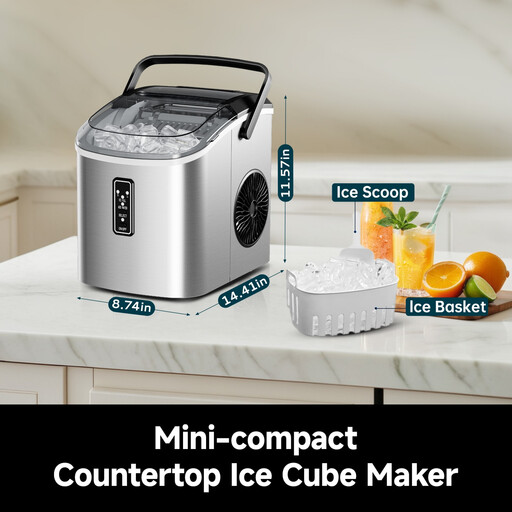
For a cottage kitchen where moving the machine matters, this variant lists a handle, two ice sizes, self-cleaning, a basket and a scoop. Its product title states nine cubes in six minutes.
Check the water-tank and basket capacities against your refill and storage plans, and confirm the supplied plug and voltage. Self-cleaning does not replace manual cleaning.
Do not rely on its daily production rating as the amount ready to serve. The Cookworks 1.8L model is listed at 10 kg per 24 hours but only 0.5 kg of internal ice storage; for several guests, start early and plan where finished batches will go.
No. Coventry City Council advises that an automatic cycle cleans the surface where ice is made, so other surfaces still need manual cleaning. Follow the appliance instructions and keep the scoop and any ice container clean.
The CASO Design IceChef Compact, Cookworks 1.8L Ice Cube Maker and Comfee' RCI12WH1UK are described as water-tank models rather than plumbed-in machines. Check the exact version you intend to buy; that distinction does not apply to every ice maker.