Small-group cottage hosts
If you make occasional rounds for a few guests, a compact machine may be easier to accommodate on a busy worktop. Check its basket capacity as well as how quickly it makes a batch.


For occasional fruit coolers in a small holiday cottage, start with a compact countertop maker and check that its tank and ice basket suit the number of drinks you expect to serve. For repeated rounds with a larger group, compare tank capacity and production rate, but do not mistake a daily output claim for ice ready to serve at once. Whichever format you choose, a self-cleaning cycle does not replace manual cleaning.
If you make occasional rounds for a few guests, a compact machine may be easier to accommodate on a busy worktop. Check its basket capacity as well as how quickly it makes a batch.
For a larger group, water-tank size and the rate at which ice is produced matter alongside how much finished ice the machine can hold. Compare those figures separately before planning a drinks session.
If you serve drinks individually and want a particular ice appearance or shape, check the exact ice format. A specialist format may require a different preparation pace from ordinary cubes.
Decide how many drinks need ice close together, then check ready-to-serve storage, worktop fit and the ice shape you want.
| Concern | What to check | Who this matters to |
|---|---|---|
| Repeated servings | Compare claimed production rate, water-tank size and ice-basket capacity separately; a 24-hour output is not stored ice. | When several guests want another fruit cooler, I need ice to keep coming without frequent refills. Around 44% of consumers could put repeated-serving capacity first. |
| Worktop fit and disruption | Measure the available space and lid clearance; check dimensions, socket access and the exact model’s stated noise level. | In a small or open-plan cottage kitchen, I want room to prepare drinks without the machine getting in the way. Roughly 33% of consumers could make placement and disruption their primary concern. |
| Ice style | Confirm whether the machine makes standard cubes, clear cubes or spheres, and check its stated production pace for that format. | For fruit coolers served one at a time, I may care more about how the ice looks and fits the glass than about group-serving volume. Around 23% of consumers could prioritise ice style. |
A production figure describes ice made over time, not the amount held in the basket. Costway lists one commercial machine at up to 23 kg per 24 hours but with a 5 kg storage bin; those figures answer different questions.
Check first-batch time, production rate and basket capacity on the exact model. If you need ice well before serving, check whether you can transfer finished batches to a freezer.
Coventry City Council advises that a self-cleaning cycle cleans the surface where ice is made, while other parts still need manual cleaning. Ice-handling equipment also needs attention.
Look for accessible parts and drainage, and follow the model’s instructions for cleaning and handling ice between cottage guests.
Allow time for manual cleaning as well as running any automatic cycle.
CASO Design lists its Clear Ice Advanced at 7.7–8.8 kg per 24 hours, compared with 12 kg per 24 hours for its IceChef Compact and IceChef Pro. Those are manufacturer output claims for different models, not amounts immediately available in their baskets.
If appearance is the priority, check the specialist machine’s ice shape and serving pace. If guests will need repeated rounds, check its production and storage figures against that plan.
Its UK-facing range includes compact countertop models and a separate clear-ice option for home drinks.
Costway lists both countertop and larger commercial-style machines, which call for different space and serving plans.
Lakeland lists a Gastroback countertop ice maker for home and drinks-service settings.
These countertop choices cover machines for conventional drink ice and a separate sphere-making option for individually served coolers. Check each product’s ice shape and batch pace against the way you serve drinks.
 No image available
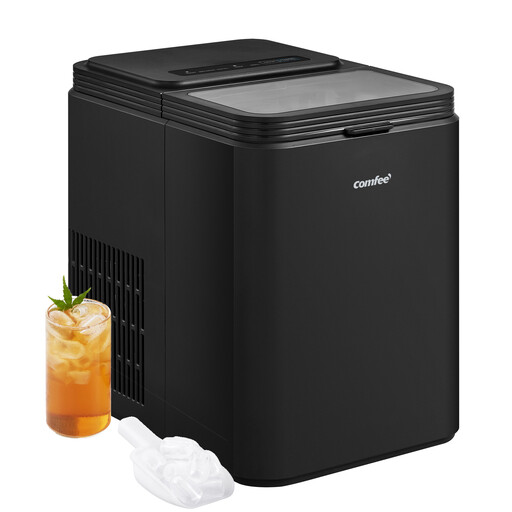
Consider this model for conventional drink ice when two listed bullet-ice sizes would be useful. Its title claims eight bullets in 6–9 minutes and 12 kg of production in 24 hours; it also lists self-cleaning, a scoop and a basket. Check the basket’s ready-to-serve capacity, worktop fit and expected noise before buying, and plan for manual cleaning.
 No image available
This portable countertop option may suit batches of ice for cottage drinks. Its title claims nine cubes in six minutes and lists a self-cleaning function, scoop and basket; check the stated cycle conditions, tank and basket capacities, dimensions and UK plug and supply rating for the exact variant. Manual cleaning is still needed.
 No image available
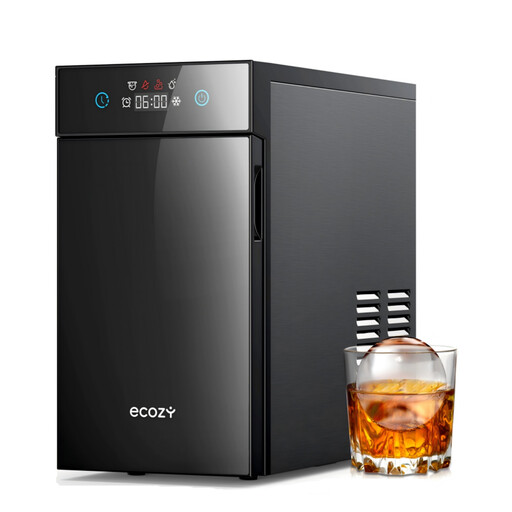
Consider the 60 mm sphere format only if it suits the glasses and serving style planned for your fruit coolers; this is not a conventional cube maker. Its title lists an eight-hour timer, a 40-minute making time and a claim of 32 spheres per day. Check the number made per cycle, available storage, dimensions and UK plug and supply rating before planning drinks for a group.
No. Coventry City Council advises that self-cleaning cycles clean the ice-making surface but do not replace manual cleaning of other parts. Follow the instructions for the exact machine, including its emptying and drainage procedure.
Use a clean scoop or tongs rather than hands or a drinking glass. Coventry City Council advises keeping the scoop handle out of the ice, cleaning ice-handling equipment regularly and replacing ice when meltwater has accumulated rather than refreezing it.
Put it where it can be kept clean and monitored, with enough space to use and clean it. Coventry City Council advises keeping ice-making equipment away from sunlight and dirty areas; follow the chosen model’s ventilation and clearance instructions too.
No: the Food Standards Agency guidance concerns glycerol-containing slush drinks, not ordinary fruit coolers made with fruit and ice. If a cooler uses a slush concentrate containing glycerol, the Agency’s guidance for England, Northern Ireland and Wales says children under seven should not consume it, while children under 10 should have no more than one 350 ml drink a day.