Fruit-cooler makers with little prep space
You need room for fruit, glasses and perhaps a blender alongside the ice maker. Check its width and depth before giving much weight to a daily-output figure.


Measure the usable width and depth before choosing an ice maker for fruit coolers: a narrow machine leaves more room to prepare and serve drinks. If you make several rounds, compare first-batch output, water capacity and ice storage as well as the stated daily output. Self-cleaning may make routine use easier, but it does not replace cleaning food-contact parts as instructed.
You need room for fruit, glasses and perhaps a blender alongside the ice maker. Check its width and depth before giving much weight to a daily-output figure.
You want ice ready for the first drinks and a manageable way to keep serving. Compare cubes per cycle and cycle time separately from water capacity and the amount the basket can hold.
Alerts, removable parts and a self-cleaning programme may matter more if you use the maker regularly. You will still need to follow its cleaning and ice-handling instructions.
Start with the space available for both the machine and drink preparation. Then decide whether your main concern is fitting it in, keeping repeated rounds supplied or making routine cleaning manageable.
| Concern | What to check | Who this matters to |
|---|---|---|
| Worktop fit | Measure usable width and depth, then check the exact model's dimensions and placement instructions. | I need space to cut fruit and set out glasses beside the machine, so its footprint comes first. Around 42% of consumers put worktop fit first. |
| Repeated serving | Compare cubes per cycle and cycle time with the water tank and ice-basket capacities; a 24-hour output is not ice ready to serve. | When several coolers need ice in succession, I care about the first batch and how often service might pause. Around 33% of consumers prioritise repeated serving. |
| Cleaning and handling | Check cleaning instructions, removable parts and any full-basket or empty-tank alerts. | If I use the maker often, I want to manage the ice and clean food-contact parts without overlooking routine care. Around 25% of consumers make cleaning and handling their primary concern. |
A stated 12 kg per 24 hours describes production over a day, not the amount waiting in the basket when guests arrive.
For the number of drinks you plan to serve, compare the first cycle, subsequent cycles, water reservoir and ice storage separately.
An ice maker may fit between other appliances yet leave too little front-to-back space for fruit preparation and serving.
Check width and depth in the stated dimension order, and follow the model's placement instructions.
A self-cleaning programme does not remove the need to clean food-contact equipment as instructed. Food-business use brings additional food-safety responsibilities.
Follow the maker's directions for the tank, basket and other relevant parts. For business use, follow applicable food-safety management and cleaning requirements.
Related product names do not establish that two listings describe the same model or variant.
Check the full model identifier, dimensions and features on the product-detail page before relying on a comparison.
The EK6760 is a narrow option to consider when preserving worktop width matters most.
Model 796222 is worth considering when a short stated cycle and two cube sizes matter more than finding the narrowest machine.
The IceChef Compact 03401UK offers cleaning and monitoring features for consumers who can accommodate its footprint.
These countertop ice makers are choices for preparing ice for fruit coolers. Check each machine's fit on your worktop, particularly if you also need space to prepare the drinks.
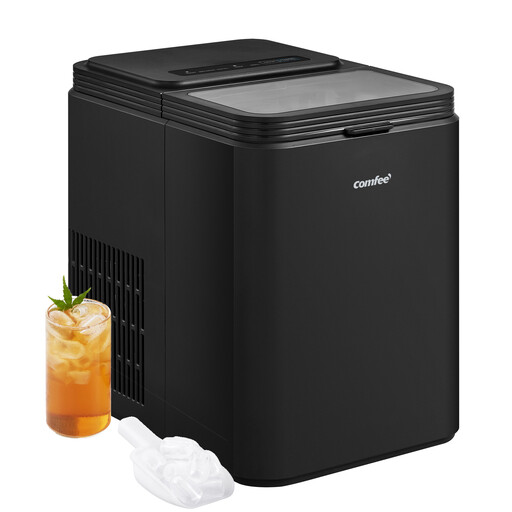 No image available
Consider this model if you want to make ice for several rounds of fruit coolers and can confirm that it fits alongside your prep area.
The product title states eight ice bullets per 6–9-minute cycle, two sizes, self-cleaning, and an included scoop and basket. Its stated 12 kg per 24 hours is production over time, not ice ready in the basket.
Confirm which listed dimension is the width, and check the required placement clearance before buying.
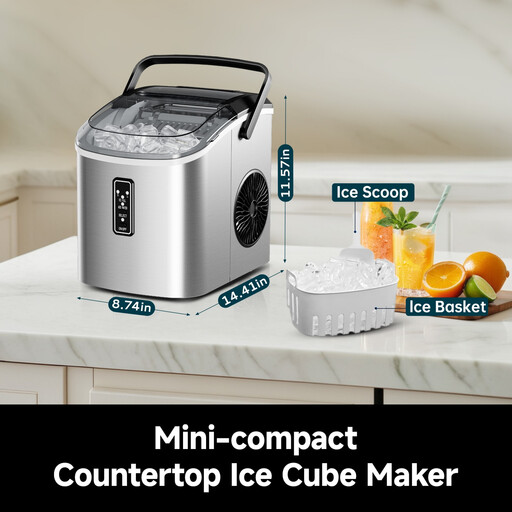 No image available
Consider this machine for fruit coolers only if its stated width and placement clearance leave enough room to prepare and serve drinks.
The product title states nine cubes in six minutes, two cube sizes and 12 kg of production per day. Cycle-time descriptions differ within the listing, so confirm the applicable figure before relying on it.
The listing states a width of 36.6 cm and calls for at least 15 cm clearance from walls; measure the intended position with that clearance in mind.
Check both width and depth, not just whether the maker is described as compact. The Salter EK6760 is listed at 18.5 cm wide and 27.4 cm deep and Daewoo model 796222 at 22.2 cm wide and 29.4 cm deep; CASO Design UK's manual gives 22 cm by 29 cm for the IceChef Compact 03401UK. Leave room for preparation and follow the chosen model's placement instructions.
No. A 12 kg-per-24-hour figure describes stated production over that period, not ice held in the basket at once. For example, John Lewis & Partners lists the Hostess IM03A with 12 kg-per-24-hour production but storage of up to 700 g. Check storage and cycle output for the drinks you plan to serve together.
No. These countertop machines make ice for drinks; they do not blend or juice fruit. If your recipe calls for either step, allow worktop space for the equipment you will use.
No. Use it as the maker instructs, while continuing to clean relevant food-contact parts and handle ice hygienically. For food businesses, GOV.UK also sets out requirements for effective cleaning and a food-safety management system.
Food-business requirements differ from ordinary home use. The Food Standards Agency says to register a food business at least 28 days before trading or food operations begin, and GOV.UK requires a food-safety management system. Follow the applicable cleaning requirements and check that the ice maker's instructions suit your intended setting.