
24/7 Customer Support

Free returns

Same-day & Next-day Delivery

Quality Guaranteed

Unlock Your Welcome Offers: FREE Delivery | Up to 80% OFF | Free 30-day JoyPlus trial
Download the APP
A countertop ice maker can solve a familiar problem: the freezer tray is empty just before guests arrive, bags of supermarket ice melt on the journey home, or your fridge freezer simply cannot keep up with drinks, barbecues and parties. Compact machines can produce fresh bullet-shaped ice within minutes, but the specifications used in listings can be easy to misread.
Before buying an ice maker machine for your kitchen, office, motorhome or home bar, check more than the headline production figure. The following guide explains the main purchasing pitfalls, the technical details that matter and a selection of products matched to different UK lifestyles.
A listing may advertise 12 kg of ice in 24 hours, but that does not mean the machine stores 12 kg at once. Many compact models have a basket holding less than 1 kg. Once the basket is full, production pauses, and the ice may gradually melt because most countertop units are not freezers.
For parties, you may need to remove finished ice regularly and transfer it to a freezer or insulated cooler. Check both the daily production rate and ice basket capacity before purchasing.
A portable ice maker may produce its first batch in six minutes under suitable conditions. Room temperature, water temperature, ventilation and the selected cube size all affect the cycle. Larger ice generally takes longer, while a hot kitchen or blocked ventilation can reduce performance.
A “fast ice maker” is useful for topping up drinks, but it may not replace advance preparation for a large gathering.
A self-cleaning ice maker still needs regular care. Automatic cleaning cycles help rinse internal surfaces, but users should follow the manual, drain residual water, wipe accessible areas and clean the basket and scoop. Use clean, drinkable water and never submerge the main unit or power cord.
Also check how the cleaning programme works. Some models use a five-minute cycle, while others run for around 30 minutes.
For everyday drinks, look for a machine producing approximately 8–9 ice bullets in 6–12 minutes. A stated capacity of 12 kg per day may suit family use, office refreshments and small gatherings, provided you empty the basket regularly.
If you need clear ice spheres for whisky or cocktails, production is different. A specialist ice ball maker may take around 40 minutes per sphere and produce approximately 32 spheres per day. This is slower than a standard bullet ice maker but designed for a different serving style.
A larger water reservoir means fewer refills. The products below offer tanks ranging from 0.85 litres to 1.5 litres. Consider where the machine will sit: a unit under a wall cabinet may be awkward to fill from the top.
A removable basket and included scoop make serving easier. A side or bottom drain is also useful when emptying the appliance after use or before moving it.
Measure the worktop, allowing clear space around ventilation openings. Several compact ice makers measure roughly 30–37 cm across, but the required clearance varies by model. A handle is useful for moving a machine between the kitchen, office, garden room or motorhome.
Noise ratings in the supplied specifications range from below 45 dB to approximately 50 dB. These figures provide a useful comparison, although compressor noise can be more noticeable in a quiet room.
For UK use, confirm that the product is suitable for the local electrical supply, with the correct plug and 220–240V compatibility. Do not assume that every portable ice maker listed online is ready for a UK socket. Place the unit on a stable, level surface and keep ventilation openings unobstructed.

Why This Fits Their Persona: A straightforward option for renters, flats and first-time buyers wanting an ice maker for home, office or bar use without a complicated control system.
The listing states 9 cubes in 6–9 minutes, a 12 kg daily output and a basket and scoop, making capacity easier to assess than relying on one headline figure.
Two bullet ice sizes, LED indicators, a 30-minute self-cleaning programme and stated noise below 45 dB.
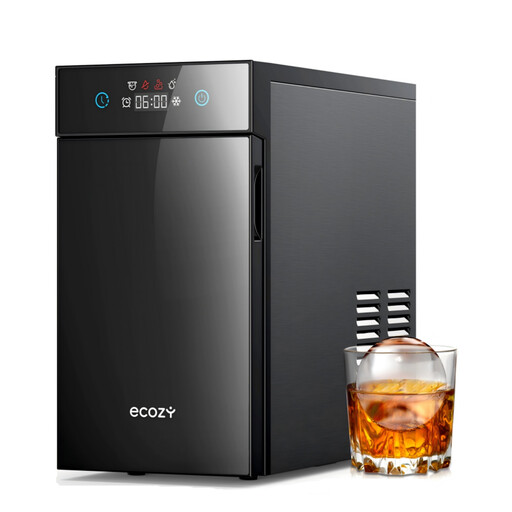
Why This Fits Their Persona: Designed for whisky, bourbon and cocktail drinkers who prefer large spherical ice and can plan servings in advance.
Its stated 40-minute production time and approximately 32 spheres per day set realistic expectations instead of presenting it as a rapid general-purpose ice maker.
Produces 60 mm clear ice spheres, includes an 8-hour timer, LED touchscreen, 0.85-litre tank and self-cleaning control.
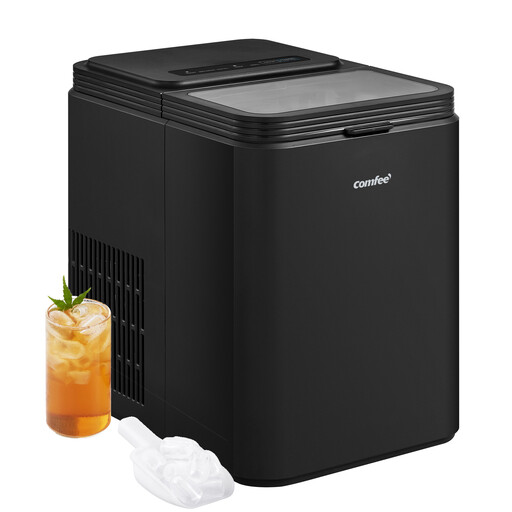
Why This Fits Their Persona: Suitable for hosts who want a compact countertop ice machine with a stated 12 kg daily capacity and quick initial batches.
The 1.3-litre tank, 0.4 kg removable basket and stated 6–9-minute cycle clarify what the machine can do between refills and basket emptying.
Two ice sizes, self-cleaning operation, compact dimensions of approximately 29.6 × 21.3 × 29.5 cm, plus a scoop and basket.
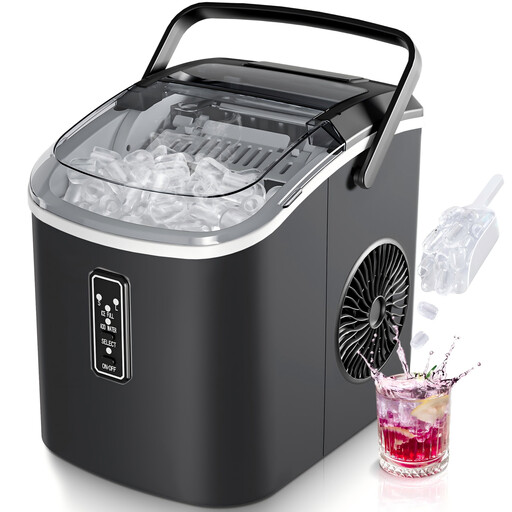
Why This Fits Their Persona: The handle and 6.3 kg weight make this compact ice maker practical for moving between a kitchen, caravan, motorhome or outdoor gathering.
The stated output is approximately 12 kg per day rather than unlimited storage, while water-shortage and ice-full indicators show when attention is needed.
Two bullet ice sizes, a handle, basket and scoop, self-cleaning mode and stated operation below 45 dB.
We have compiled a complete, real-time list of products that fully satisfy these strict selection criteria and UK safety regulations.
Running cost depends on the appliance’s power consumption, electricity tariff, ambient temperature and how often it operates. A machine producing ice continuously will use more electricity than one used for occasional drinks. Check the wattage and energy information in the listing or manual, and switch it off when the required amount has been made.
Lifespan depends on cleaning, ventilation, water quality and frequency of use. Mineral build-up, blocked vents and moving the machine while tilted can reduce reliability. Follow the care instructions, keep the appliance level and allow it to settle after transport before switching it on.
Only do so if the manufacturer’s instructions permit it and the machine is positioned safely with sufficient ventilation. A full basket may pause production, but compact appliances generally do not keep ice frozen indefinitely. For overnight preparation, check the timer, storage guidance and whether the finished ice should be transferred to a freezer.